
CFA Calculator Guide: Approved Models and Setup Tips
CFA Institute allows only two calculator families on exam day: the Texas Instruments BA II Plus and the Hewlett Packard 12C. Everything else, including phones, scientific calculators, and online tools, will get your results voided. The good news: picking a model and setting it up takes minutes. Once the keys become second nature, calculations stop eating into time you need for thinking.
This guide covers the approved models, how to choose between them, and the setup steps worth doing before your first practice question.
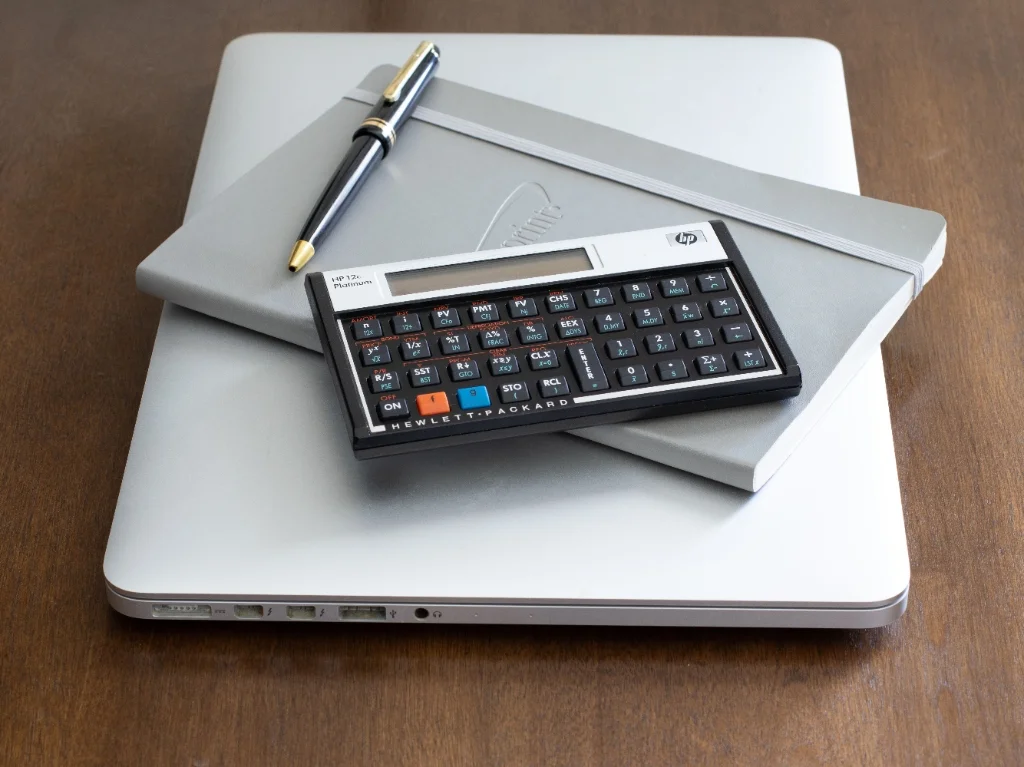
Which Calculators Are Allowed for the CFA Exam?
Only two calculator models are allowed on the CFA exam:
- The first is the Texas Instruments BA II Plus, including the BA II Plus Professional.
- The second is the Hewlett Packard 12C, which covers the HP 12C Platinum, the Platinum 25th anniversary edition, the 30th anniversary edition, and the HP 12C Prestige.
Your calculator gets inspected before the exam starts. Using or even holding an unauthorized model at any point during the exam will void your results.
Practical rules worth knowing in advance:
- You cannot borrow a calculator from the test center or share one with another candidate, so bring your own.
- Calculator covers, keystroke cards, and loose batteries are permitted in the testing room, but instruction manuals are not.
- If you use a BA II Plus, you can also keep a small screwdriver with you in case you need to replace the batteries.
Texas Instruments BA II Plus
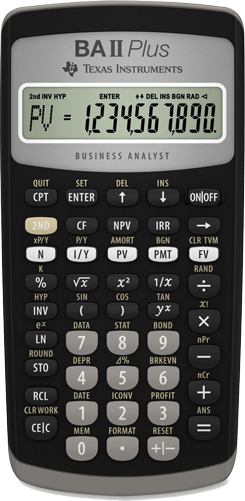
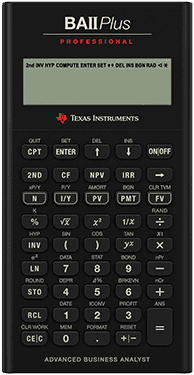
The approved Texas Instruments models are the BA II Plus and the BA II Plus Professional. Both use the same core layout, so the setup tips later on this page apply to either one.
The BA II Plus is the more common choice among CFA candidates, partly because most prep materials, including ours, demonstrate keystrokes on it. If you have never used a financial calculator before, this is usually the easier starting point.
Hewlett Packard HP 12C
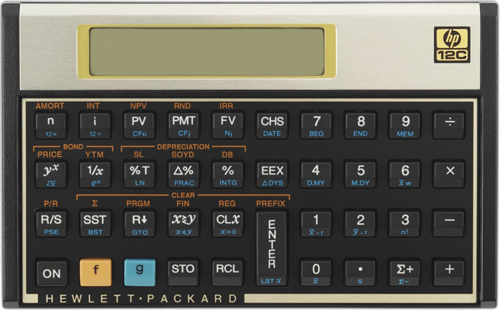
The approved Hewlett Packard models are the HP 12C, the HP 12C Platinum, the Platinum 25th anniversary edition, the 30th anniversary edition, and the HP 12C Prestige.
The classic HP 12C uses Reverse Polish Notation, an entry style where you input numbers first and operations after. It feels unusual at first, but candidates who already use it at work tend to be fast with it. If the HP 12C is what your hands already know, there is no need to switch.
BA II Plus vs HP 12C: Which CFA Calculator Should You Choose?
Choose the calculator you can operate without thinking. Exam speed comes from familiarity, not features.
For most first-time candidates, that means the BA II Plus. Its algebraic entry matches how most people learned math, it costs less, and most prep walkthroughs use it.
The HP 12C makes sense if you already use one at work or you are comfortable with Reverse Polish Notation. It is a durable, well-loved machine, but learning RPN from scratch during CFA prep adds a hurdle you do not need.
Whichever you pick, commit early. Switching models a few weeks before the exam trades away the muscle memory you have been building since day one.
How to Set Up Your CFA Calculator Before Studying
Set up your calculator before your first practice question, not the week of the exam.
Three settings matter most: decimal places, the calculation method, and knowing how to reset the device if something goes wrong.
Both models default to two decimal places. That hides precision you often need for time value of money and bond math.
The sections below walk through each adjustment for the BA II Plus and the HP 12C, using the same keystrokes you will see throughout our study materials.
BA II Plus Calculator Tips for CFA Candidates
Getting comfortable with the BA II Plus before exam day pays off on nearly every quantitative question. The three settings below are the ones to handle first. Specific worked examples for TVM, IRR, and cash flow problems are included throughout our study package materials.
Set Your Decimal Places
The BA II Plus can display a fixed number of decimal places from 0 to 8, with 2 as the default, or up to 10 digits using the floating-decimal option.
We recommend the floating-decimal setting so you see full precision while you work.
Set Decimal to Floating
To set floating decimals, press 2nd, then [FORMAT], then 9, then ENTER.
2nd . [FORMAT] 9 ENTER
Set Decimal to Fixed
To fix the display at four decimal places instead, press 2nd, then [FORMAT], then 4, then ENTER.
2nd . [FORMAT] 4 ENTER
Display Comparison
| Precise Value | Floating | Fixed |
|---|---|---|
| 4.1234567 | 4.1234567 | 4.1234 |
| 5.12 | 5.12 | 5.1200 |
| 8 | 8 | 8.0000 |
Switch From Chain to AOS Calculation
The BA II Plus offers two calculation methods, and the difference changes your answers.
Chain (Chn) is the default. It solves problems strictly left to right, so 6 + 2 x 3 returns 24. AOS, the Algebraic Operating System, follows the standard rules of algebraic hierarchy.
The same entry returns 12 because multiplication happens before addition.
We recommend AOS for more straightforward and logical execution of calculations.
| Calculation Method | Operation Sequence | Example Output |
|---|---|---|
| Chn - Chain Method | Left to right | 6 2 3 24 |
| AOSTM - Algebraic Operating System | Relative priorities* | 6 (2 3) 12 |
* relative priorities: universal powers & roots multiplication & division addition & subtraction
Change Chn to AOS
To switch, press 2nd, then [FORMAT], arrow down four times, press 2nd, then ENTER [SET]. Press CE|C or 2nd, then CPT [QUIT] to exit settings.
2nd . [FORMAT] 2nd ENTER [SET]
CE|C or 2nd CPT [QUIT] to exit settings.
To confirm the active calculation method, repeat the above sequence.
Know How to Reset the BA II Plus
Resetting clears the display, all ten memories, and all worksheet data. It also restores default settings and returns the calculator to standard mode.
Resetting the Calculator
Press 2nd, then +/- [RESET], then ENTER.
2nd | [RESET] ENTER
Replacing the battery has the same effect as resetting the calculator.
Note: a hard reset can be performed via the small hole marked RESET on the back of the calculator.
For additional details, refer to the: BA II PlusTM Guidebook
HP 12C Calculator Tips for CFA Candidates
If the HP 12C is your calculator, the two settings below cover the essentials before you start practicing. As with the BA II Plus, worked examples tied to specific curriculum content appear throughout our study package materials.
Set Your Decimal Places
The HP 12C displays a fixed number of decimal places from 0 to 9, with 2 as the default. Adjusting it is as simple as pressing the f key followed by the number of places you want.
Pressing f then 5 displays 14.87456, while f then 1 rounds the display to 14.9.
Pick a precision you will use consistently in practice so the display never surprises you mid-question.
| Keystroke Examples | Display |
|---|---|
| f 5 | 14.87456 |
| f 1 | 14.9 |
| f 0 | 15 |
| f 9 | 14.87456320 |
Reset the HP 12C to Factory Settings
A factory reset erases the calculator's memory and restores default settings, which is useful if your device starts behaving unexpectedly or you need to clear it before the exam. Turn the calculator off by pressing ON.
Resetting the Calculator
- Press ON to turn off the calculator
- Press & hold
- Press & release ON
- Release
- Screen will display "Pr Error"
- The calculator will then be reset to the default settings, and memory will be erased.
For anything beyond the basics, the official HP 12C User's Guide is the reference to keep bookmarked.
Calculator Mistakes to Avoid on Exam Day
Most calculator problems on exam day are preventable, and the same few mistakes come up again and again. Bringing an unapproved model is the costly one, since possession alone voids your results. A dying battery is the avoidable one, so put fresh batteries in the week before and pack spares, which the policy permits.
The subtler mistakes happen during prep. Practicing on a phone app or a different model than the one you will bring means your fingers learn the wrong layout. Leaving the default settings untouched means discovering mid-exam that your display rounds to two decimals or that Chain mode is changing your order of operations. None of this requires extra study hours. It just requires doing your practice questions on the exact calculator, with the exact settings, you will use on exam day. A realistic study plan builds that in from the start.
Practice CFA Calculations With KeyPoint Learning
Knowing your calculator's settings is the easy part. The harder part is using it quickly and accurately under time pressure, and that only comes from working real exam-style problems.
KeyPoint Learning study packages include practice quizzes and mock exams built to match the format and pacing of the actual exam. Calculator-driven questions run across time value of money, cash flows, and fixed income. Calculator-specific examples are woven through the study materials, so you learn the keystrokes alongside the concepts rather than as a separate chore.
If you are deciding how to structure your prep, comparing the packages by level is the natural next step.
FAQs About CFA Calculators
Quick answers to the calculator questions candidates ask most often.
Only two models are allowed. They are the Texas Instruments BA II Plus, including the BA II Plus Professional, and the Hewlett Packard 12C, including the Platinum, Platinum 25th anniversary edition, 30th anniversary edition, and Prestige versions.
Any other calculator, even one simply in your possession during the exam, will void your results.
Yes, as long as the backup is also an approved model. Many candidates bring a second approved calculator or spare batteries, which are permitted in the testing room, so a dead battery never becomes an exam-day crisis.
Neither model is officially better, so choose the one you can use fastest. The BA II Plus suits most first-time candidates. Its algebraic entry feels familiar, and most prep materials demonstrate keystrokes on it. The HP 12C suits candidates who already use Reverse Polish Notation comfortably.
We recommend the floating-decimal setting on the BA II Plus, which shows full precision instead of the two-decimal default. On the HP 12C, set at least four decimal places. Rounding too early is a common source of small errors in multi-step work like bond pricing and TVM problems.
No. Phones, scientific calculators, programmable devices, and online calculator tools are all prohibited. Only the two approved physical models are permitted, and your calculator is inspected before the exam begins.
Prepare With the Calculator You'll Use on Exam Day
The candidates who breeze through quantitative questions are not the ones with the fanciest calculator. They are the ones whose calculator has become automatic. Every practice question they answered used the same device and settings they brought into the exam room. Set yours up now, then put it to work on realistic practice.
Our study packages give you structured lessons, practice quizzes, and mock exams for every CFA level, so your calculator skills and your curriculum knowledge build together.