
CFA GIPS Standards Guide: What Candidates Need to Know
The Global Investment Performance Standards, or GIPS Standards, are voluntary ethical standards for how firms calculate and present investment performance. They rest on two principles: fair representation and full disclosure. The standards show up in the Ethics portion of the CFA curriculum, and they tend to catch candidates off guard because the material feels more like industry rules than exam content.
This guide explains what the standards are, why they exist, how they connect to your exam, and how to study them without drowning in compliance detail.

What Are the GIPS Standards?
The GIPS Standards are voluntary ethical standards created by CFA Institute that investment firms use to calculate and present performance to clients and prospective clients. CFA Institute continues to administer them up to this day, and even partners with sponsor groups around the world to promote its adoption.
The whole framework stands on two key principles: fair representation and full disclosure.
Before standards like these existed, firms could cherry-pick their best portfolios or their most flattering time periods. Unsurprisingly, that made performance numbers nearly impossible to compare across firms.
GIPS compliance closes those gaps by requiring consistent calculation methods and honest, complete presentation. The current 2020 edition is organized into three chapters: the GIPS Standards for Firms, for Asset Owners, and for Verifiers.
Why Do GIPS Standards Matter?
GIPS Standards matter because performance numbers drive investment decisions. Those numbers are only useful if they are honest and easy to compare. When firms follow a single global standard, an investor can put two performance records side by side and trust they were calculated the same way. That builds investor confidence and supports fair competition between firms. It also encourages the industry to police itself rather than wait for scattered national rules.
For you as a candidate, the standards also matter for a more practical reason. CFA Institute treats honest performance reporting as central to the profession's ethics, which is exactly why GIPS sits inside the Ethics topic you will be tested on.
How GIPS Standards Relate to the CFA Program
GIPS material sits within the Ethical and Professional Standards topic, alongside the Code of Ethics and the Standards of Professional Conduct.
At Level I, Ethics carries a topic weight of 15 to 20 percent, the heaviest single topic on that exam. The GIPS readings ask you to understand why the standards were created, who can claim compliance, and who benefits.
Ethics remains tested at Levels II and III at 10% to 15%, where the emphasis shifts toward applying the standards in scenario-based questions.
The depth required of candidates is real but bounded. You are learning the standards as a future professional who needs to understand them, not as a compliance officer rolling them out at a firm.
Ethical & Professional Standards
Official CFA Institute topic weight by level
| Exam Level | Topic Weight |
|---|---|
|
Level I
Highest Weight
|
15% – 20% |
|
Level II
|
10% – 15% |
|
Level III
|
10% – 15% |
Key GIPS Concepts CFA Candidates Should Know
A handful of concepts carry most of the exam weight on GIPS, and understanding them well beats memorizing provision numbers.
Composites
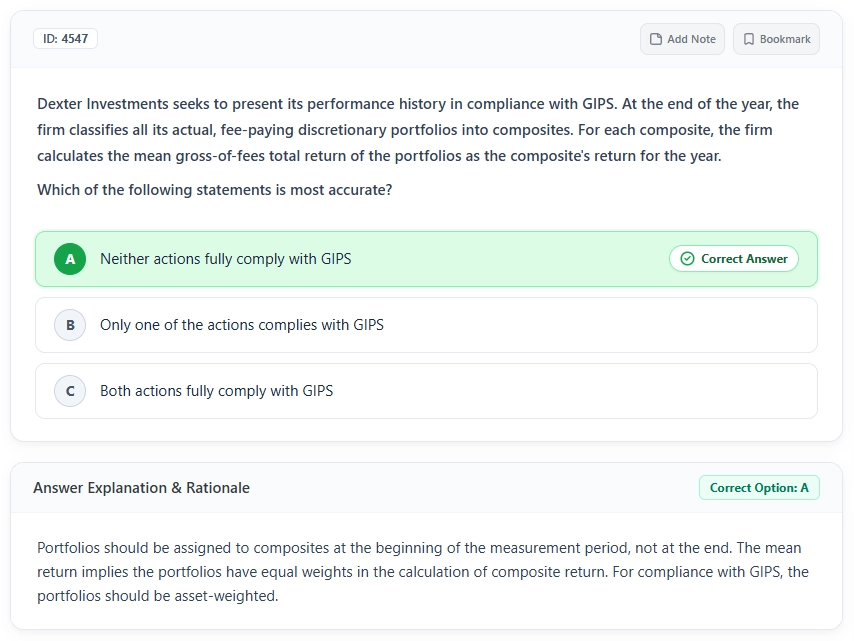
A composite groups portfolios that follow a similar strategy or mandate. Firms present performance at the composite level rather than showing off a single star portfolio. This is what prevents cherry-picking, which makes it a favorite exam concept. Expect questions on why composites exist and which portfolios must be included.
Definition of the Firm
GIPS compliance applies firm-wide, so how the firm defines itself sets the boundary of that claim. A firm cannot claim compliance for only its best-performing division. Ensure you understand where that line sits and why it matters because this concept comes up regularly in GIPS questions.
Investment Discretion
Only discretionary portfolios belong in composites, and these are the portfolios where the firm can actually carry out its strategy. Client restrictions can make a portfolio non-discretionary. The exam tests whether you can reason about which portfolios qualify, not just recite the definition.
Verification
Verification is an independent review of whether a firm's policies and procedures comply with GIPS requirements. The detail candidates miss most often: verification applies to the whole firm, not to single composites, and it is recommended rather than required. That distinction is classic exam material.
Official GIPS Standards Documents
For the complete standards, the official documents from CFA Institute are the source to trust. The 2020 GIPS Standards for Firms contains the full provisions, while the GIPS Standards Handbook for Firms explains the provisions in sections 1 through 8 with added guidance.
Both are worth bookmarking, though your curriculum readings define what you actually need for the exam. New standards and guidance develop as the industry evolves, shaped by broad public comment. The official site is where any updates land first.
It is also worth noting that new standards and guidance develop as the industry evolves and reshaped by broad public comment. If you want to ensure the documents are updated, the official site is where the recent revisions land first.

2020 GIPS Standards for Firms
Contains the full provisions and requirements for how investment firms must calculate and present investment performance to clients and prospective clients.

GIPS Standards Handbook for Firms
Explains the provisions in sections 1 through 8 with added interpretation, practical application guidance, and calculation examples.
Official CFA Institute GIPS Standards Portal
Access official guidance statements, Q&As, verification tools, and recent revisions directly from the source.
Disclaimer: GIPS is a registered trademark owned by CFA Institute. CFA Institute does not endorse or promote this organization, nor does it warrant the accuracy or quality of the content contained herein.
How to Study GIPS for the CFA Exam
Start with the purpose, not the provisions. Once you understand why the standards exist, to stop misleading performance reporting, the individual rules start to feel logical instead of arbitrary.
From there, learn the core definitions covered above, then move to application as quickly as you can. GIPS questions reward candidates who can read a scenario and judge whether a firm's behavior complies. That is a different skill from recognizing a definition.
Practice questions expose the gap between the two faster than rereading ever will. They also surface the small distinctions the exam loves to test, like verification being firm-wide and recommended.
Ultimately, treat GIPS as a steady, modest part of your Ethics review rather than a topic to cram, since Ethics rewards consistent exposure over time.

Practice Ethics and GIPS Questions With KeyPoint Learning
Reading about GIPS builds familiarity, but Ethics scores are won through repetition with exam-style questions. The scenarios are vague on purpose, and the wrong answers sound plausible.
KeyPoint Learning study packages include structured lessons, practice quizzes, and mock exams that cover Ethics alongside every other topic for your level. GIPS gets tested in context rather than studied on its own.
If you are weighing how much structure and practice you want in your prep, the package comparison lays out the options by level.
FAQs About CFA GIPS Standards
Quick answers to the GIPS questions candidates search for most.
Sign Up For Updates
Sign up and be the first to receive updates on upcoming product availability and latest offers.

Build Confidence in Ethics and GIPS Topics
GIPS rewards the same approach as the rest of Ethics: understand the purpose, learn the key concepts, then practice until scenario questions stop feeling like traps. With the heaviest topic weight on the Level I exam, Ethics is worth that investment.
When you are ready to put structured lessons and realistic practice behind your prep, our study packages cover Ethics and every other topic for your level.