CFA Level I Prep Built Around a Clear Study Path
CFA Level I covers a lot of ground, and most candidates are fitting it around a job, a degree, or both. The challenge is usually not the difficulty of the material. It is that there is so much to cover, and so little time to decide what to study next.
KeyPoint Learning gives you a clear order to follow, realistic exam-style practice, and a simple way to see where you stand. You spend your hours studying, not planning.
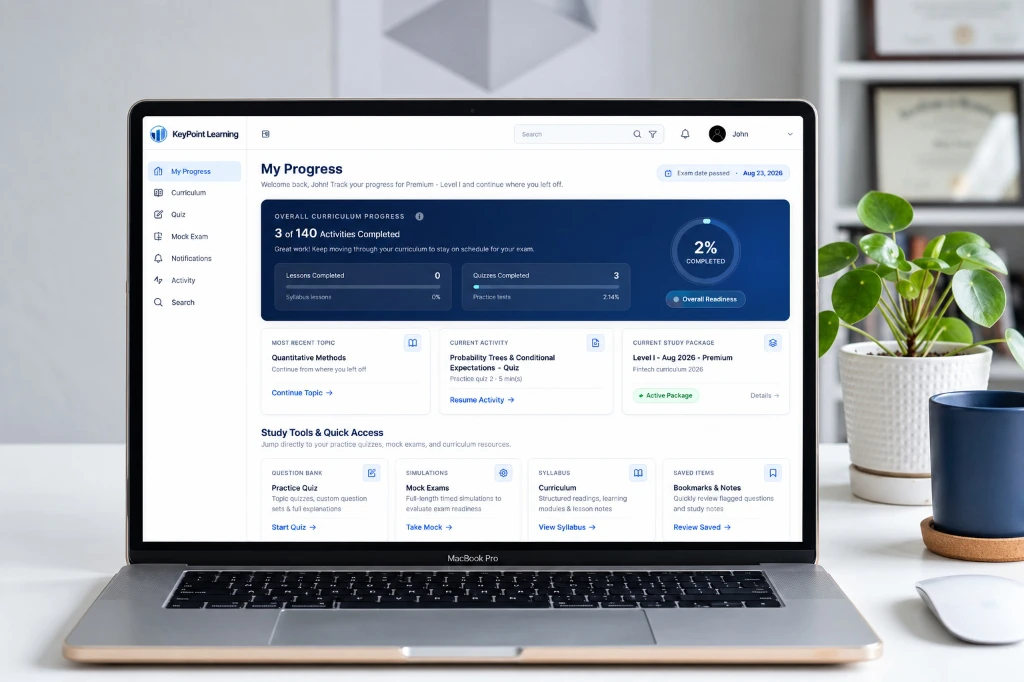
Everything You Need to Prepare for CFA Level I
KeyPoint Level I prep brings the main parts of your study plan into one place, so you are not switching between scattered notes, question banks, and spreadsheets. Each piece has a clear role, and they work together.
Video lessons
Work through each topic in a clear order, with harder ideas broken down step by step.
Study notes
Review each topic without rereading the full curriculum, then return to key areas before exam day.
Practice questions
Test what you know as you go, using the same multiple-choice style as the Level I exam.
Mock exams
Sit full-length timed mock exams so the format and pacing feel familiar before exam day.
Progress tracking
See what you have covered, what still needs work, and where to spend your next session.
Study tools
Take notes, bookmark lessons, flag tricky questions, and build custom quizzes around the areas you need to review.
Which CFA Level I Package Fits You?
The right Level I package depends on how much structure, practice, and support you want. Use this section as a decision guide, not another pricing block.
A lower-cost option with a clear study path
A good fit if you already have a study routine and mainly want structured Level I materials, practice, and progress tracking.
A stronger balance of structure, practice, and value
A better fit if you want more support for practice questions, mock exams, and weak-area review without moving to the highest tier.
The most complete Level I support
A better fit if you want more guidance, more practice support, and less pressure managing your prep alone.
Compare what each option includes, then choose based on your exam window, your weekly study time, and how much practice you want before exam day.
How KeyPoint Helps You Study for CFA Level I
KeyPoint works as a study path, not a pile of content. You move through five steps, and the platform keeps track of where you are so you always know the next move.
- Learn the core concepts. Take each topic in a set order instead of guessing where to start.
- Practice as you go. Answer questions while a topic is fresh, not weeks later when it has faded.
- Review weak areas. Use your results to find the topics that need another pass.
- Sit mock exams. Practice the full format and pacing under timed conditions.
- Track your progress. Watch your coverage build, and spend your last weeks where they count.
This is the difference a clear path makes. You stop losing time to "what should I do next" and put those hours into the material instead.
CFA Level I at a Glance
CFA Level I is the first of three exams in the CFA Program. It tests your knowledge of the key terms, concepts, and formulas that the rest of the program builds on. The questions are all multiple choice.
Here is the exam in short, based on current CFA Institute information.
| Question | Short answer |
|---|---|
| What is CFA Level I? | The first CFA exam. It tests foundational knowledge across ten topic areas. |
| How many questions? | 180 multiple-choice questions, split into two sessions of 90. |
| How long is it? | Two 135-minute sessions, about 4.5 hours of exam time, plus time for a tutorial, a break, and a survey. |
| Is there a guessing penalty? | No. There is no penalty for a wrong answer, so you should answer every question. |
| How hard is it? | The 10-year average pass rate is 41%, per CFA Institute. Most candidates pass by putting in the time, not being brilliant. |
| How long should you study? | CFA Institute says successful candidates report over 300 hours on average for each level. |
| What comes after? | Level II, which moves from knowing the material to applying it. |
What Does CFA Level I Cover?
The CFA Level I syllabus is organized into 10 topic areas, grouped into four main functional areas across two exam sessions.
These are the current curriculum weights from CFA Institute for the 2027 cycle. Treat the ranges as planning guidance for your study time.
| Topic | Exam Weight | Functional Area |
|---|---|---|
| Quantitative Methods | 6 - 9% | Tools |
| Economics | 6 - 9% | |
| Financial Statement Analysis | 11 - 14% | |
| Corporate Issuers | 6 - 9% | |
| Equity Investments | 11 - 14% | Assets |
| Fixed Income | 11 - 14% | |
| Derivatives | 5 - 8% | |
| Alternative Investments | 7 - 10% | |
| Portfolio Management | 8 - 12% | Portfolio Management and Analysis |
| Ethical & Professional Standards | 15 - 20% | Ethical and Professional Standards |
Exam Structure
The Level I exam is 100% multiple choice (three answer choices) consisting of 180 questions split between two sessions over 4.5 hours.
Both sessions must be attended with an optional 30-minute break between sessions.
| Session | Duration | Questions | Topics Tested |
|---|---|---|---|
| First Session | 2hrs, 15min | 90 | Ethical and Professional Standards, Quantitative Methods, Economics, Financial Statement Analysis |
| Second Session | 2hrs, 15min | 90 | Corporate Issuers, Equity, Fixed Income, Derivatives, Alternative Investments and Portfolio Management |
| Total | 4hrs, 30min | 180 | 90 seconds (1.5 minutes) / question |
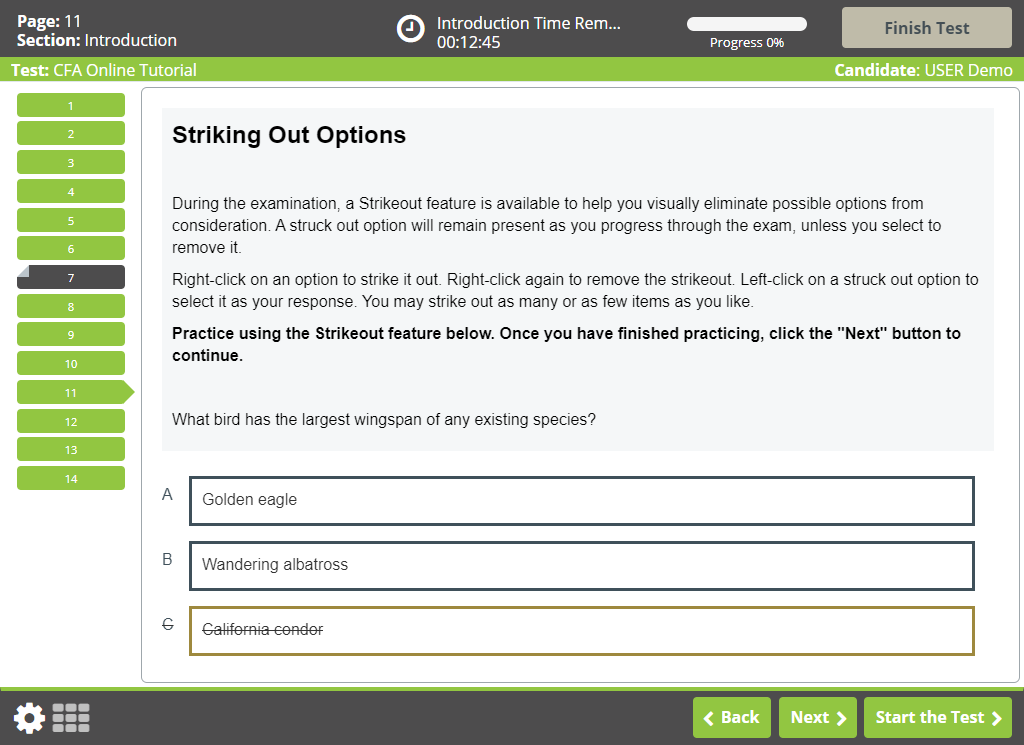
As of August 2021, the CFA exams switched to computer-based testing (CBT) format. The practice testing component of all our study packages are designed to closely simulate the look and feel of the actual exam so candidates are familiar with the layout and functionality come exam day.
Exam Results
- Exam results for Level I are provided via email approximately 7 - 10 weeks (~ 60 days) after the corresponding exam period.
- Results are designated as either "pass" or "fail". Included in the exam results email is a performance report outlining general results per topic.
- A minimum passing score (MPS) is implemented by the CFA Institute for each exam. The MPS is not made
public before or after the exam. Although the MPS is not disclosed, it is estimated candidates
should aim for a score of above 70%.
Note, the minimum passing score is not to grade the results on a curve, but rather to establish a minimum difficulty hurdle. - Pass rates for the Level I exam is usually in the 40% range.
CFA Level I Exam Dates
Key Deadlines
Show all milestones
- Registration & Scheduling Opens Key date May 5, 2026
- Early Registration Deadline Jul 7, 2026
- Invoice Payment Deadline Sep 26, 2026
- Registration Closes Key date Nov 5, 2026
- Scheduling Deadline Key date Nov 10, 2026
- Disability Accommodations Request Deadline Nov 11, 2026
- Rescheduling Deadline Feb 11, 2027
- CFA Exam Dates Feb 22 – 28, 2027
Key Deadlines
Show all milestones
- Registration & Scheduling Opens Key date Aug 12, 2026
- Early Registration Deadline Oct 14, 2026
- Invoice Payment Deadline Jan 1, 2027
- Registration Closes Key date Feb 10, 2027
- Scheduling Deadline Key date Feb 16, 2027
- Disability Accommodations Request Deadline Feb 17, 2027
- Rescheduling Deadline Apr 30, 2027
- CFA Exam Dates May 11 – 17, 2027
Key Deadlines
Show all milestones
- Registration & Scheduling Opens Key date Nov 3, 2026
- Early Registration Deadline Jan 20, 2027
- Invoice Payment Deadline Mar 20, 2027
- Registration Closes Key date Apr 29, 2027
- Disability Accommodations Request Deadline May 5, 2027
- Scheduling Deadline Key date May 6, 2027
- Rescheduling Deadline Aug 4, 2027
- CFA Exam Dates Aug 15 – 22, 2027
Key Deadlines
Show all milestones
- CFA Exam Dates Nov 13 – 19, 2027
Dates are subject to change. Check the CFA Institute for the latest exam dates and registration information.
CFA Level I Study Resources
If you are not ready to choose a package, these resources help you keep moving. Each one supports a different part of your prep.
FAQs About CFA Level I
What is CFA Level I?
CFA Level I is the first exam in the CFA Program. It tests your knowledge of the core terms, concepts, and formulas across ten topic areas, using multiple-choice questions. You take it before Levels II and III.
Is CFA Level I hard?
It is challenging, but the difficulty comes from the volume, not the depth. CFA Institute reports a 10-year average pass rate of 41% for Level I. Most candidates who fall short ran out of study time or skipped practice, rather than failing to understand the material.
What topics are covered in CFA Level I?
The Level I syllabus covers ten areas: Ethics, Quantitative Methods, Economics, Financial Statement Analysis, Corporate Issuers, Equity Investments, Fixed Income, Derivatives, Alternative Investments, and Portfolio Management. Ethics carries the highest weight.
What is the CFA Level I exam format?
The exam has 180 multiple-choice questions across two 135-minute sessions of 90 questions each. You get roughly 90 seconds per question, and there is no penalty for a wrong answer.
How long should I study for CFA Level I?
CFA Institute says successful candidates report studying over 300 hours on average for each level. How you spread those hours depends on your schedule, which is why a clear study path matters when you are studying around work.
Can I prepare for CFA Level I while working full time?
Yes. Most CFA candidates study while working. The key is a plan that fits the hours you actually have, with practice you can do in short, regular sessions rather than long blocks you rarely get.
Do I need CFA Level I prep?
Not always. Self-study works if you have time, discipline, and a clear plan. A prep provider helps most when you want structure, exam-style practice, and a way to see where you stand without building it all yourself.
What does KeyPoint Level I prep include?
KeyPoint Level I prep includes video lessons, study notes, practice questions, mock exams, and progress tracking.
Is KeyPoint Learning endorsed by CFA Institute?
No. CFA Institute does not endorse, promote, or warrant the accuracy or quality of the products or services offered by KeyPoint Learning Inc. CFA and Chartered Financial Analyst are registered trademarks owned by CFA Institute.
Sign Up For Updates
Sign up and be the first to receive updates on upcoming product availability and latest offers.