
CFA Study Notes
KeyPoint Learning CFA® study materials give you focused, topic-by-topic notes for CFA Levels I, II, and III. Each note helps you work through one concept, understand why it matters, and see how you may need to apply it on the exam. You will find clear explanations, worked examples, common exam traps, and practice questions where they support the topic. Choose your level below, then open the concept you want to learn or review.
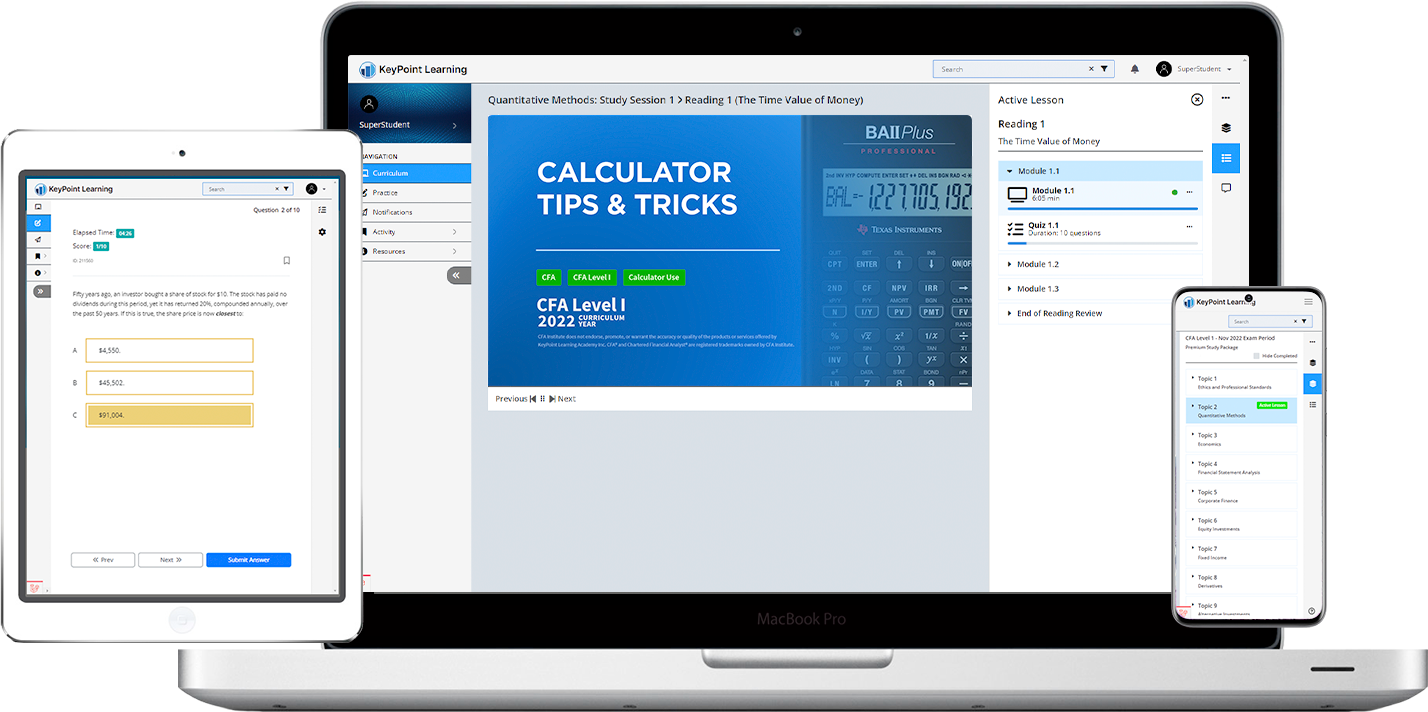
Choose Your CFA Level
The study-note library is organized by CFA level and curriculum topic. Start with the exam level you are preparing for, then choose the topic or concept that needs your attention.

CFA Level I
Build your foundation across all ten Level I topic areas, from Ethics and Quantitative Methods to Fixed Income and Portfolio Management. These notes introduce the main ideas, explain the essential calculations, and help you connect related concepts as you move through the curriculum.

CFA Level II
Work through applied analysis and valuation concepts in the context of Level II item sets. These notes help you identify the relevant information, select the appropriate method, complete the analysis, and interpret what the result means.

CFA Level III
Review the Level III common core and the material for your selected pathway. These notes focus on portfolio decisions, client and institutional circumstances, investment tradeoffs, and the reasoning needed for item-set and constructed-response questions.
Why Use KeyPoint Study Notes
These notes are designed for candidates fitting CFA preparation around work, university, or other commitments. Each note helps you learn the concept, connect it to the exam, and check your understanding before you move forward.
Understand the Concept
Each note begins by putting the concept into plain language and placing it within the wider topic. Once you understand what the idea means and where it fits, the formulas, frameworks, and technical details become easier to follow.
Focus on Exam Application
The notes explain what you may need to recognize, calculate, compare, interpret, or evaluate at your CFA level. This gives your review a clear purpose and helps you concentrate on the knowledge and skills covered by the curriculum.
Learn Through Examples and Practice
Original examples show how a concept works with realistic figures, situations, or investment decisions. Many notes also identify common exam traps and include a practice question, giving you a quick way to check whether you can apply what you have reviewed.
Continue Through the Curriculum
Each note connects to its parent topic and closely related concepts, with previous and next navigation where the sequence is confirmed. You can follow the curriculum in order or go directly to a concept that needs more work.
What You Can Expect From Each Study Note
KeyPoint notes follow a familiar structure, making it easier to find the explanation or review tool you need.
Most notes include a short opening explanation, a Quick Answer, Key Takeaways, and a clear summary of what matters for that CFA level. The main teaching section then uses the format that best suits the topic.
Formula-based notes explain the notation and calculation steps, comparison topics use side-by-side tables, and ethics topics use practical scenarios. Where useful, the note also includes a worked example, common exam traps, a practice question, related-note links, and previous and next navigation.
Preview the Study-Note Format
The preview below gives you a quick look at how a KeyPoint note explains a concept and highlights a likely mistake. This example comes from a Level I Quantitative Methods note covering the defining properties of probability.
Defining Properties of Probability
Quick Answer
A probability must fall between 0 and 1. The probabilities of mutually exclusive and collectively exhaustive outcomes in a sample space add up to 1. Two mutually exclusive events cannot occur at the same time.
The complement rule gives the probability that an event does not occur. If the probability of event A is 0.65, its complement has a probability of 1 minus 0.65, or 0.35.
Exam Trap
A common mistake is adding the probabilities of overlapping events as though the events were mutually exclusive. When two events can occur together, their shared probability must be subtracted once when calculating the probability that either event occurs.
Find the Concept You Need
Start by choosing your CFA level, then move into a curriculum topic and select the reading or concept you want to review. Each level library can support search, topic filters, curriculum-order browsing, and related-note links. This structure helps you locate one specific idea without working through an entire reading when a focused review is all you need.


When Study Notes Are Enough and When You May Want More
Study notes work well for learning a specific concept, clearing up a difficult section, and revisiting key material during revision. Candidates who are comfortable planning their own preparation can use them alongside the official CFA Program curriculum, practice questions, and other resources.
A study package becomes useful when you want lessons, a broader question bank, mock exams, and progress tracking arranged within one study process. Your choice should reflect how much guidance you need, how confidently you can manage your own schedule, and how much time you want to spend organizing separate resources.
Start With Your CFA Level
Choose the exam level you are preparing for and open its study-note library. From there, you can search for a concept, browse by topic, or review the curriculum in sequence.
Frequently Asked Questions About CFA Study Notes
What are CFA study notes?
CFA study notes are focused lessons that explain individual exam concepts and show how candidates may need to use them.
A KeyPoint note usually includes a plain-language explanation, key takeaways, an example or framework where useful, common exam traps, and an original practice question. This structure helps you review one idea at a time and check your understanding before continuing.
Are KeyPoint CFA study notes free?
Yes. KeyPoint CFA study notes are free to browse and use for focused concept review. Paid study packages include more comprehensive preparation materials and additional study support for candidates who want a more structured approach.
Which CFA levels have study notes?
Study notes are organized for CFA Levels I, II, and III. Level I covers the ten foundational topic areas. Level II develops the analysis and application skills used in item sets. Level III covers the common core and the candidate’s selected pathway, with an emphasis on portfolio decisions and applied judgment.
How should I use study notes with the official curriculum?
Use the official CFA Program curriculum as your main source, then use the matching study note to reinforce the central idea, calculation, interpretation, or exam application.
A practical sequence is to study the curriculum section, review the related note, and complete a practice question before moving to the next concept. You can also return to the note later when a question exposes a gap in your understanding.
Do study notes replace practice questions and mock exams?
Study notes, practice questions, and mock exams support different parts of your preparation.
Study notes help you learn or repair individual concepts. Topic practice develops your ability to apply those concepts across different question styles, while mock exams help you manage timing, concentration, and decision-making across a full exam session.
A complete study process makes room for all three.