
Updated for the 2026-2027 CFA® Level I curriculum.
The indirect method starts with net income. The direct method reports actual cash receipts and cash payments. Converting between them means taking accrual-based income statement figures and adjusting each one for the related balance sheet change. CFA Level I tests this as a calculation skill. You will be given revenue, cost of goods sold (COGS), or operating expenses along with changes in accounts receivable, inventory, or accounts payable, and asked to find the cash equivalent.
Quick Answer
Converting cash flows from indirect to direct format means recalculating operating cash flow line items, such as cash collected from customers and cash paid to suppliers, from accrual-based income statement figures. You adjust each figure for the change in its related balance sheet account. Total cash flow from operations (CFO) never changes. Only the level of detail in the operating section changes.
Key Takeaways
Total CFO is identical under the direct and indirect methods. Conversion changes presentation, not the total.
Converting an income statement item to its cash equivalent requires adjusting for the change in the related balance sheet account.
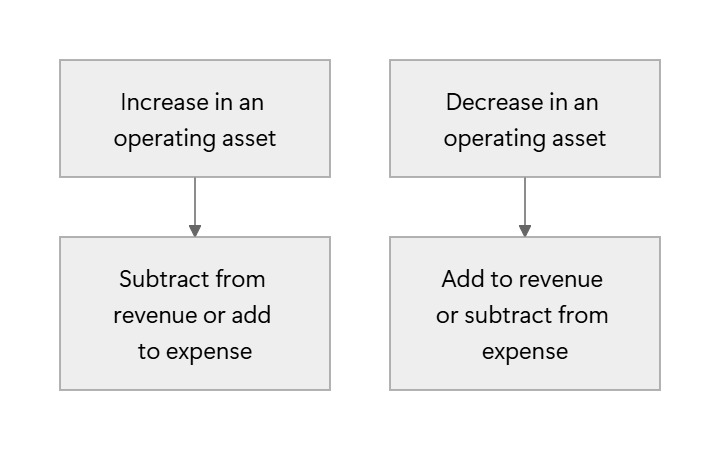
An increase in an operating asset (AR, inventory, prepaid expense) is a use of cash. A decrease is a source of cash.
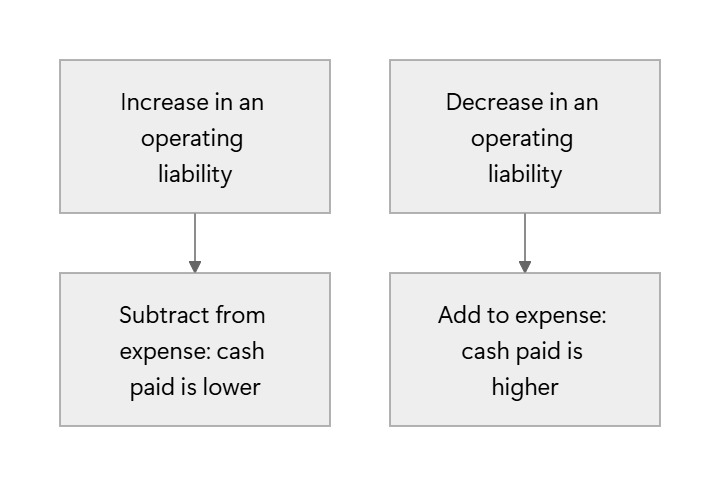
An increase in an operating liability (AP, accrued liabilities, taxes payable) is a source of cash. A decrease is a use of cash.
Useful conversions include cash collected from customers, cash paid to suppliers, cash paid for operating expenses, and cash paid for interest and taxes.
This is a calculation-based LOS, not a conceptual definition. Expect numeric problems.
What You Need to Know for CFA Level I
The LOS verb is "demonstrate." Expect to perform the conversion, not just describe it.
You need to convert accrual-based revenue and expense figures into cash equivalents using balance sheet changes.
Total CFO stays the same under both methods. Only the line-item detail differs.
This note assumes you already know how to build indirect and direct statements from scratch. That skill belongs to the prior note, not this one.
The main trap is applying the wrong sign to a balance sheet change, especially mixing up the asset rule and the liability rule.
Exam questions typically give you one income statement figure plus one or two balance sheet changes and ask for a single cash figure.
Why Convert Indirect Cash Flows to the Direct Format?
Analysts sometimes prefer the direct method because it shows exactly how much cash came from customers and how much went to suppliers and employees. Most companies report the indirect method, so an analyst who wants direct-method detail has to reconstruct it from the indirect statement and the balance sheet.
The conversion does not create new information. It reorganizes information that is already in the financial statements. Net income, revenue, and expenses are accrual numbers. Balance sheet changes tell you the gap between what was recognized and what was actually collected or paid in cash.
The Core Conversion Framework
Every conversion follows the same logic: start with the income statement figure, then adjust for the change in the related balance sheet account.
Adjusting for Changes in Operating Assets
Operating assets include accounts receivable, inventory, and prepaid expenses. An increase in an operating asset means cash left the company (or wasn't collected) faster than the income statement shows. A decrease means the opposite.
Adjusting for Changes in Operating Liabilities
Operating liabilities include accounts payable, accrued liabilities, and taxes payable. An increase means the company delayed paying cash. A decrease means the company paid down obligations with cash.
Apply these rules to operating balances after excluding non-cash changes, acquisitions, and foreign-currency effects. For taxes, use current tax expense; for interest, remove any non-cash amortization before adjusting interest payable.
Converting Specific Income Statement Items
Cash Collected from Customers
Cash collected from customers = Revenue - ∆AR
where:
∆AR: ending receivables minus beginning receivables.
Subtract an increase and add a decrease when reconstructing cash collections.
Cash Paid to Suppliers
Cash paid to suppliers = COGS + ∆Inventory - ∆AP
where:
∆Inventory: ending inventory minus beginning inventory, and
∆AP: ending operating payables minus beginning operating payables.
An inventory increase raises purchases; an increase in payables reduces the cash paid for those purchases.
Cash Paid for Operating Expenses
Use operating expenses excluding depreciation, amortization, and other non-cash charges in this formula. Adjust only the related operating prepayments and accruals after excluding unrelated account movements.
Cash paid for operating expenses = Operating expenses - ∆Accrued liabilities + ∆Prepaid expenses
where:
∆Accrued liabilities: ending accrued operating liabilities minus beginning accrued operating liabilities, and
∆Prepaid expenses: ending operating prepayments minus beginning operating prepayments.
An increase in accruals reduces cash paid relative to expense; an increase in prepayments raises it.
Cash Paid for Interest and Taxes
Cash paid for interest = Interest expense - ∆Interest payable
Cash paid for taxes = Current tax expense - ∆Taxes payable
where:
∆Interest payable: ending interest payable minus beginning interest payable, and
∆Taxes payable: ending current taxes payable minus beginning current taxes payable.
Subtract increases in the respective payable balance, after excluding non-cash and other unrelated movements.
Working Example
Pinnacle Technologies reports the following for the year:
Item | Amount |
|---|---|
Revenue | $500,000 |
COGS | $300,000 |
Accrual operating expenses, excluding depreciation | $80,000 |
Balance sheet changes during the year:
Account | Beginning | Ending | Change |
|---|---|---|---|
Accounts receivable | $40,000 | $55,000 | +$15,000 |
Inventory | $60,000 | $72,000 | +$12,000 |
Accounts payable | $35,000 | $42,000 | +$7,000 |
Accrued liabilities | $20,000 | $16,000 | -$4,000 |
Step 1: Cash collected from customers
500,000 - 15,000 = $485,000
Step 2: Cash paid to suppliers
300,000 + 12,000 - 7,000 = $305,000
Step 3: Cash paid for operating expenses
Accrued liabilities decreased by $4,000 so the company paid down $4,000 more cash than the current year's expense.
80,000 - (-4,000) = $84,000
Pinnacle collected $485,000 in cash from customers, paid $305,000 to suppliers, and paid $84,000 in operating expenses. That produces $96,000 in cash from these three activities ($485,000 - $305,000 - $84,000), a figure the indirect method would never show directly. The total still reconciles to the same CFO figure Pinnacle would report starting from net income.
Extending the Conversion to Prepayments and Taxes
In a separate example, a company reports $120,000 of operating expenses, including $20,000 of depreciation. Prepaid operating expenses increase by $5,000, and accrued operating liabilities increase by $8,000. Assume no other movements in those balances.
First remove depreciation, because it is not a cash payment. Then adjust the remaining accrual expense:
Cash paid for operating expenses = ($120,000 - $20,000) + $5,000 - $8,000 = $97,000
The increase in prepayments means the company paid for more benefits than it consumed this period. The increase in accrued liabilities means some recognized expense remains unpaid. These adjustments work in opposite directions.
Now suppose total income tax expense is $30,000, including $6,000 of deferred tax expense. Current taxes payable rise by $3,000. Assume no settlements, refunds, acquisitions, or other tax-balance changes.
Current tax expense = $30,000 - $6,000 = $24,000
Cash taxes paid = $24,000 - $3,000 = $21,000
Using total tax expense directly would incorrectly treat the deferred portion as a current cash obligation. The same check applies to interest: remove non-cash discount or premium amortization before using changes in interest payable to reconstruct the cash payment.
Common Exam Traps
Reversing the sign on a balance sheet change
Candidates often add an increase in AR instead of subtracting it, which overstates cash collected from customers.
Confusing this conversion with full statement preparation
This note covers converting specific accrual figures into cash equivalents. Building an entire direct-method statement from raw transactions is a separate skill covered in the prior note.
Forgetting to adjust for the liability side
Many candidates adjust COGS for the inventory change but forget the accounts payable change, which only captures half the cash paid to suppliers.
Treating a decrease the same as an increase
A decrease in an operating asset is a source of cash. A decrease in an operating liability is a use of cash. Mixing these two rules up is the most common arithmetic error on this topic.
Assuming total CFO changes under the direct method
It does not. Only the detail inside the operating section changes. The bottom-line CFO figure is identical regardless of presentation.
Practice Question
ABC Company reports COGS of $240,000 for the year. Inventory increased by $18,000, and accounts payable decreased by $6,000 during the same period. Calculate cash paid to suppliers.
$222,000
$252,000
$264,000
Correct Answer: C
240,000 + 18,000 - (-6,000) = 240,000 + 18,000 + 6,000 = $264,000
Inventory increased, so the company purchased more than it sold, adding $18,000 to cash paid. Accounts payable decreased, meaning the company paid down existing obligations with cash, which also adds to cash paid.
Option A: ($222,000) subtracts the inventory increase and ignores the accounts payable decrease, understating cash paid.
Option B: ($252,000) correctly adjusts for the inventory increase but reverses the accounts payable rule, treating a decrease in AP as a source of cash instead of a use of cash.
Continue Your CFA Level I Prep With KeyPoint
Use structured lessons, practice questions, mock exams, and progress tracking to focus on the time you have left
FAQs About Converting Cash Flows from the Indirect to Direct Method
Does converting from indirect to direct change total cash flow from operations?
No. Total CFO is identical under both methods. The conversion only reallocates the operating section into specific cash inflow and outflow categories.
Do I need to memorize a formula for every income statement line item?
Focus on these recurring conversion types: cash collected from customers, cash paid to suppliers, cash paid for operating expenses, and cash paid for interest and taxes. The same logic, adjusting for the related balance sheet change, applies to any line item the exam gives you.
How is this different from the previous note on direct and indirect statement preparation?
That note teaches how to build each statement format from the ground up, either from cash receipts and disbursements or from net income. This note focuses narrowly on converting individual indirect-method figures into their direct-method cash equivalents.
Does depreciation factor into this conversion?
Depreciation is a noncash expense already added back to net income under the indirect method. It does not appear in any direct-method cash line item. Confirm whether operating expenses given in a problem already exclude depreciation before you apply the conversion formula.
What if a question gives a change in deferred or unearned revenue?
Treat it like any other operating liability. An increase in deferred revenue means the company collected cash before recognizing the revenue, so add the increase to revenue when calculating cash collected from customers.