
Updated for the 2026-2027 CFA® Level II curriculum.
Event-driven hedge funds buy securities whose value depends on a specific corporate event, such as a merger or a bankruptcy filing. The fund's return hinges on whether that event closes as expected. CFA Level II tests whether you can trace the payoff if the event succeeds and if it fails, not whether you can quote the deal spread.
Quick Answer
Event-driven hedge fund strategies invest in securities tied to a specific corporate event, mainly mergers, bankruptcies, and restructurings. Merger arbitrage earns the deal spread if a transaction completes but can lose far more than the spread if the deal breaks. Distressed investing holds claims across a company's capital structure and profits from recovery value. Both carry real event, timing, and financing risk.
Key Takeaways
Merger arbitrage profits from the deal spread between the current target price and the offer price, not from general market direction.
Completion at the stated cash terms realizes the quoted spread before costs. A broken deal can produce a loss far larger than the spread, so the position is not risk-free.
Stock-for-stock deals require a hedge sized to the exchange ratio. Using that hedge on a cash deal creates unintended exposure.
Distressed investing holds claims at different points in a company's capital structure, and recovery value depends on legal priority, not on a quoted spread.
Event-driven allocations concentrate exposure to a small number of event outcomes and depend on financing conditions that can change quickly.
What You Need to Know for CFA Level II
The LOS requires you to discuss investment characteristics, strategy implementation, and portfolio role for event-driven strategies, not just define them.
You must evaluate the asymmetry between completion and failure payoffs rather than describe merger arbitrage as a low-risk spread trade.
You need to distinguish a quoted deal spread from an annualized realized return that accounts for time to close.
You should separate cash-deal exposure, which needs no acquirer-side hedge, from stock-deal exposure, which needs a hedge sized to the exchange ratio.
You need to compare distressed claims by priority, recovery timing, and liquidity rather than treat all claims the same.
Portfolio role questions test event concentration risk and financing risk, not only diversification benefit.
Trace merger-arbitrage payoff paths
Merger arbitrage buys target company shares after a merger announcement, at a price below the offer price. That gap is the deal spread: offer price minus current target price. The fund captures the full spread if the deal closes.
Two outcomes drive the payoff. If the deal completes, the fund receives the offer price and earns the spread. If the deal breaks, the target price typically falls back toward its pre-announcement level, and the loss can exceed the spread by a wide margin. This asymmetry is the central idea tested at Level II: the spread exists because the deal can fail, not because the position is a free arbitrage.
Deal structure changes the hedge. In a cash deal, the fund holds only target shares; no acquirer-side hedge is needed, because the payoff does not depend on the acquirer's stock price. In a stock-for-stock deal, the fund typically holds target shares and shorts acquirer shares in the exchange ratio, since the payoff depends on the acquirer's price at closing.
Timing also matters. A deal spread of 3 earned in three months produces a different annualized return than the same spread earned in twelve months. Regulatory review, financing contingencies, and shareholder votes can extend the timeline and reduce the realized annualized return below what the quoted spread implies.
Compare distressed and restructuring investments
Distressed investing buys claims on a company already in financial trouble, expecting a restructuring, bankruptcy, or out-of-court workout to restore value. The claim's position in the capital structure sets its priority. Senior secured debt is repaid before senior unsecured debt, which is repaid before subordinated debt and equity. Recovery depends on legal priority, collateral value, enterprise value, restructuring terms, and the time needed to receive payment.
The catalyst differs from merger arbitrage. Merger arbitrage reacts to an announced transaction with a stated offer price. Distressed investing reacts to a bankruptcy filing or a restructuring plan where the outcome and timing are far less certain. Legal proceedings can extend for months or years, and specialist knowledge of bankruptcy law and industry conditions is often needed to estimate recovery value.
Liquidity differs too. Distressed claims often trade infrequently and can require long holding periods before a recovery outcome is known. This affects portfolio role directly. An allocation to event-driven strategies concentrates exposure to a limited set of event outcomes, whether mergers closing or restructurings resolving. It also carries financing risk: funds that use leverage or hedge financing to hold these positions face higher costs, or forced unwinds, if financing conditions tighten before the event resolves.
Working Example
An event-driven fund buys target shares at 49 per share after a cash offer of 52. Assume a failed deal would leave the target at 38. Ignore dividends, taxes, financing, and trading costs. These are scenario prices, not a maximum-loss guarantee.
Step 1: Calculate the completion gain.
Step 2: Calculate the assumed break loss.
Both amounts are currency units per share. The downside in the stated break scenario is more than three times the completion gain.
Step 3: Compare the outcome paths.
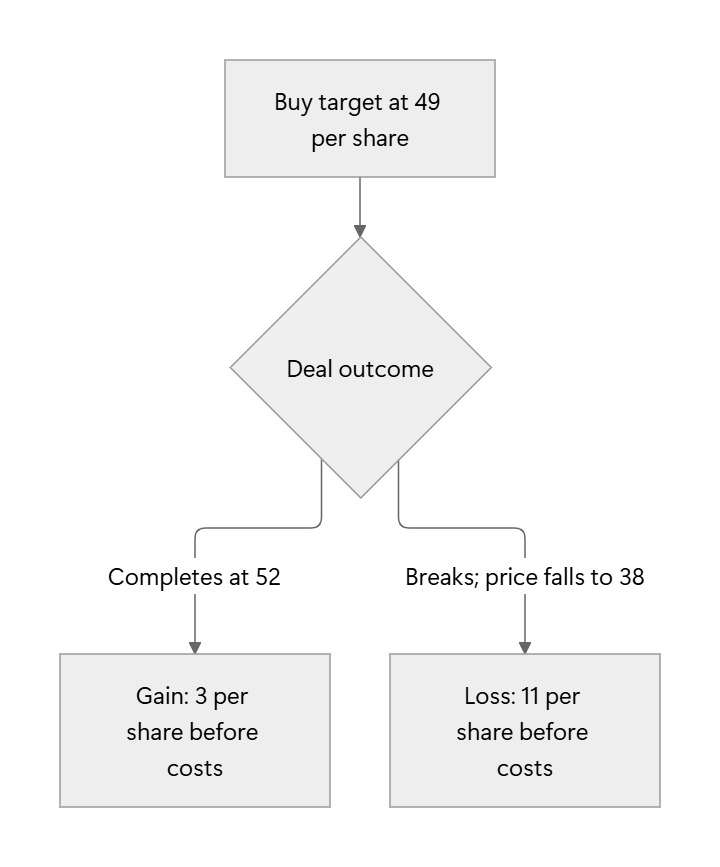
A small quoted spread can accompany a substantial downside. The expected return also depends on completion probability, time, and costs. The spread alone does not demonstrate that the trade is attractive or that the potential loss is limited to the spread.
Common Exam Traps
Calling merger arbitrage risk-free
The deal spread exists as compensation for break risk. In the working example, the 3-point spread exists precisely because an 11-point loss is possible if the deal fails.
Ignoring deal timing and financing costs
A spread earned over three months is not equivalent to the same spread earned over twelve months. Financing costs on borrowed capital or short positions reduce the net, annualized return below the quoted spread.
Using a stock-deal hedge ratio for a cash deal
Cash deals carry no exposure to the acquirer's share price. Applying an exchange-ratio hedge meant for stock deals adds an unhedged, unintended short position in the acquirer with no offsetting purpose.
Treating all distressed claims as having the same priority
Senior secured debt is repaid before subordinated debt and equity in a restructuring. Assuming equal recovery across the capital structure misstates both expected payoff and risk for each claim.
Practice Question
An event-driven hedge fund buys shares of Vantor Corp at 57 per share after Harlan Industries announces a cash offer of 60 per share. If regulators later block the deal, the fund expects Vantor shares to fall back to 45. Which statement best describes the fund's risk exposure before the deal outcome is known?
The position is a guaranteed gain of 3 per share because cash offers eliminate deal risk.
The position offers a potential gain of 3 per share if the deal completes and a potential loss of 12 per share if the deal breaks.
The position carries a symmetric risk of 3 per share in either direction, since the deal spread sets the maximum gain and loss.
Correct Answer: B
Calculations/Workings:
Completion payoff:
Currency units per share.
Break payoff:
Currency units per share.
The gain and loss are not symmetric. The fund risks four times more on the downside than it stands to gain on the upside. The deal spread compensates for this asymmetric risk, not for a guaranteed or balanced outcome.
Why Other Options Are Wrong
Option A: A cash offer removes exposure to the acquirer's stock price, not exposure to deal failure. Regulatory review, financing conditions, and shareholder votes can still block the deal.
Option C: The loss is not capped at the spread amount. The scenario assumes a 12-per-share loss if the deal breaks, but the actual post-break price could be lower, well beyond the 3-point spread.
Continue Your CFA Level II Prep With KeyPoint
Use structured lessons, practice questions, mock exams, and progress tracking to focus on the time you have left
FAQs About Event-Driven Hedge Fund Strategies
Why is merger arbitrage exposed to deal risk?
The fund holds target shares before the deal legally closes. Regulatory approval, financing, antitrust review, or a shareholder vote can still cause the deal to fail, and that risk is priced into the deal spread.
How does distressed investing differ from merger arbitrage?
Distressed investing buys claims on a company already in financial trouble and profits from recovery through a legal process. Merger arbitrage focuses on an announced transaction and its completion terms. A target need not be financially healthy; the event driving the position distinguishes the strategy.
Why does a longer closing period matter?
The same cash gain earned over more time produces a lower annualized return, all else equal. Borrowing costs, stock-borrow fees where relevant, and changed deal terms can reduce the realized gain further. Compare both payoff size and expected time to resolution.