
As of June 6, 2026, the latest CFA pass rates published by CFA Institute are 45% for Level I, 42% for Level II, and 50% for Level III. Level I and Level III results are from the February 2026 exam window, while the latest Level II result is from November 2025. Test
Those numbers matter, but they do not predict your personal result. A pass rate tells you how a group performed in one exam window. Ultimately, your own result will depend on how consistently you study, how early you start practice questions, and how well you review weak areas before exam day.
Quick Answer: What Is the CFA® Pass Rate?
The CFA pass rate is the percentage of candidates who pass a specific CFA exam level in a specific exam window.
These rates change by level and testing window. They are quite useful for understanding how difficult a particular exam can be, but they should be used as planning context. Do not treat it as a prediction of whether you will pass.
Key Takeaways About the CFA® Pass Rate
The latest CFA Level I pass rate is 45% for the February 2026 exam window.
The latest CFA Level II pass rate is 42% for the November 2025 exam window.
The latest CFA Level III pass rate is 50% for the February 2026 exam window.
CFA Institute’s historical record shows average pass rates of 41% for Level I, 46% for Level II, and 55% for Level III from 1963 to 2026.
A low pass rate means the exam is demanding. It does not mean the exam is impossible.
Latest CFA® Pass Rates by Level
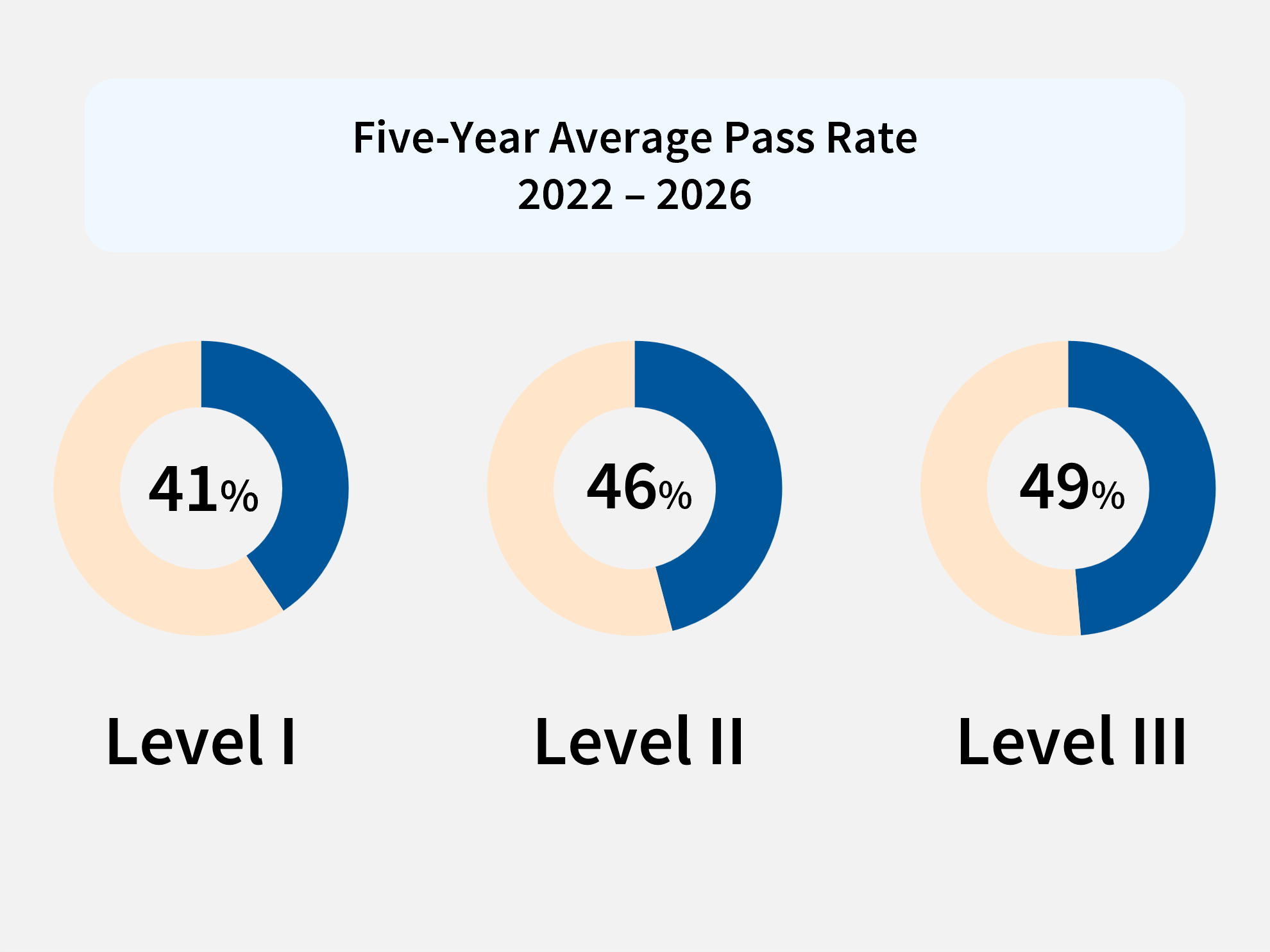
CFA Institute publishes the most recent CFA exam pass rates in its official pass-rate infographic and maintains a historical pass-rate record going back to 1963.
CFA Level | Latest Exam Window | Pass Rate | Source | Planning Note |
|---|---|---|---|---|
Level I | February 2026 | 45% | CFA Institute | Broad curriculum and first-time candidate volume make structure important. |
Level II | November 2025 | 42% | CFA Institute | Item sets test application, so practice matters more than passive reading. |
Level III | February 2026 | 50% | CFA Institute | Constructed response and portfolio management require targeted exam technique. |
The main takeaway of these figures are simple: every level needs a serious plan.
Level I tests a wide base of knowledge. Level II asks you to apply that knowledge in deeper scenarios. Level III adds more judgment, portfolio management, and written response discipline.
Historical CFA® Pass Rates
Historical CFA pass rates show that the exam has always been challenging, but the pattern differs by level. CFA Institute’s 1963 to 2026 historical data shows average pass rates of 41% for Level I, 46% for Level II, and 55% for Level III.
A higher Level III pass rate does not mean the exam is easy. It means the candidate pool is different. By the time candidates reach Level III, they have already passed Level I and Level II, so the group is more filtered.
Recent pass rates are closer to long-term averages than the unusually low results recorded in 2021. For example, CFA Institute’s historical file shows Level I at 22% in July 2021, compared with 45% in February 2026.
CFA® Level I Pass Rate
The latest CFA Level I pass rate is 45%, based on the February 2026 exam window. CFA Institute’s latest pass-rate infographic lists 24,006 tested candidates for that window.
Level I often has the lowest pass rate, partly because it is the entry point into the CFA Program. That matters because many candidates are taking their first professional finance exam while also learning how the curriculum works and adjusting to the amount of material.
A common mistake is treating Level I like a reading project. It is not enough to get through the material. You need to test yourself early, fix weak areas, and build enough question practice before the final review period.
CFA® Level II Pass Rate
The latest CFA Level II pass rate is 42%, based on the November 2025 exam window. CFA Institute’s latest pass-rate infographic lists 15,003 tested candidates for that window.
Level II is difficult because the exam moves beyond definitions and recall. The item set format asks you to apply concepts across longer case-style questions, so you need to understand the material well enough to use it under pressure.
This is where practice becomes a bigger part of preparation. Reading can help you build the base, but item sets show whether you can connect the data, select the right method, and avoid traps in the question.
CFA® Level III Pass Rate
The latest CFA Level III pass rate is 50%, based on the February 2026 exam window. CFA Institute’s latest pass-rate infographic lists 11,269 tested candidates for that window.
Level III has a different challenge. The exam places more weight on portfolio management, wealth planning, and applied judgment. It also includes constructed response questions, which require a more precise answering style than multiple choice.
For Level III, knowing the material is only part of the job. You also need to practice how to write clear answers, manage your time, and respond directly to what each question asks.
Why Do CFA® Pass Rates Change?
CFA pass rates change because each exam window has a different group of candidates, different levels of preparedness, and different testing patterns. The pass rate reflects how candidates performed in that window. It is not a fixed benchmark that produces the same result every time.
Several factors can affect pass rates, such as:
How early candidates start preparing
Whether candidates defer or stay on schedule
How much practice candidates complete before exam day
How well candidates manage weak topics
How prepared candidates are for the exam format
Differences in the candidate pool for each window
A pass rate can show what happened in a given exam window, but it does not prove one single cause. That’s why we always recommend pass rates to be used for planning only, not for explaining the difficulty of the exam.Paid deferrals are being phased out for 2027 CFA Program exams. Candidates should confirm the policy and deadline that apply to their specific registration.
Does a Low CFA® Pass Rate Mean the Exam Is Impossible?
Not necessarily. A low CFA pass rate means the exam is demanding, not impossible. It should push you to take the exam seriously, but it should not make you assume the result is already decided.
A pass rate does not measure your study habits. It does not show how many practice questions you completed, how honestly you reviewed your mistakes, or whether you fixed weak topics before exam day.
Use the number as a reminder that casual preparation is risky. Do not use it as a reason to panic.
How Should Pass Rates Affect Your Study Plan?
CFA pass rates should push you toward earlier, more active preparation. They should not make you study in a rushed or scattered way.
A stronger study plan usually includes five habits:
Start early enough to avoid cramming.
Use practice questions while you study, not only at the end.
Take mock exams before the final stretch.
Review weak areas by topic.
Track progress so you know what still needs work.
The better question is not, “What is the pass rate?” It is, “What does this pass rate tell me about the level of preparation I need?”
If you want a more structured way to prepare, you can compare CFA study packages and choose the option that fits your level, schedule, and support needs.
What to Do While Waiting for CFA® Results
While waiting for CFA results, take a short break first. You just finished a demanding exam window, and replaying remembered questions in your head will not change the outcome.
After a few days, write a short debrief while the exam is still fresh. Note what felt strong, what felt weak, where timing became a problem, and what you would change next time.
CFA Institute says candidates receive results within 5 to 9 weeks after the exam window closes. Results include pass or fail status, topic-level performance, and an overall scale score
compared with the Minimum Passing Score. Candidates who pass Level III do not receive detailed results.
A practical waiting-period plan looks like this:
Take a short break after the exam.
Write down what you would change about your preparation.
Avoid building conclusions from remembered questions.
Plan your next step for both outcomes.
Start light prep for the next level only if it is realistic for your timeline.
This keeps you moving without acting like the result is already decided.
How KeyPoint Learning Helps Candidates Prepare With Structure
KeyPoint Learning helps CFA candidates prepare with study materials, practice questions, mock exams, progress tracking, and level-specific preparation. The goal is not to promise a result. The goal is to help you study with more direction.
That matters because the CFA exam is not only a knowledge test. It is also a time-management problem. You need to know what to study, when to practice, when to test yourself, and where to spend your final review time.
With KeyPoint, you can choose the CFA level you are preparing for, then compare the study package that fits your schedule, budget, and support needs.
If mock exams are part of your review plan, you can also explore CFA Level I mock exams, CFA Level II mock exams, or CFA Level III mock exams based on your current level.
Use CFA® Pass Rates as Planning Context
The CFA pass rate matters because it shows that the exam deserves serious preparation. As of June 6, 2026, the latest published CFA pass rates are 45% for Level I, 42% for Level II, and 50% for Level III.
Use those numbers to plan better. Start earlier, practice throughout your study period, sit mock exams before the final stretch, and review weak areas with discipline.
The pass rate gives you context. Your preparation decides what you do with it.
If you want a clearer way to prepare, compare your CFA study package options and choose the one that fits your level, schedule, and support needs.
FAQs About the CFA® Pass Rate
What Is the CFA Pass Rate?
The CFA pass rate is the percentage of candidates who pass a specific CFA exam level in a specific exam window. For example, a 45% pass rate means 45 out of every 100 tested candidates passed that level in that window.Detailed answer text goes here. You can format this text or add links.
Which CFA Level Has the Lowest Pass Rate?
Level I often has the lowest pass rate. In CFA Institute’s 1963 to 2026 historical record, Level I has a 41% average pass rate, compared with 46% for Level II and 55% for Level III.
Why Is the CFA Level I Pass Rate Low?
The CFA Level I pass rate is often low because Level I is the entry point into the CFA Program. Many candidates are adjusting to the curriculum size, the exam format, and the study discipline required for a professional finance exam.
Are CFA Pass Rates Official?
Yes, CFA pass rates are official when they come from CFA Institute. For the most reliable numbers, use CFA Institute’s official exam results page, current pass-rate infographic, and historical pass-rate record.
Do CFA Pass Rates Predict My Chance of Passing?
No. CFA pass rates show how a group of candidates performed in a specific exam window. They do not predict your individual result because they do not measure your study plan, practice quality, or review discipline.
How Should I Use CFA Pass Rate Data?
Use CFA pass rate data as planning context. A low pass rate should push you to start earlier, practice more consistently, and take mock exams before the final stretch.
How Long Does It Take to Get CFA Results?
CFA Institute says candidates receive official exam results within 5 to 9 weeks after the exam window closes. The exact timing can depend on the exam level and window.