
You can show your CFA® Program progress on a resume, but the wording needs to match your actual status. A small wording choice can carry a lot of weight. The right phrasing shows progress, discipline, and professional awareness. The wrong phrasing can make it look like you are claiming a credential you have not earned.
The basic rule is simple: describe where you are in the CFA journey today. If you are registered for an exam, say that. If you passed a level, state the level you passed. If you hold the charter and remain in good standing, you can place “CFA” after your name.
This guide provides practical wording for your resume, LinkedIn profile, and interview answers. You will also find copy-ready examples for each common CFA status. For a broader view of the qualification and exam path, start with our CFA Program guide.
Quick Answer
Put your CFA progress in the education, certifications, or professional development section of your resume. Use wording that matches your current status, such as “CFA Program candidate” if you are registered for an upcoming exam or awaiting results, or “Passed Level I of the CFA Program” if you completed that level. Add “CFA” after your name only if you are a charterholder in good standing.
Key Takeaways About How to Put CFA on Resume
Your wording depends on whether you are registered, awaiting results, have passed a level, or hold the charter.
Use “CFA Program candidate” only when you are registered for an upcoming exam or awaiting results.
If you passed a level, state it directly, such as “Passed Level I of the CFA Program.”
Passing Level I, Level II, or Level III does not create a partial designation.
Your LinkedIn wording should match your resume.
Interview answers should connect your CFA progress to relevant knowledge and professional skills.
Only charterholders in good standing can add “CFA” after their names.
The Main Rule: State Your CFA Status Accurately
Your resume should reflect your current CFA status, rather than where you expect to be later. CFA Institute separates registered candidates, people who have passed individual levels, people who have passed all three exams, and charterholders. Each stage requires different wording.
If you are registered for an upcoming exam or awaiting results, you can describe yourself as a CFA Program candidate. If you passed a level and have not registered for the next exam, list the completed level instead.
Passing all three levels also does not automatically make you a CFA charterholder. You must still meet the relevant work experience and membership requirements before the charter is awarded.
The safest approach is to keep the wording factual and current. Review CFA Institute’s guidance on sharing your achievements before publishing your resume, LinkedIn profile, website biography, or email signature.
CFA Resume Wording by Status
Your resume wording should follow your exact stage in the CFA journey. Use this table as a practical starting point, then confirm your final wording against current CFA Institute guidance.
Your Status | Where to Place It | Example Wording | Wording to Avoid |
|---|---|---|---|
Registered for Level I or awaiting results | Education or professional development | “CFA Program candidate, Level I exam” | “Jane Doe, CFA”; “CFA Level I certified”; “CFA expected” |
Passed Level I | Education or professional development | “Passed Level I of the CFA Program” | “CFA Level I”; “CFA certified”; “CFA” after your name |
Registered for Level II or awaiting results | Education or professional development | “CFA Program candidate, Level II exam. Passed Level I of the CFA Program.” | “Partial CFA”; “CFA Level II” after your name |
Passed Level II | Education or professional development | “Passed Levels I and II of the CFA Program” | “Almost CFA”; “CFA charterholder candidate” |
Passed all three levels, but not yet a charterholder | Education, certifications, or professional development | “Passed all three levels of the CFA Program; charter award is contingent on meeting applicable work experience and membership requirements.” | “CFA charter pending”; “Jane Doe, CFA”; “CFA charterholder” |
Charterholder in good standing | Resume header and certifications | “Jane Doe, CFA” and “CFA® charterholder, CFA Institute” | “Jane Doe, CFA®”; using CFA as a job title |
Two details are worth remembering.
First, when “CFA” immediately follows a charterholder’s name, the registration symbol is not used. Write “Jane Doe, CFA,” rather than “Jane Doe, CFA®.”
Second, the word “candidate” has a specific meaning. Use it when you are registered for an upcoming exam or awaiting your results. If you passed a level and are between registrations, list the passed level instead.
CFA Resume Examples You Can Copy
The following examples show how your CFA Program entry could appear in a real resume. You can adjust the section heading and formatting to match your existing layout, but the status wording should remain accurate.
Example 1: Registered for the Level I Exam
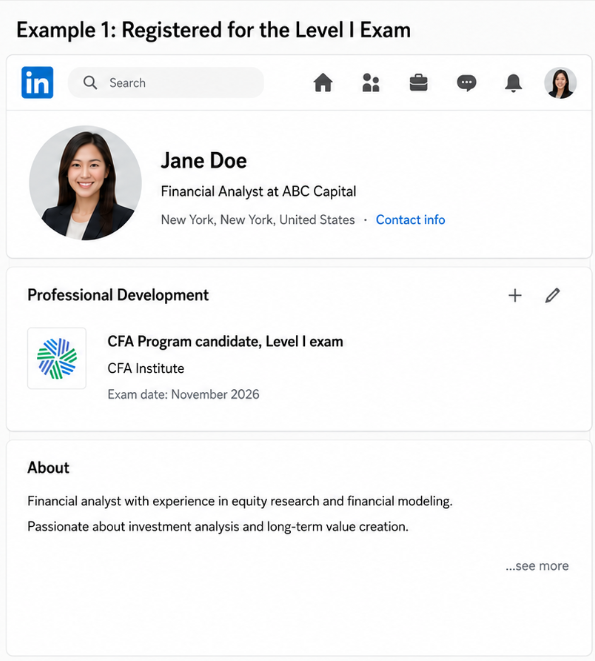
Professional Development
CFA Program candidate, Level I exam
CFA Institute
Exam date: November 2026
Use this format if you are registered for the Level I exam. You may include the exam month and year when it helps recruiters understand your timeline.
Example 2: Passed Level I
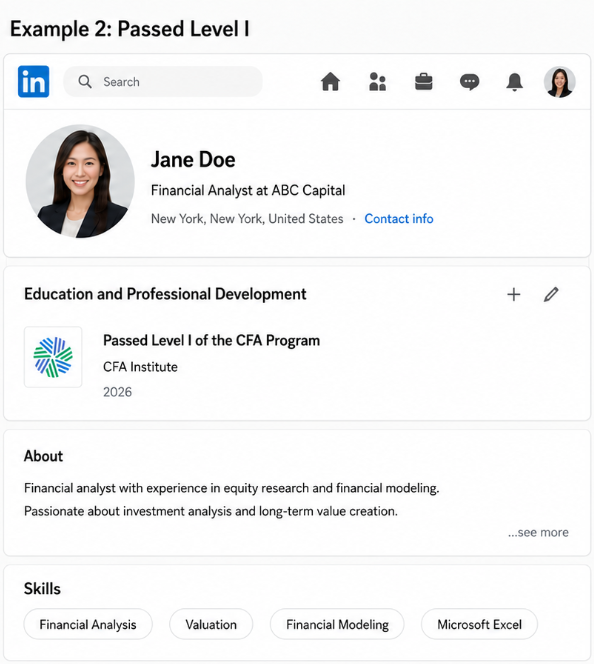
Education and Professional Development
Passed Level I of the CFA Program
CFA Institute
2026
This entry states your achievement directly. There is no need to describe Level I as a certification or place “CFA” after your name.
Example 3: Passed Level I and Registered for Level II
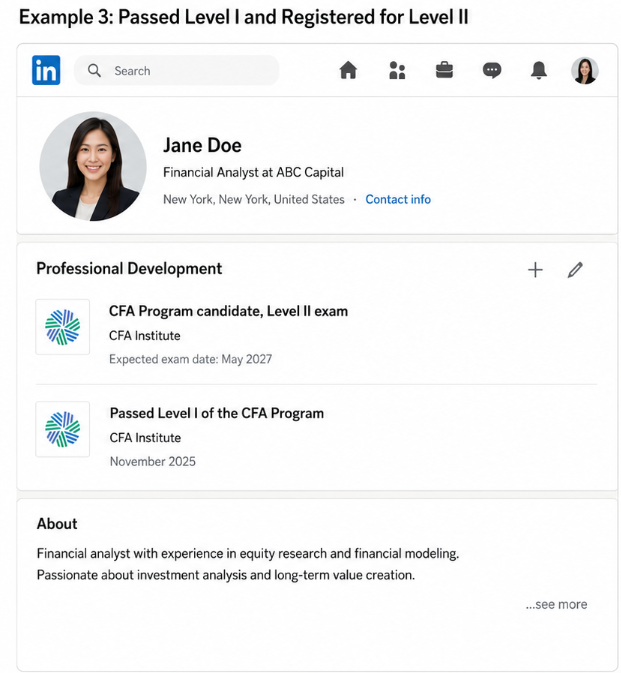
Professional Development
CFA Program candidate, Level II exam
Passed Level I of the CFA Program
CFA Institute
This format shows both your completed milestone and your current candidate status. It works well when Level II is relevant to the role you are applying for.
Example 4: Passed Levels I and II
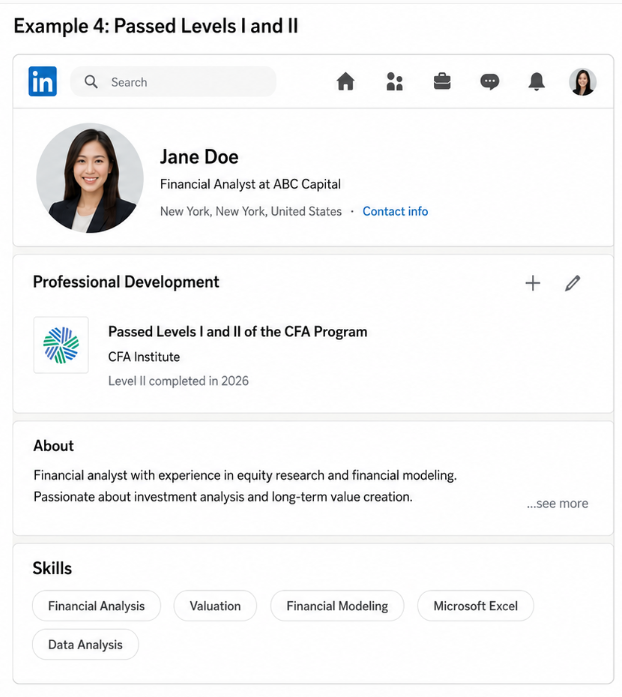
Professional Development
Passed Levels I and II of the CFA Program
CFA Institute
Level II completed in 2026
You can include the completion year if it helps establish when you reached the milestone. Keep the entry brief and avoid phrases such as “almost CFA.”
Example 5: Passed All Three Levels but Have Not Earned the Charter
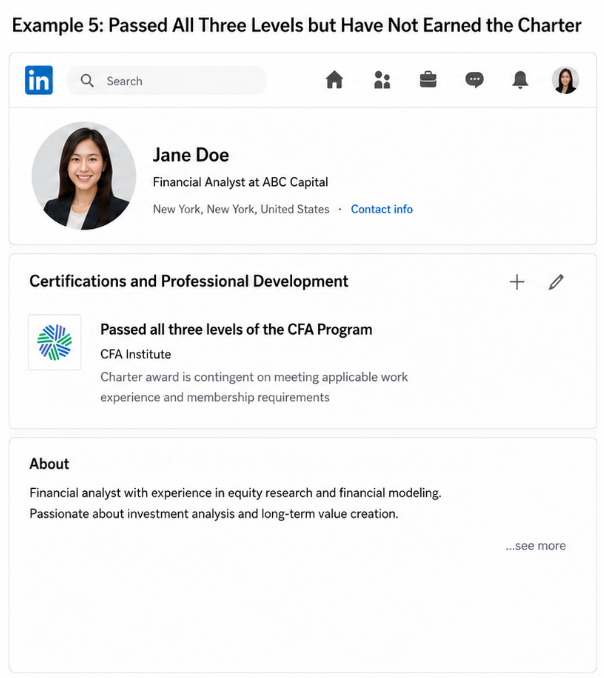
Certifications and Professional Development
Passed all three levels of the CFA Program
CFA Institute
Charter award is contingent on meeting applicable work experience and membership requirements
This format makes your exam progress clear while acknowledging that the charter requirements are still being completed.
Example 6: CFA Charterholder
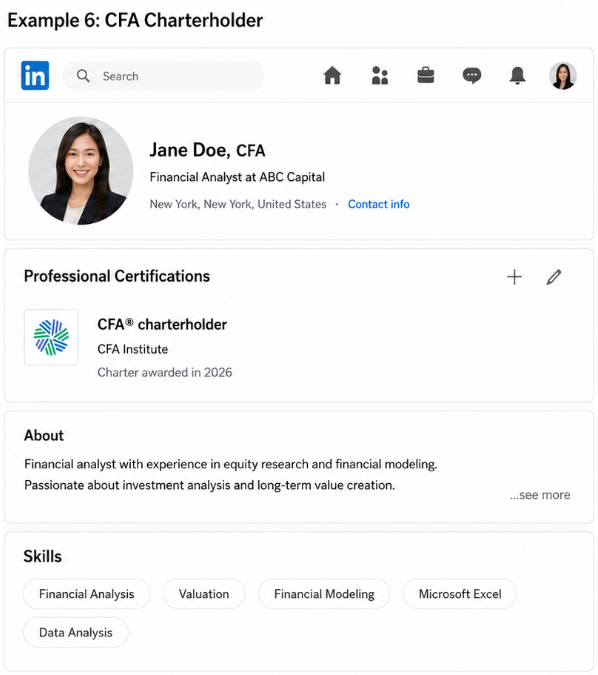
Resume Header
Jane Doe, CFA
Professional Certifications
CFA® charterholder
CFA Institute
Charter awarded in 2026
Use “CFA” after your name only if you have earned the charter and remain in good standing.
Where Should CFA on Resume Appear?
CFA progress usually belongs in the education, certifications, or professional development section. That placement keeps it visible without presenting it as a completed credential before the charter is awarded.
For candidates and people who have passed one or more levels, the education or professional development section often works best. It places your CFA progress alongside other formal learning and career development.
A certifications section may also work, particularly if your resume already includes professional qualifications. However, the wording must still make your exact status clear.
Use your resume header only when you are a CFA charterholder in good standing.
Resume Section | Best For | Why It Works |
|---|---|---|
Education | Candidates and passed levels | Places CFA progress beside formal academic learning |
Professional Development | Candidates, passed levels, and career changers | Shows continued professional growth |
Certifications | Passed levels or charterholders, with accurate wording | Keeps credential-related information together |
Name or Header | Charterholders in good standing only | This is where “Jane Doe, CFA” belongs |
Keep the entry proportionate to the rest of your resume. Relevant work experience, achievements, and technical skills should still receive more space than your CFA status.
How to Put CFA Level I on Resume
For Level I, your wording depends on whether you are registered, awaiting results, or have already passed.
If you are registered or waiting for your results, you can write:
CFA Program candidate, Level I exam
If you passed Level I, write:
Passed Level I of the CFA Program
That wording is clear enough. Passing Level I already shows discipline, finance knowledge, and commitment to the CFA path. Adding phrases such as “certified” or “partial CFA” creates unnecessary compliance risk.
Keep the entry in the education or professional development section, rather than beside your name. If you are still early in your preparation, our CFA Level I guide explains the curriculum, exam structure, and study process.
How to Show CFA Candidate on Resume Without Overstating It
Many people use the phrase “CFA candidate” casually, but “CFA Program candidate” is clearer and provides more context.
Use candidate wording when you are registered for an upcoming exam or awaiting results. If you passed Level I and have not registered for Level II, state that you passed Level I.
Better Wording | Wording to Avoid |
|---|---|
“CFA Program candidate, Level I exam” | “CFA candidate” with no level or context |
“Passed Level I of the CFA Program” | “CFA Level I certified” |
“Passed Levels I and II of the CFA Program” | “Partial CFA” |
“Passed all three levels of the CFA Program; charter award is contingent on meeting applicable work experience and membership requirements.” | “CFA charter pending” |
“Jane Doe, CFA” after earning the charter and remaining in good standing | “Jane Doe, CFA expected 2027” |
The entry should help a recruiter understand your progress within a few seconds. Direct wording usually communicates more than an inflated title.
How to Show CFA Progress on LinkedIn
Your LinkedIn profile should match your resume. Recruiters may compare the two, and inconsistent wording can raise questions even when the difference was accidental.
Avoid placing CFA candidacy in your LinkedIn headline. You should also avoid “expected CFA” language because the charter is not awarded automatically on a projected date.
Here are practical ways to show your status:
Status | LinkedIn Placement | Suggested Wording |
|---|---|---|
Registered or awaiting results | About section or relevant credential area | “CFA Program candidate, Level I exam” |
Passed Level I | About, Featured, or credential section | “Passed Level I of the CFA Program” |
Passed Level II | About, Featured, or credential section | “Passed Levels I and II of the CFA Program” |
Passed all three levels, but no charter yet | About or Featured section | “Passed all three levels of the CFA Program; charter award is contingent on meeting applicable work experience and membership requirements.” |
Charterholder in good standing | Name field and Licenses & Certifications | “Jane Doe, CFA” and “CFA® charterholder, CFA Institute” |
A LinkedIn entry for someone who passed Level I could look like this:
About
I work in financial analysis and recently passed Level I of the CFA Program. My studies have strengthened my foundation in financial statement analysis, ethics, quantitative methods, and investment analysis.
This format provides context without making the exam result sound like a standalone professional designation.
If CFA Institute issues you an official digital badge, use the badge provider’s verification link rather than recreating the badge yourself.
For detailed instructions, review CFA Institute’s achievement guidance.
How to Talk About CFA Progress in Job Interviews
In interviews, CFA progress works best when it supports a broader career story. Mention the exam when it helps explain your finance knowledge, discipline, or interest in the role.
A stronger answer goes beyond saying, “I am taking the CFA exams.” It explains what the process has helped you learn and how that knowledge applies to the position.
For example:
“I am preparing for Level I, which has helped me build a stronger foundation in ethics, financial reporting, quantitative methods, and investment analysis.”
“Passing Level I gave me a better understanding of how financial statements, valuation concepts, and investment decisions connect.”
“My Level II preparation has pushed me to apply valuation and financial analysis concepts to more detailed scenarios.”
“Studying for the CFA Program has made my learning more structured. I am comfortable working through a large body of material and testing my understanding through practice.”
Tailor the answer to the role. For an equity research position, focus on financial statement analysis, valuation, and investment reasoning. For portfolio-related work, discuss asset classes, risk, portfolio construction, and ethics.
Your interview answer should still reflect your real experience. CFA study can strengthen your technical foundation, but employers will also want examples of how you have applied that knowledge through work, projects, internships, or personal analysis.
Common CFA Resume Mistakes to Avoid
Most CFA resume mistakes come from making progress sound like a completed credential. These errors are easy to prevent once you know which phrases create problems.
Avoid:
Adding “CFA” after your name before earning the charter.
Writing “CFA Level I” after your name.
Calling yourself “CFA certified.”
Using “expected CFA” or “CFA expected [year].”
Calling yourself a charterholder before completing the work experience and membership requirements.
Using “CFA charter pending.”
Placing candidate wording in your resume headline.
Making your CFA progress more prominent than your relevant work experience.
Using different status wording on your resume and LinkedIn profile.
Review the entry whenever your status changes. Passing an exam, registering for the next level, receiving results, and earning the charter may each require an update.
How KeyPoint Helps You Keep Progress Moving
A resume entry becomes more valuable as you continue moving through the CFA Program. Once your current status is described correctly, the practical next step is building a study routine that supports your next exam.
A clear study path helps you decide what to study, when to begin practice questions, and how to check your progress. Lessons, practice quizzes, mock exams, and progress tracking can give each study session a clearer purpose.
KeyPoint Learning is built for candidates studying around work, university, or other commitments. You can begin with a CFA study plan or compare CFA study packages when you are ready to choose a preparation option.
Continue Your CFA Level I Prep With KeyPoint
Use structured lessons, practice questions, mock exams, and progress tracking to focus on the time you have left
Show Your CFA Progress With the Right Wording
Knowing how to put CFA on resume comes down to accuracy. State your current status, place it in the appropriate section, and use consistent wording across your resume and LinkedIn profile.
Registered candidates can use CFA Program candidate wording. People who have passed a level should state the completed level. Charterholders in good standing can add “CFA” after their names.
Once the entry is correct, turn your attention back to the next step. Build a study schedule you can maintain, practise consistently, and update your professional profiles whenever your official status changes.
FAQs About How to Put CFA on Resume
How Do I Put CFA on Resume if I Am a Candidate?
Place it in your education or professional development section using wording such as “CFA Program candidate, Level I exam.” Use candidate wording when you are registered for an upcoming exam or awaiting results. Do not add “CFA” after your name.
Can I Write CFA Candidate on Resume?
“CFA Program candidate” is the clearer wording. Use it only when you are registered for an upcoming exam or awaiting results. If you passed a level and are not currently registered for the next exam, state the level you passed instead.
How Do I Put CFA Level 1 on Resume?
If you are registered or awaiting results, write “CFA Program candidate, Level I exam.” If you passed Level I, write “Passed Level I of the CFA Program.” Keep the entry in your education or professional development section.
Can I Put CFA After My Name if I Passed Level I?
No. “CFA” after your name is reserved for charterholders in good standing. You can still list your Level I result by writing “Passed Level I of the CFA Program.”
Where Should CFA on Resume Appear?
Candidates and people who have passed individual levels should place their CFA progress in the education, professional development, or certifications section. Charterholders in good standing can place “CFA” after their names and include the charter in their certifications section.
How Should I Discuss CFA Progress in Interviews?
Connect your progress to the role. Explain how your studies have strengthened relevant areas such as ethics, financial analysis, valuation, investment reasoning, portfolio management, or disciplined long-term learning.