
Updated for the 2026-2027 CFA® Level I curriculum.
A country's exchange rate regime determines how much its currency's value is allowed to move and who controls that movement. This note classifies regimes on a spectrum from hard pegs to independent floats and compares their tradeoffs. CFA Level I candidates need to identify a regime from its stated rules and explain what a country gives up or gains under each system.
Quick Answer
Exchange rate regimes range from arrangements with no separate currency (currency unions and currency boards) through conventional and crawling pegs to managed and independent floats. Each point on the spectrum trades exchange-rate stability for monetary-policy autonomy.
Fixed regimes need large reserves and strict discipline to defend a parity.
Floating regimes need no reserves for defense but accept more currency volatility.
A regime's official label does not always match how the central bank actually manages the currency, so candidates must read the stated rules, not just the name.
Key Takeaways
Hard pegs, including currency unions and currency boards, eliminate an independent monetary policy and require full reserve backing of the monetary base.
Currency boards legally commit to converting domestic currency into a reserve currency at a fixed rate, backed one-to-one by reserves.
Conventional pegs fix the currency to another currency or basket but allow a narrow trading band and periodic realignment.
Crawling pegs and target bands allow a preannounced, gradual adjustment path instead of a single fixed rate.
Managed floats involve central bank intervention without a published rate target, so the degree of control stays discretionary.
Independent floats let supply and demand set the rate, with intervention limited to smoothing excess volatility.
Reserve holdings and monetary autonomy move in opposite directions across the spectrum: more fixity requires more reserves and less independent policy.
What You Need to Know for CFA Level I
Identify a regime type from a description of its intervention rules, parity commitment, and reserve use.
Compare the benefits and costs of fixed versus flexible regimes.
Explain the mechanics of defending a peg, including reserve use and interest rate alignment.
Recognize the loss of monetary autonomy under fixed regimes as a central tradeoff.
Distinguish exchange-rate regime classification from central bank inflation or interest rate targeting, which is a separate topic.
Avoid treating all "fixed" regimes as identical; hard pegs, currency boards, and conventional pegs carry different credibility and reserve requirements.
The Exchange-Rate Regime Spectrum
Exchange rate regimes sit on a spectrum. On one end, a country gives up its own currency or locks its value with full legal backing. On the other end, the market sets the rate with little or no government involvement.
No separate legal tender and currency unions
A country adopts another country's currency or joins a monetary union, giving up its own currency entirely. There is no exchange rate to manage because there is no separate currency.
Currency boards
The central bank legally commits to exchanging domestic currency for a specified foreign currency at a fixed rate. The monetary base must be fully backed by foreign reserves. This removes discretionary monetary policy because the money supply moves only with reserve inflows and outflows.
Conventional (fixed) pegs
The currency is fixed to another currency or a basket of currencies, usually within a narrow band (commonly plus or minus one percent). The central bank intervenes to defend the parity but is not bound by the strict reserve-backing rule of a currency board.
Pegged with crawling bands or crawling pegs
The parity adjusts on a preannounced schedule, often to reflect inflation differentials. This gives some accommodation for economic differences while preserving a predictable path.
Managed floating
The central bank intervenes to influence the rate without committing to a specific level or path. The degree and timing of intervention is discretionary and often undisclosed.
Independent floating
The exchange rate is determined mainly by market supply and demand. The central bank may intervene occasionally to reduce excessive volatility but does not target a rate level.
Moving left to right on this spectrum, exchange rate stability decreases and monetary policy autonomy increases. Reserve requirements decrease from left to right. Vulnerability to speculative attack is highest in conventional pegs and crawling arrangements, where the parity is visible but the commitment is less than a currency board's legal backing.
How Fixed and Pegged Regimes Work
A fixed or pegged regime commits to a specific parity against a reference currency. Defending that parity requires active management.
When market demand for the domestic currency falls below the level needed to hold the parity, the currency faces depreciation pressure. The central bank defends the peg by selling foreign reserves and buying domestic currency, which reduces the domestic money supply. If reserves run low, the bank may raise domestic interest rates to attract capital inflows and support the currency.
When demand for the domestic currency rises above the level needed to hold the parity, the currency faces appreciation pressure. The bank buys foreign reserves and sells domestic currency, which increases the domestic money supply.
Pressure-Response Flow
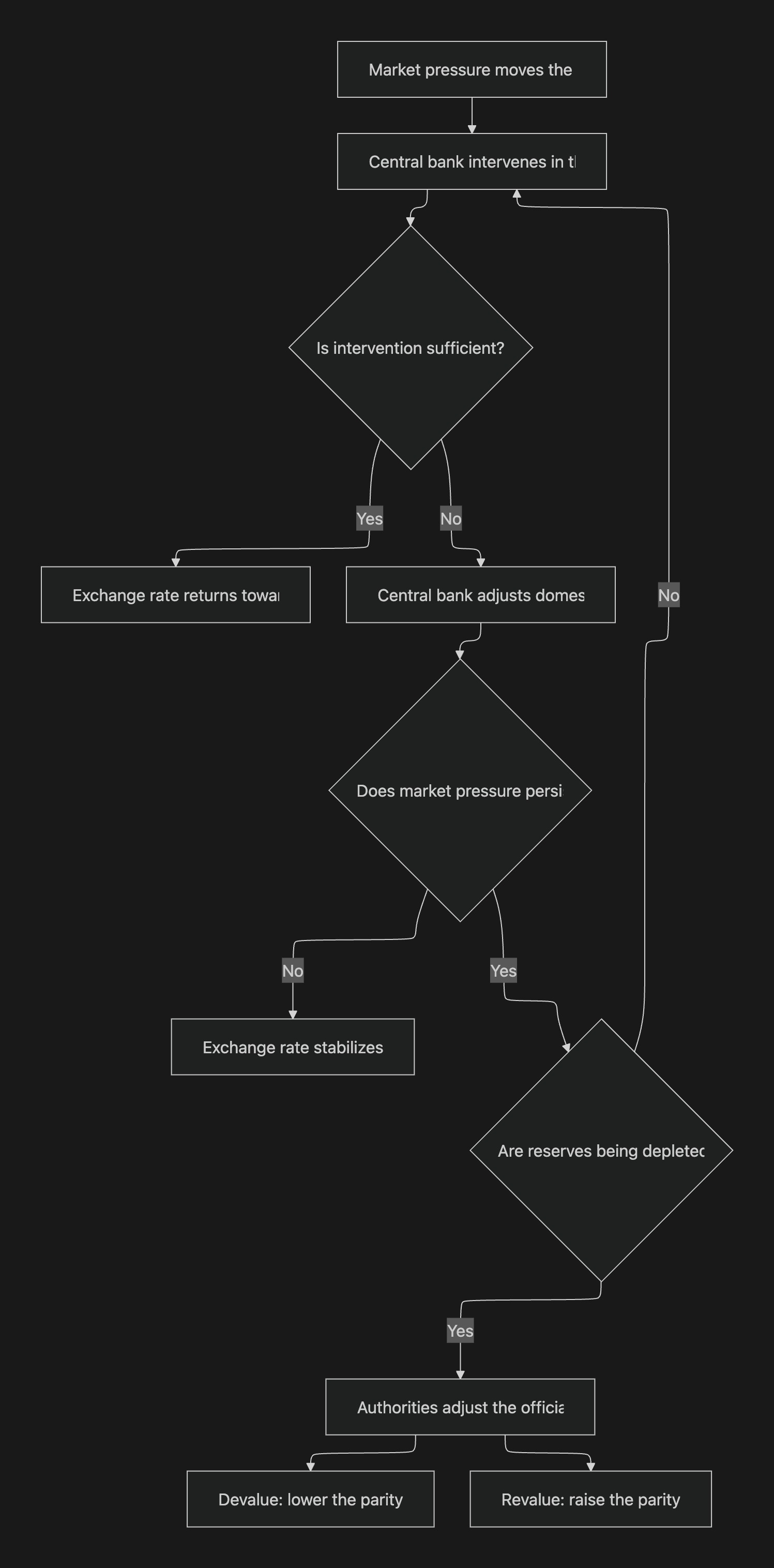
Market pressure moves the exchange rate away from parity.
Central bank intervenes in the foreign exchange market using reserves.
If intervention is insufficient, the central bank adjusts domestic interest rates.
If the pressure persists and reserves are depleted, the authorities may devalue (lower the parity) or revalue (raise the parity).
A sustained loss of reserves signals weak credibility. Markets test pegs they believe are unsustainable, which is why speculative attacks cluster around conventional pegs with visible parities and limited reserves. Capital controls can reduce this pressure by limiting capital outflows, but this note covers that only at the level of brief mention; the mechanics and effects of capital restrictions belong on a separate note.
How Managed and Floating Regimes Work
In a floating regime, the exchange rate responds to shifts in currency supply and demand from trade flows, capital flows, and interest rate differentials. No parity exists to defend, so the central bank holds no obligation to intervene.
Independent floating regimes allow this market process to operate with minimal interference. The central bank may step in occasionally to calm disorderly trading, but it does not attempt to steer the rate toward a target level.
Managed floating regimes involve more active and frequent intervention. The central bank buys or sells currency to influence the rate's direction or speed of movement, but it does not announce a specific target rate or band. This distinguishes a managed float from a crawling peg: a crawling peg publishes its adjustment path, while a managed float's intervention rule stays discretionary and often unstated.
Comparison With Fixed Systems
Feature | Fixed / Pegged | Floating (Managed or Independent) |
|---|---|---|
Published rate target | Yes | No |
Reserve requirement to defend rate | High | Low to none |
Monetary policy autonomy | Limited or none | Retained |
Exchange rate volatility | Low, until a crisis | Higher, day to day |
Main adjustment channel | Reserves and interest rates | Market price movement |
A managed float still allows monetary policy independence because the central bank is not legally bound to hold a rate. This is a common point of confusion: the presence of intervention does not mean the regime behaves like a peg.
Choosing and Comparing Exchange-Rate Regimes
No single regime works best for every country. The right choice depends on several structural features.
Trade openness
Economies with heavy trade dependence on one partner may prefer a fixed rate against that partner's currency to reduce transaction uncertainty.
Inflation history and credibility
A country with a history of high inflation may adopt a hard peg or currency board to import credibility from a stable anchor currency.
Reserve capacity
Defending a peg requires reserves. Countries with limited reserves face higher risk under fixed regimes.
Capital mobility
Open capital accounts make pegs harder to defend because capital can move quickly in response to perceived weakness.
Shock type
Countries facing frequent country-specific shocks benefit from floating rates, which let the currency absorb the shock instead of forcing a change in interest rates or fiscal policy.
Regime Benefit-Cost Comparison
Regime Type | Main Benefit | Main Cost |
|---|---|---|
Hard peg / currency board | High credibility, low inflation risk | No monetary autonomy, high reserve need |
Conventional peg | Exchange rate certainty for trade | Vulnerable to speculative attack |
Crawling peg / band | Predictable gradual adjustment | Still requires reserve defense |
Managed float | Some stability with retained flexibility | Intervention rules unclear to markets |
Independent float | Full monetary autonomy, shock absorption | Exchange rate volatility |
There is no universal best regime. The tradeoff is always between exchange-rate stability and policy flexibility, shaped by a country's specific economic structure.
Worked Example
Three fictional economies illustrate the classification task.
Vantoria: Currency Board
Vantoria operates a currency board. Its central bank holds foreign reserves equal to 100% of the domestic monetary base and is legally required to exchange domestic currency for the reserve currency at a fixed rate of 4 vantors per reserve unit, on demand.
Classification: Currency board.
Benefit: High credibility. The legal backing makes the commitment difficult to reverse, which anchors inflation expectations.
Vulnerability: No independent monetary policy. If Vantoria faces a recession, the central bank cannot lower interest rates to stimulate demand without threatening the reserve backing.
Halberg: Managed Float
Halberg does not publish a target rate. Its central bank buys and sells its currency in the foreign exchange market at its own discretion, based on internal assessments of excessive volatility.
Classification: Managed float.
Benefit: Retains monetary policy autonomy while reducing sharp day-to-day swings in the exchange rate.
Vulnerability: Markets cannot predict intervention timing or size, which can create uncertainty for importers and exporters pricing contracts.
Sorenna: Independent Float
Sorenna allows its currency's value to move freely based on trade and capital flows. Its central bank has not intervened in the foreign exchange market in over five years.
Classification: Independent float.
Benefit: Full monetary policy independence. The central bank sets interest rates based only on domestic objectives.
Vulnerability: Exchange rate volatility can raise costs for firms with foreign currency exposure and complicate import price forecasting.
Classification depends on the stated rules, not the outcome. Vantoria's legal commitment and full reserve backing place it at the fixed end of the spectrum.
Halberg's undisclosed, discretionary intervention places it in the managed middle.
Sorenna's absence of intervention and market-driven rate place it at the floating end.
Each economy accepts a different tradeoff between exchange-rate stability and policy autonomy.
Common Exam Traps
Confusing a managed float with a fixed peg. A managed float involves intervention, but without a published target rate. Candidates sometimes assume any intervention means a fixed regime. Check whether a specific parity or band is stated.
Assuming a peg requires no reserves or policy adjustment. All pegs require active defense. Even currency boards require full reserve backing; a peg is not a passive, cost-free commitment.
Treating all fixed systems as identical. A currency board's legal backing differs sharply from a conventional peg's discretionary intervention. Currency boards carry higher credibility and lower devaluation risk than conventional pegs.
Ignoring the loss of monetary autonomy. Fixed and pegged regimes limit the central bank's ability to set interest rates independently. Candidates who focus only on exchange-rate stability miss this core tradeoff.
Using exchange-rate targeting and exchange-rate regime as interchangeable terms. A regime describes the overall exchange-rate framework. Targeting language often belongs to central bank policy discussions and should not be merged with regime classification on the exam.
Practice Question
A central bank publishes no specific exchange rate target. It intervenes in the foreign exchange market at unscheduled intervals, using foreign reserves to moderate large swings in its currency's value. It has not announced a parity or an adjustment schedule.
Which exchange rate regime does this description best match?
Conventional fixed peg
Managed floating
Independent floating
Correct Answer: B
The central bank intervenes using reserves, which rules out independent floating (no active management toward a rate objective). It does not announce a parity, adjustment band, or schedule, which rules out a conventional fixed peg. Undisclosed, discretionary intervention without a published target is the defining feature of a managed float.
Option A. Conventional fixed peg is incorrect. A conventional peg requires a stated parity or band, which this description does not include.
Option C. Independent floating is incorrect. Independent floats limit intervention to occasional smoothing of disorderly markets, not regular use of reserves to moderate swings.
Continue Your CFA Level I Prep With KeyPoint
Use structured lessons, practice questions, mock exams, and progress tracking to focus on the time you have left
FAQs About Exchange Rate Regimes
What are the main types of exchange-rate regimes?
Regimes range from hard pegs and currency boards through conventional and crawling pegs to managed and independent floats. Each type differs in reserve requirements, monetary policy autonomy, and how the rate adjusts to market pressure.
How does a fixed exchange rate limit monetary policy?
A fixed rate requires the central bank to prioritize defending the parity over domestic objectives like inflation or employment. Interest rate decisions must support the peg, which removes the flexibility to respond independently to local economic conditions.