
Updated for the 2026-2027 CFA® Level I curriculum.
Central banks steer the economy by easing or tightening monetary conditions. This note contrasts expansionary and contractionary monetary policy by instrument direction, intended financial conditions, typical macro effects, use cases, and risks.
Level I candidates need to classify a central bank's action and separate the intended stance from what the economy actually delivers. This distinction shows up repeatedly in exam vignettes that describe a rate decision alongside other signals.
Quick Answer
Expansionary monetary policy lowers policy rates, adds liquidity, or signals future easing to make credit cheaper and support borrowing, spending, and growth.
Contractionary monetary policy raises rates, withdraws liquidity, or signals future tightening to make credit more expensive and slow demand and inflation. The stance describes intent. The outcome depends on transmission, lags, and how markets interpret guidance.
Key Takeaways
Expansionary policy uses rate cuts, asset purchases, and liquidity facilities to ease financial conditions.
Contractionary policy uses rate increases, asset sales or non-reinvestment, and liquidity withdrawal to tighten financial conditions.
Easing lowers borrowing costs and typically supports growth and inflation; tightening raises borrowing costs and typically restrains both.
Interest-rate effects are direct. Currency effects depend on relative rates abroad and market expectations, so they are not automatic.
A central bank can ease or tighten stance without changing its policy rate, through guidance or balance-sheet actions.
Context matters. Expansionary policy fits weak growth or below-target inflation; contractionary policy fits overheating or above-target inflation.
Intended stance and realized inflation or growth outcome are not the same thing. Lags separate the two.
What You Need to Know for CFA Level I
Classify a described action (rate change, asset purchase or sale, reserve requirement change, forward guidance) as expansionary or contractionary.
Trace the expected direction through financial conditions: credit cost, credit availability, and asset prices.
Recognize that policy works with a lag, so current inflation or growth does not confirm the stance.
Know that exchange-rate response to a rate change is conditional, not guaranteed.
Explain the risk of overdoing either stance: asset bubbles and inflation from too much easing, or weak growth and credit stress from too much tightening.
Keep comparisons of inflation targeting, exchange-rate targeting, and other regimes on Central Bank Policy Targets; this note covers direction and effects only.
Expansionary Monetary Policy
Expansionary policy is the easing stance. A central bank uses it when growth is weak, unemployment is high, or inflation sits below target.
The core tools are a policy rate cut, outright asset purchases, new liquidity facilities for banks, and forward guidance that signals lower rates ahead. Each tool works through the same action-channel-effect flow:
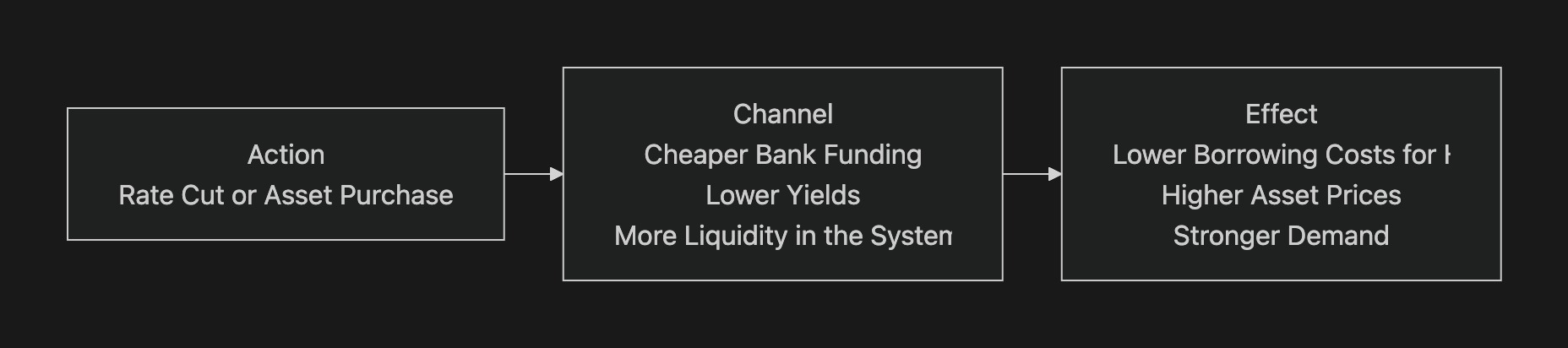
Cheaper credit encourages firms to invest and households to borrow and spend. Investors often bid up asset prices when yields fall, which supports wealth and further spending. The intended result is stronger aggregate demand and, over time, upward pressure on inflation.
The risk runs in the same direction. Extended easing can push inflation above target or inflate asset prices beyond levels supported by fundamentals. Both outcomes matter to the exam because they show why a central bank does not ease indefinitely even when growth stays soft.
Contractionary Monetary Policy
Contractionary policy is the tightening stance. A central bank uses it when inflation runs above target or when demand growth threatens price stability.
The tools mirror the easing set. A policy rate increase, asset sales or a decision not to reinvest maturing securities, and guidance signaling further rate increases all reduce liquidity and raise funding costs. The flow mirrors the easing framework:
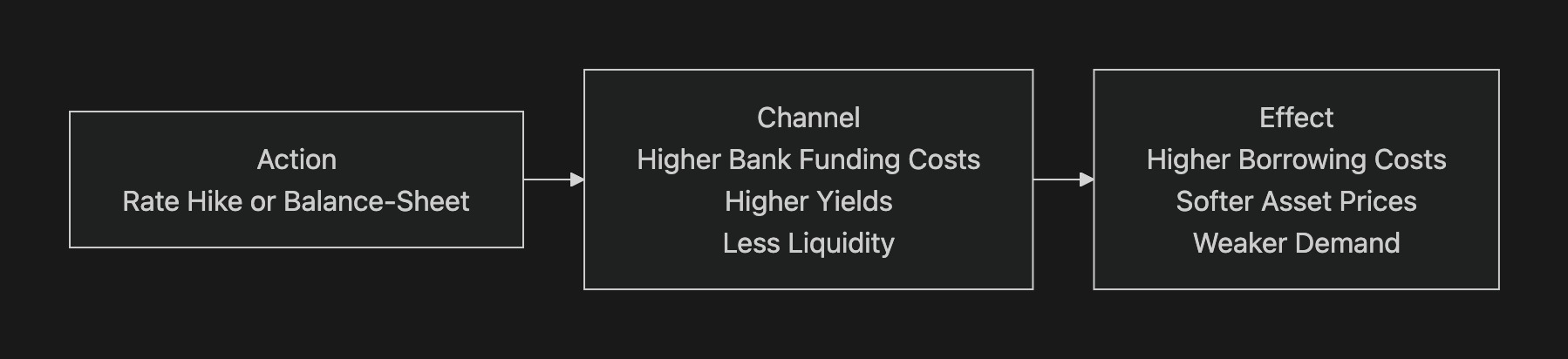
Higher borrowing costs discourage investment and consumer credit use. Slower demand growth eases upward pressure on prices. This is the intended path from tightening to lower inflation.
The risk here is overtightening. Raising rates too far or too fast can slow growth more than needed and create credit stress for borrowers carrying variable-rate debt.
Do not assume tightening guarantees currency appreciation. A rate increase raises the return on holding that currency, all else equal, but capital flows also respond to relative growth prospects, risk sentiment, and expectations about future policy elsewhere. The exchange-rate response is conditional, not automatic.
Expansionary vs Contractionary Monetary Policy Comparison
The table below summarizes the contrast for quick review before the exam.
Dimension | Expansionary Policy | Contractionary Policy |
|---|---|---|
Typical tools | Rate cuts, asset purchases, new liquidity facilities | Rate increases, asset sales or non-reinvestment, liquidity withdrawal |
Immediate financial effect | Lower funding costs, more liquidity | Higher funding costs, less liquidity |
Growth | Tends to strengthen, other factors held constant | Tends to slow, other factors held constant |
Inflation | Tends to rise over time if demand strengthens | Tends to ease over time if demand slows |
Interest rates | Fall across the curve, generally | Rise across the curve, generally |
Exchange rate | May depreciate if rate differentials narrow, but response depends on relative conditions abroad | May appreciate if rate differentials widen, but response depends on relative conditions abroad |
Main risk | Overheating, asset-price inflation | Overtightening, credit stress, weaker growth |
Treat the exchange-rate row as conditional. Two central banks can cut rates by the same amount and see different currency outcomes if market expectations or foreign policy differ. This table addresses monetary policy only; fiscal policy stance is a separate topic and is not covered here.
How to Identify the Policy Stance
Exam vignettes often mix signals. Use this checklist to classify the stance without guessing:
Check the current action. Did the policy rate move, and in which direction?
Check guidance. Did the central bank signal a future rate path, even without an immediate rate change?
Check balance-sheet activity. Is the central bank buying, selling, or letting securities mature without reinvestment?
Compare to the baseline. A held rate with dovish guidance and new asset purchases is expansionary, even though the rate itself did not move.
Confirm it is a stance change, not routine operations. Day-to-day liquidity operations that keep short-term rates on target do not signal a new stance.
A single liquidity operation is not evidence of a stance shift. Look for the combination of action, guidance, and balance-sheet direction before classifying.
Worked Example
The Republic of Vantara's central bank holds its policy rate at 4.00% at its latest meeting. In the same statement, it says it expects to cut rates "over the coming quarters if inflation continues to slow" and announces it will begin purchasing government bonds starting next month.
Step 1: Classify the current action. The policy rate itself is unchanged. Taken alone, this looks neutral.
Step 2: Check guidance. The bank signals a lower future rate path. This is forward-looking easing language.
Step 3: Check balance-sheet activity. New bond purchases add liquidity and put downward pressure on longer-term yields.
Step 4: Combine the signals. Guidance plus asset purchases point to an expansionary stance, even though the policy rate did not move this meeting.
Interpretation: Market interest rates can move before the policy rate changes because guidance and asset purchases affect financial conditions directly. Bond yields typically fall on the announcement, ahead of any future rate cut. This is why candidates must read the full statement, not just the rate decision, to classify the stance correctly.
Common Exam Traps
Reversing purchase and sale effects. Asset purchases add liquidity and ease conditions; asset sales or non-reinvestment remove liquidity and tighten conditions. Mixing these up flips the entire answer.
Treating unchanged rates as neutral. A held rate with dovish or hawkish guidance, or with ongoing balance-sheet action, still carries a stance. Ignore the guidance and you will misclassify the answer.
Equating expansionary policy with economic expansion. Expansionary policy is an intended easing stance. Whether the economy actually expands depends on transmission lags and other conditions. The two are not synonyms.
Assuming currency response is unconditional. A rate cut does not guarantee depreciation. Relative rates abroad, growth prospects, and risk sentiment all influence the exchange-rate outcome.
Confusing intended stance with realized inflation. A central bank can run an expansionary stance for months before inflation responds. Do not read current inflation data as proof the stance has not changed.
Practice Question
A central bank raises its policy rate by 25 basis points at its meeting. In the same announcement, it confirms it will continue reinvesting all proceeds from maturing government bonds, keeping its balance sheet unchanged.
Which best describes the overall monetary policy stance, and why?
Expansionary, because continued reinvestment keeps liquidity conditions unchanged and offsets the rate increase.
Contractionary, because the rate increase raises funding costs even though the balance sheet is held steady.
Neutral, because an unchanged balance sheet and a small rate move cancel each other out.
Correct Answer: B
The rate increase is the active policy signal here. It raises funding costs across the economy, which is the defining feature of a contractionary stance. Holding the balance sheet steady is a routine operational choice, not an offsetting easing action; it does not add new liquidity, so it does not cancel the tightening effect of the rate hike.
Option A. This choice mistakes an unchanged balance sheet for an active easing move. Reinvestment maintains existing conditions; it does not inject new liquidity. Weighs the rate action correctly and does not overstate the balance-sheet effect.
Option C. This choice assumes a routine operational decision offsets an active rate increase. A held balance sheet is not equivalent in size or direction to a rate change.
Continue Your CFA Level I Prep With KeyPoint
Use structured lessons, practice questions, mock exams, and progress tracking to focus on the time you have left
FAQs About Expansionary vs Contractionary Monetary Policy
What makes monetary policy expansionary?
A policy counts as expansionary when it eases financial conditions. This can come from a rate cut, new asset purchases, added liquidity facilities, or guidance signaling future rate cuts. The rate itself does not have to move for the stance to be expansionary.
Can monetary policy be expansionary without a rate cut?
Yes. A central bank can hold its policy rate steady and still run an expansionary stance through asset purchases or guidance pointing to lower rates ahead. Candidates should check guidance and balance-sheet activity, not just the rate decision, before classifying the stance.