
Updated for the 2026-2027 CFA® Level I curriculum.
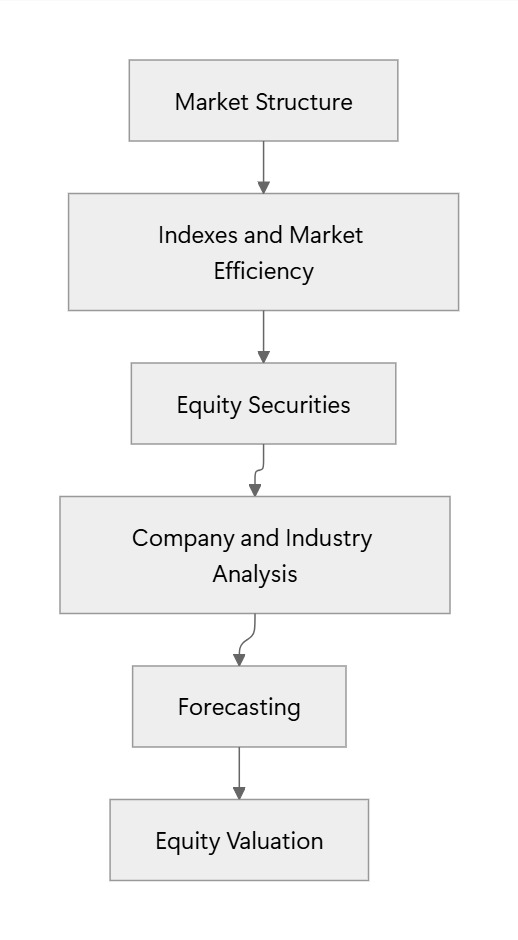
Use this hub to move through the CFA Level I Equity Investments curriculum in a logical order. It connects market structure, security market indexes, market efficiency, equity securities, company analysis, forecasting, and equity valuation.
Each linked note focuses on one testable concept. Start with the first reading if the topic is new, or jump to a specific section when reviewing.
Quick Answer
CFA Level I Equity Investments explains how equity markets work, how companies and industries are analyzed, how financial results are forecast, and how common stock valuation methods estimate intrinsic value. The 2026 topic contains eight official readings. The most effective sequence is to learn the market setting first, build company forecasts next, and finish with valuation.
Key Takeaways
Equity Investments covers trading and market structure, indexes, efficiency, equity securities, company and industry analysis, forecasting, and valuation.
The readings form a sequence: understand the market, analyze the business, forecast financial performance, and estimate value.
Keep market value, book value, and intrinsic value separate. They answer different questions.
A valuation model is only as reliable as the cash flow, growth, profitability, and risk assumptions that support it.
Know when to use present value models, price or enterprise value multiples, and asset-based methods.
Practice both calculations and interpretation because CFA questions often test the meaning of an input or result.
CFA Level I Equity Investments Topics and Syllabus
The 2026 curriculum organizes Equity Investments into eight readings:
Market Organization and Structure
Security Market Indexes
Market Efficiency
Overview of Equity Securities
Company Analysis: Past and Present
Industry and Competitive Analysis
Company Analysis: Forecasting
Equity Valuation: Concepts and Basic Tools
The first four readings explain the market environment and the securities being traded. The next three build the evidence and forecasts used in company analysis. The final reading applies that work to stock valuation.
How the Equity Investments Concepts Connect
Market structure affects how orders are executed, how prices form, and how easily investors can trade. Indexes then summarize market performance, while market efficiency explains how quickly available information may be reflected in prices.
Equity security features determine ownership rights, risk, return, and financing effects. Company and industry analysis turn those features into a structured view of business quality, competitive position, and financial performance.
Forecasting converts operating assumptions into expected revenue, expenses, working capital, investment, and financing. Equity valuation models use those forecasts to estimate intrinsic value or compare a company with similar firms.
CFA Level I Equity Investments Study Notes
Work through the notes in reading order for full coverage. During review, use the descriptions to find the exact concept or calculation you need.
1. Market Organization and Structure
Main Functions of the Financial System: Understand how financial systems allocate capital, transfer risk, and support price discovery.
Asset and Market Classifications: Distinguish the asset and market classifications used to organize investment opportunities.
Securities, Currencies, Contracts, Commodities, and Real Assets: Separate securities, currencies, contracts, commodities, and real assets by their economic features.
Financial Intermediaries and Their Services: Match financial intermediaries with their trading, funding, liquidity, and risk-management services.
Investor Positions in Assets: Interpret long, short, leveraged, and ownership positions and the exposures they create.
Margin Transactions: Leverage, Returns, and Margin Calls: Calculate leveraged returns, maintenance margin, and the price that triggers a margin call.
Execution, Validity, and Clearing Instructions: Compare execution, validity, and clearing instructions and their effects on an order.
Market Orders vs Limit Orders: Choose between the execution certainty of market orders and the price control of limit orders.
Primary vs Secondary Markets: Distinguish new security issuance from trading between investors after issuance.
Quote-Driven, Order-Driven, and Brokered Markets: Compare dealer, auction, and brokered market structures and how each matches buyers and sellers.
Characteristics of a Well-Functioning Financial System: Identify the liquidity, transparency, low costs, and informational qualities of effective markets.
Objectives of Market Regulation: Explain how regulation supports investor protection, fair dealing, market integrity, and stability.
2. Security Market Indexes
Security Market Indexes: Value, Price Return, and Total Return: Calculate an index value, price return, and total return while treating distributions correctly.
Index Construction and Management: Trace how an index provider defines a market, selects securities, and maintains the benchmark.
Index Weighting Methods: Compare price, equal, market-capitalization, and fundamental weighting methods.
Calculating Index Values and Returns by Weighting Method: Calculate index values and returns under different weighting methods and interpret their biases.
Index Rebalancing and Reconstitution: Distinguish rebalancing of constituent weights from reconstitution of index membership.
Uses and Types of Security Market Indexes: Match security market indexes with benchmarking, market measurement, research, and investment products.
Equity Indexes: Compare broad-market, sector, style, and other equity index categories.
Fixed-Income and Alternative Investment Indexes: Explain the construction challenges of fixed-income and alternative investment indexes.
3. Market Efficiency
Market Efficiency and Factors Affecting Efficiency: Analyze how information, transaction costs, market participants, and trading limits affect efficiency.
Market Value vs Intrinsic Value: Distinguish an observed market price from an analyst's estimate of intrinsic value.
Forms of Market Efficiency and Investment Implications: Compare weak-form, semi-strong-form, and strong-form efficiency and their investment implications.
Market Anomalies and Behavioral Finance: Evaluate market anomalies and behavioral explanations without assuming excess returns will persist.
4. Overview of Equity Securities
Types, Classes, and Voting Rights of Equity Securities: Distinguish equity types, share classes, ownership rights, and voting structures.
Public vs Private Equity Securities: Compare public and private equity in liquidity, disclosure, valuation, governance, and exit options.
Investing in Non-Domestic Equity Securities: Assess the structures, currency effects, costs, and governance risks of non-domestic equity investing.
Risk and Return Characteristics of Equity Securities: Explain the return potential, downside exposure, and risk characteristics of equity securities.
Role of Equity Securities in Company Financing: Describe how equity provides permanent capital, financial flexibility, and potential control rights.
Market Value vs Book Value of Equity: Separate accounting book value from the market's assessment of a company's equity.
Cost of Equity, Accounting ROE, and Investors’ Required Return: Connect accounting return on equity, the cost of equity, and investors' required return.
5. Company Analysis: Past and Present
Elements of a Company Research Report: Organize a company research report around the business, industry, forecasts, valuation, risks, and conclusion.
Determining a Company’s Business Model: Analyze how a company creates value through its customers, products, resources, and revenue model.
Revenue, Revenue Drivers, and Pricing Power: Break revenue into volume, price, mix, and other drivers, then assess pricing power.
Operating Profitability and Working Capital Analysis: Assess margins, operating efficiency, liquidity, and working-capital management.
Capital Investments and Capital Structure Analysis: Evaluate capital intensity, capital expenditure, financing choices, and capital structure.
6. Industry and Competitive Analysis
Purpose and Steps in Industry and Competitive Analysis: Apply a disciplined process to define an industry, identify drivers, and assess competition.
Industry Classification and Company Grouping Methods: Choose useful industry classifications and peer groups for comparable analysis.
Industry Size, Growth, Profitability, and Market Share Trends: Evaluate industry size, growth, profitability, concentration, and market-share trends.
Porter’s Five Forces and PESTLE Analysis: Use Porter's Five Forces and PESTLE analysis to assess competitive and external pressures.
Competitive Strategy and Company Position: Compare competitive strategies and judge whether a company's position is defensible.
7. Company Analysis: Forecasting
Forecasting Financial Results and Position: Principles and Approaches: Build internally consistent forecasts using historical, trend, and driver-based approaches.
Forecasting Company Revenues: Forecast revenue with top-down and bottom-up methods tied to operating drivers.
Forecasting Operating Expenses and Working Capital: Forecast operating expenses and working capital using cost behavior, margins, and turnover.
Forecasting Capital Investments and Capital Structure: Forecast capital expenditure, depreciation, financing needs, debt, and equity consistently.
Scenario Analysis in Forecasting: Use base, upside, and downside scenarios to test uncertainty and key sensitivities.
8. Equity Valuation: Concepts and Basic Tools
Overvalued, Fairly Valued, and Undervalued Securities: Compare market price with estimated intrinsic value to classify a security's valuation.
Equity Valuation Model Categories: Uses, Advantages, and Disadvantages: Select among present value, multiple-based, and asset-based equity valuation models.
Dividends, Stock Splits, Share Repurchases, and Dividend Payment Chronology: Explain how dividends, stock splits, and repurchases affect shareholders, prices, and share counts.
Present Value Models: Dividend Discount and FCFE Models: Value equity by discounting expected dividends or free cash flow to equity.
Preferred Stock Valuation: Value preferred stock as a perpetuity when its dividend is fixed and continuing.
Gordon Growth and Two-Stage Dividend Discount Models: Apply constant-growth and two-stage dividend discount models with appropriate assumptions.
Price Multiples and Fundamental Drivers: Interpret price multiples through their fundamental drivers, including growth, profitability, and risk.
Comparable Company Valuation Using P/E, P/OCF, P/S, and P/B: Select comparable companies and apply P/E, P/OCF, P/S, and P/B multiples consistently.
Enterprise Value Multiples: Use enterprise value multiples with measures available to all capital providers.
Asset-Based Valuation Models: Estimate value from assets less liabilities and recognize when asset-based methods are most useful.
How to Study CFA Level I Equity Investments
Start with market organization. Learn the participants, instruments, orders, trading venues, and regulatory purpose before tackling indexes.
Study index construction as a process. Define the market, select constituents, choose a weighting method, calculate returns, and maintain the index.
Separate observed price from estimated value. Market efficiency concerns how information enters prices, not whether every price is always correct.
Analyze the business before building a forecast. Identify the business model, revenue drivers, cost structure, working-capital needs, capital investment, and financing.
Build forecasts in a linked order. Revenue drives many expenses and working-capital accounts, while investment plans affect depreciation and financing.
Finish with valuation model selection. Match the model to the company's cash flows, growth pattern, capital structure, and available comparable firms.
After each reading, answer focused questions. Then combine topics so that market, forecasting, and valuation ideas are tested together.
Common CFA Level I Equity Investments Exam Traps
Confusing the primary market, where issuers raise capital, with the secondary market, where investors trade existing securities.
Treating a market order as price certain or a limit order as execution certain.
Mixing price return with total return by omitting or double-counting distributions.
Confusing index rebalancing, which resets weights, with reconstitution, which changes constituents.
Assuming market efficiency means prices are always equal to intrinsic value.
Using market value, book value, and intrinsic value as if they were interchangeable.
Forecasting income-statement and balance-sheet items independently, which can create inconsistent results.
Mismatching the numerator and denominator of a multiple, such as pairing enterprise value with a measure available only to equity holders.
Using the Gordon growth model when the required return is not greater than the sustainable growth rate.
Selecting comparable companies by industry label alone without checking business model, growth, profitability, and risk.
Practice CFA Level I Equity Investments
Use the study notes to review one concept at a time, then solve questions without looking at the explanation. For calculation topics, write the formula, define each input, calculate the answer, and state what the result means.
After completing all eight readings, use mixed practice sets. Move between market structure, indexes, company analysis, forecasting, and valuation so the sequence becomes automatic.
Related CFA Level I Resources
Continue Your CFA Level I Prep With KeyPoint
Use the full Equity Investments directory above for targeted review, then combine it with a study schedule and mixed practice. KeyPoint Learning's CFA Level I study packages can help organize the remaining topics and practice into one plan.
FAQs About CFA Level I Equity Investments
What does CFA Level I Equity Investments cover?
It covers how markets and indexes work, how equity securities are structured, how analysts assess companies and industries, how financial results are forecast, and how equity is valued.
How many Equity Investments readings are in the 2026 CFA Level I curriculum?
There are eight official readings in the 2026 curriculum, from Market Organization and Structure through Equity Valuation: Concepts and Basic Tools.
Where should I start studying Equity Investments?
Start with Market Organization and Structure. It provides the vocabulary and market context used in the index, efficiency, security, analysis, and valuation readings.
Which calculations should I know?
Focus on margin and leverage, index values and returns, index weighting, forecasting relationships, present value models, dividend discount models, price multiples, enterprise value multiples, and asset-based valuation.
What is the difference between market value, book value, and intrinsic value?
Market value is the price investors currently assign to equity. Book value is the accounting value of equity on the balance sheet. Intrinsic value is an analyst's estimate based on expected benefits, growth, and risk.
How should I study equity valuation models?
First understand the company's operating and financial drivers. Then match the model to the available cash flows, growth pattern, capital structure, and comparable-company evidence. Check every model's assumptions before interpreting the result.