
Updated for the 2026-2027 CFA® Level I curriculum.
The financial system connects people who have money to invest with people and businesses who need money. This reading asks you to describe the functions the system performs as a whole, not just list the institutions inside it.
CFA Level I tests whether you can separate a system-level function from a service provided by one bank, broker, or exchange. After reviewing this note, you should be able to name each function and match it to a short scenario.
Quick Answer
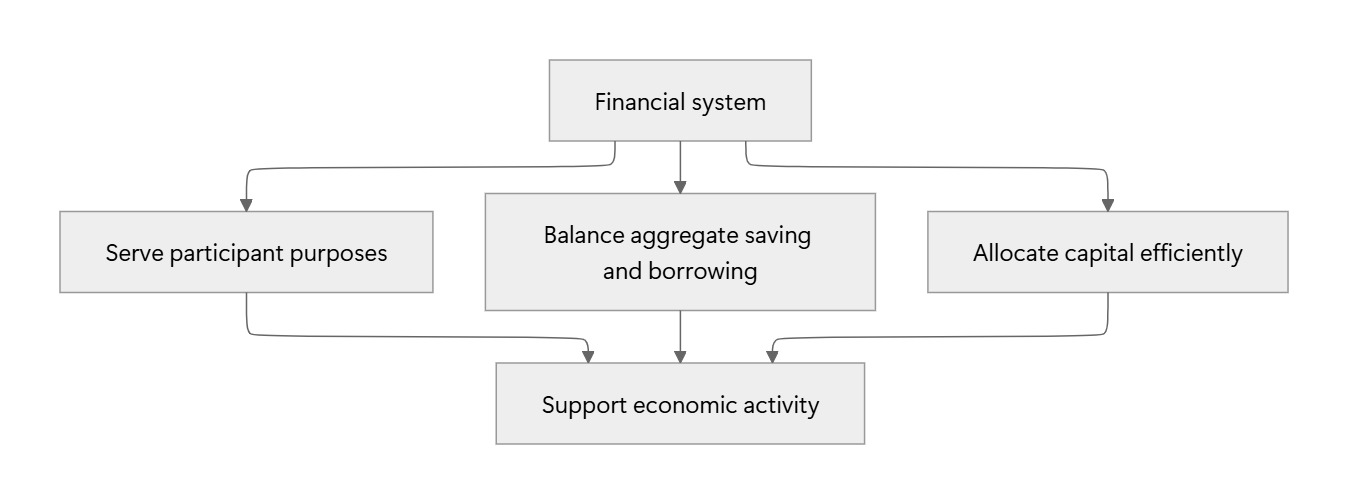
The financial system performs three main functions. It helps individuals and businesses achieve six specific purposes: saving, borrowing, raising equity capital, managing risk, exchanging assets for immediate delivery, and trading on information. It helps determine the rate of return that equates aggregate savings with aggregate borrowing in the economy. It helps allocate capital to its most efficient uses, a result called allocational efficiency. Exam questions test whether you can match a scenario to the correct function.
Key Takeaways About Main Functions of the Financial System
The financial system serves six purposes for participants: saving, borrowing, raising equity capital, managing risk, exchanging assets for immediate delivery, and information-motivated trading.
Beyond serving individual purposes, the system sets the rate of return that balances total savings with total borrowing across the economy.
The system directs capital toward its most productive uses. This result is called allocational efficiency.
A single intermediary, such as a bank or broker, provides a service. The financial system as a whole performs functions that no single institution can replicate alone.
Prices that reflect available information support efficient capital allocation. Information-motivated trading helps make this happen.
Level I questions often describe a transaction and ask which function it illustrates, not which institution handled it.
Mixing up a specific service with a system-level function is a common and testable mistake.
What You Need to Know for CFA Level I
Identify and describe each of the six purposes individuals and businesses have for using the financial system.
Explain how the financial system determines a rate of return that equates aggregate savings and aggregate borrowing.
Explain how the financial system supports allocational efficiency by directing capital to its most productive uses.
Distinguish a system-level function from a service performed by one intermediary, exchange, or market.
Apply these functions to a short scenario and identify which one is being illustrated.
The Main Functions Performed by the Financial System
The financial system performs three broad functions. Two of them, savings/borrowing rate discovery and allocational efficiency, work at the level of the entire economy. The third works at the level of the individual participant.
Helping Participants Achieve Six Purposes
People and businesses use the financial system for six reasons. Each reason maps to a specific type of transaction.
Purpose | What It Means | Example |
|---|---|---|
Saving | Moving current income into the future | Buying a bond to fund retirement |
Borrowing | Moving future income into the present | Taking a mortgage to buy a house |
Raising equity capital | Selling ownership shares to fund a business | A company completes an IPO |
Managing risk | Reducing exposure to an unwanted risk | Buying a put option to hedge a stock position |
Exchanging assets for immediate delivery | Trading an asset now instead of saving, borrowing, or hedging | A firm buys foreign currency on the spot market to pay an overseas supplier |
Information-motivated trading | Trading because you believe the current price is wrong | Buying a stock you believe is undervalued after research |
These six purposes explain why any single trade happens. They do not explain how the system as a whole benefits the economy. That is where the next two functions come in.
Determining the Rate of Return That Equates Savings and Borrowing
Savers want a return on their money. Borrowers want to pay as little as possible. The financial system brings these two groups together and produces a rate of return where aggregate savings equal aggregate borrowing. This rate influences interest rates across the economy and affects how much capital is available for new investment.
Allocating Capital to Its Most Efficient Uses
Capital is limited. The financial system helps direct it toward projects and companies expected to generate the highest risk-adjusted returns. Economists call this result allocational efficiency. When prices reflect available information accurately, capital tends to flow to its best use rather than being wasted on weaker projects.
How These Functions Support Investors, Issuers, and Economic Activity
Investors rely on the system to save, manage risk, and act on research. A person buying a bond is exercising the saving function. A portfolio manager buying a put option is exercising the risk management function.
Issuers rely on the system to raise capital. A company selling new shares in an IPO is using the equity capital function to fund growth without taking on debt.
The economy as a whole benefits when the system sets a fair rate of return and channels capital efficiently. Businesses with strong prospects get funded. Businesses with weak prospects have a harder time raising money. This selection process supports economic growth over time.
Distinguishing System-Level Functions From a Specific Intermediary's Services
This is the distinction Level I most often tests. A bank, exchange, or broker provides a service. The financial system performs a function. The service is the mechanism. The function is the economic result.
Scenario | Service Provided | System-Level Function Illustrated |
|---|---|---|
A bank offers a savings account | Deposit-taking service | Saving |
A broker executes a stock trade based on new earnings data | Trade execution service | Information-motivated trading |
An investment bank underwrites an IPO | Underwriting service | Raising equity capital |
A dealer quotes a bid and ask price for a bond | Market-making service | Contributes to price discovery, which supports allocational efficiency |
A question that names a specific institution is usually testing whether you can still identify the underlying function. Do not answer with the name of the institution's product. Answer with the function it serves.
Applying the Functions to a Short Exam Scenario
Exam questions typically give you one paragraph describing a transaction. Your job is to identify which function or purpose the transaction illustrates, then confirm your answer against the six purposes and the two economy-level functions.
Worked Example
Scenario. Nastan Corporation, a private manufacturer, sells new shares to the public for the first time to fund a new factory. An individual investor, Priya, buys 100 of these shares after reading Nastan's expansion plans and concluding the shares are undervalued. A separate investor, Marcus, buys a five-year put option on a stock index to protect his retirement portfolio against a market downturn.
Step 1: Identify Nastan's transaction.
Nastan is selling ownership shares to the public to fund an expansion. This matches the purpose of raising equity capital.
Step 2: Identify Priya's transaction.
Priya is buying shares because she believes the market price does not reflect Nastan's true value. This matches information-motivated trading.
Step 3: Identify Marcus's transaction.
Marcus is using an option to reduce exposure to a market decline. This matches managing risk.
One scenario can illustrate three different purposes at once. Nastan uses the system to raise capital. Priya uses the system to act on her research. Marcus uses the system to hedge risk. All three activities happen through the same financial system, but each represents a distinct function.
Common Exam Traps
Naming the institution instead of the function
A question may mention a bank, broker, or exchange. Focus on what economic purpose the transaction serves, not which institution processed it.
Treating allocational efficiency and rate-of-return determination as the same idea
Rate-of-return determination balances aggregate savings and borrowing. Allocational efficiency describes capital flowing to its best use. They are related but distinct.
Assuming information-motivated trading always means insider trading
Information-motivated trading simply means a trade based on a belief that current prices are wrong. It does not require material nonpublic information.
Picking a purpose that is close but not exact
Saving and borrowing are opposite sides of the same relationship, but they are not interchangeable. A mortgage is borrowing. A bond purchase is saving.
Practice Question
An investor sells a call option on a stock she owns to reduce the volatility of her overall position ahead of an earnings announcement. Which main function of the financial system does this transaction best illustrate?
Raising equity capital
Managing risk
Information-motivated trading
Correct Answer: B
The investor is not raising new capital and is not necessarily acting on a belief that the option or stock is mispriced. She is reducing exposure to an unwanted risk, which is the definition of the risk management purpose.
Option A: Raising equity capital applies to issuers selling new shares or ownership stakes, not to an existing shareholder adjusting a position.
Option C: Information-motivated trading requires a belief that the current price is wrong. The scenario gives no indication the investor is trading on a valuation view.
Continue Your CFA Level I Prep With KeyPoint
Use structured lessons, practice questions, mock exams, and progress tracking to focus on the time you have left
FAQs About Main Functions of the Financial System
Is liquidity a separate main function of the financial system?
Liquidity supports several functions, especially exchanging assets for immediate delivery and information-motivated trading, but the 2026 LOS groups it under these purposes rather than treating it as a fourth standalone function.
What is the difference between allocational efficiency and operational efficiency?
Allocational efficiency means capital flows to its most productive uses. Operational efficiency means transactions happen at low cost. Level I distinguishes these terms, and this note focuses only on allocational efficiency because that is what the LOS covers.
Can one transaction illustrate more than one function?
Yes. A single trade can involve saving, information-motivated trading, or risk management depending on the investor's intent. Exam questions usually specify enough detail to identify one primary function.