
Updated for the 2026-2027 CFA® Level I curriculum.
A primary market is where an issuer sells new securities and raises capital. A secondary market is where investors trade securities that already exist. This distinction matters because CFA Level I tests whether you can classify transactions correctly and explain why secondary market activity affects an issuer's ability to raise money in the primary market. After this note, you should be able to classify any transaction as primary or secondary and explain the link between the two.
Quick Answer
A primary market is where an issuer sells new securities directly to investors and receives the proceeds. A secondary market is where investors trade existing securities among themselves, with no new capital going to the issuer. The two markets are connected: investors buy new issues more willingly when they know a liquid secondary market will let them sell later. This liquidity lowers the issuer's cost of raising capital.
Key Takeaways About Primary vs Secondary Markets
Primary markets involve the sale of new securities, and the issuer receives the proceeds.
Secondary markets involve trading existing securities among investors, and the issuer receives nothing from these trades.
An IPO and a seasoned (follow-on) equity offering are both primary market transactions, even though the second one happens after the company already trades publicly.
Trading shares on an exchange or through a dealer is a secondary market transaction.
Secondary market liquidity lowers the return investors demand on new issues, which lowers the issuer's cost of capital.
Without an active secondary market, investors would demand higher compensation for holding illiquid securities, making it more expensive for issuers to raise money.
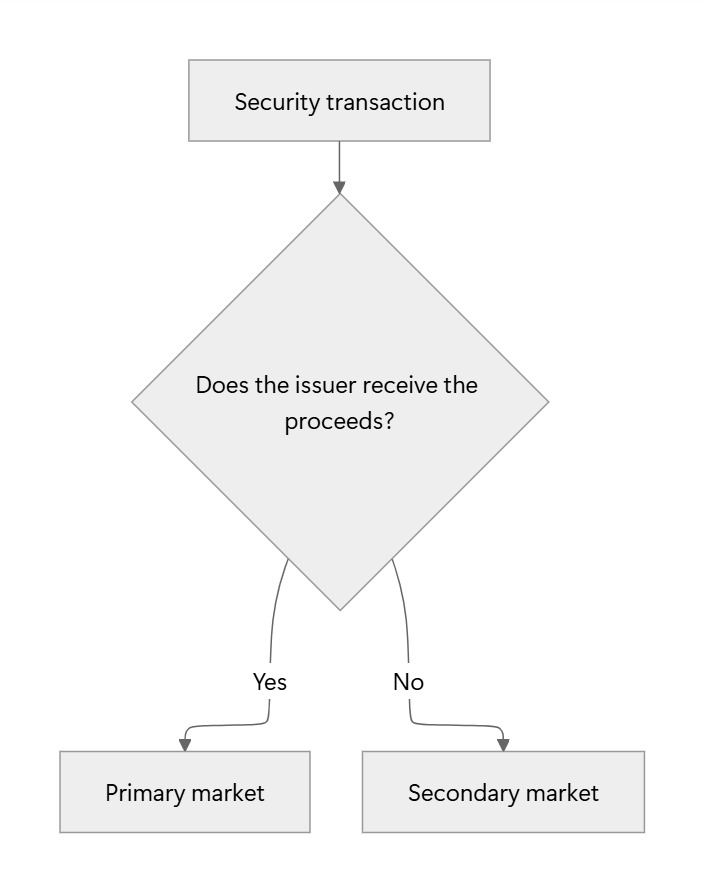
Classify any transaction with one question: does the issuer receive proceeds from this sale?
What You Need to Know for CFA Level I
Define primary markets and recognize examples, including IPOs, seasoned offerings, and private placements.
Define secondary markets and recognize examples, including exchange trading and dealer market trading.
Explain how secondary market liquidity supports primary market issuance and lowers the issuer's cost of capital.
Classify a given transaction as primary or secondary using the "who receives the proceeds" test.
Keep this concept separate from market structure topics like quote-driven and order-driven markets, which are tested in a different LOS.
Definition of Primary Markets
A primary market is where an issuer sells new securities to investors for the first time. The issuer receives the proceeds and uses them to fund operations, pay down debt, or invest in growth.
Common primary market transactions include:
Initial public offering (IPO). A company sells shares to the public for the first time.
Seasoned (follow-on) offering. A company that already trades publicly issues additional new shares.
Private placement. A company sells securities directly to a small group of investors instead of the public.
Rights offering. A company offers new shares to existing shareholders, usually at a discount.
Underwriters, typically investment banks, often help price and distribute these new securities. The key fact for this LOS is simple: in a primary market transaction, new securities are created and the issuer receives the money.
Definition of Secondary Markets
A secondary market is where investors trade securities that already exist. The issuer is not a party to these trades and receives no proceeds from them.
Common secondary market venues include:
Exchanges, such as centralized markets where buyers and sellers trade listed securities.
Dealer markets, where dealers buy and sell securities from their own inventory.
Over-the-counter (OTC) markets for securities not listed on a formal exchange.
If Investor A sells 100 shares of a company to Investor B on an exchange, the company that issued those shares receives nothing. Ownership simply transfers between the two investors. This is the core test for identifying a secondary market transaction.
How Secondary-Market Liquidity Supports Primary Issuance
This is the relationship the exam wants you to explain, not just define.
Secondary-Market Liquidity Lowers the Return Investors Require
Investors buying new securities in a primary offering want to know they can sell those securities later if they need cash or want to change their portfolio. A liquid secondary market gives them that option. If investors cannot easily resell a security, they demand a higher return to compensate for that illiquidity risk.
That higher required return translates directly into a higher cost of capital for the issuer. A liquid secondary market lowers the return investors demand, which lowers the price the issuer pays to raise money.
Price Discovery Helps Issuers Set Fair Offering Terms
Secondary markets also support primary issuance through price discovery. Trading activity in the secondary market produces continuous, observable prices. Issuers and underwriters can use these prices to set fair terms for new offerings, including follow-on offerings from companies that already trade publicly.
In short, secondary-market liquidity and price discovery make primary-market issuance cheaper and easier to execute.
How to Classify Transactions as Primary or Secondary
Use one test: does the issuer receive proceeds from this specific transaction?
If yes, it is a primary market transaction.
If no, it is a secondary market transaction.
This test works regardless of how established the company is. A company's tenth follow-on offering is still a primary market transaction, because the company receives the proceeds. A trade of that same company's shares on an exchange the next day is a secondary market transaction, because the company receives nothing.
Primary vs Secondary Markets: Comparison
Feature | Primary Market | Secondary Market |
|---|---|---|
Who sells the security | The issuer | An existing investor |
Who receives the proceeds | The issuer | The selling investor |
Main purpose | Raise new capital | Provide liquidity and price discovery |
Example transactions | IPO, follow-on offering, private placement | Exchange trading, dealer market trading |
Effect on shares outstanding | Increases | No change |
Worked Example
Scenario. Northfield Robotics Inc. completes an IPO, selling 2 million new shares at $20 per share. The company raises $40 million to fund research and development. Three months later, an investor who bought shares in the IPO sells 10,000 of those shares to another investor at $23 per share through a stock exchange.
Step 1: Classify the IPO
Northfield sells new shares and receives the $40 million in proceeds. The issuer is a direct party to the transaction and gets the money. This is a primary market transaction.
Step 2: Classify the later trade
The seller is an existing investor, not Northfield. The $230,000 from this trade goes to the selling investor, not to Northfield. This is a secondary market transaction.
Only the IPO raised new capital for Northfield. The later trade transferred ownership between two investors and set a market price for the stock, but it created no new funding for the company.
Common Exam Traps
Assuming all exchange activity is primary market activity
Some candidates think any trade happening "on the exchange" counts as primary because IPOs are often associated with exchange listings. Only the original sale by the issuer is primary. Every trade after that is secondary, even if it happens on the same exchange.
Confusing a seasoned offering with a secondary market trade
A seasoned or follow-on equity offering is a primary market transaction because the issuer receives the proceeds. do not let the word "secondary" in "secondary offering" (a common industry term) mislead you into calling it a secondary market transaction.
Forgetting the liquidity-to-cost-of-capital link
Candidates who memorize the two definitions but cannot explain why secondary market liquidity matters to issuers miss the core point of this LOS. The exam may ask you to explain the relationship, not just label a transaction.
Overgeneralizing into market structure topics
This LOS covers primary vs secondary markets, not order-driven vs quote-driven trading systems. Keep these two concepts separate, since they're tested independently.
Practice Question
Vantage Chemical Corp raised $15 million four years ago in its IPO. Last week, Vantage issued 500,000 new shares in a follow-on offering, raising $9 million for a new plant. This week, an investor sold 1,000 Vantage shares to another investor through a stock exchange at the prevailing market price.
Which of the following correctly classifies the follow-on offering and this week's exchange trade?
Follow-on offering: secondary market; exchange trade: secondary market
Follow-on offering: primary market; exchange trade: secondary market
Follow-on offering: primary market; exchange trade: primary market
Correct Answer: B
The follow-on offering involves Vantage selling new shares and receiving the $9 million in proceeds. This makes it a primary market transaction, regardless of the "follow-on" label or the fact that Vantage already trades publicly.
This week's exchange trade happens between two investors. Vantage is not a party to the trade and receives no proceeds, making it a secondary market transaction.
Option A: Incorrectly classifies the follow-on offering as secondary. The issuer received proceeds, so the transaction is primary regardless of timing after the IPO.
Option C: Incorrectly classifies the exchange trade as primary. The issuer wasn't a party to the trade and received none of the proceeds.
Continue Your CFA Level I Prep With KeyPoint
Use structured lessons, practice questions, mock exams, and progress tracking to focus on the time you have left
FAQs About Primary vs Secondary Markets
Is a follow-on (seasoned) equity offering a primary or secondary market transaction?
it is a primary market transaction. The company issues new shares and receives the proceeds, even though it already trades publicly.
Does the issuer benefit financially when investors trade its shares in the secondary market?
No. The issuer receives no proceeds from secondary market trades. Ownership simply transfers between investors.
Why do issuers care about secondary market liquidity if they do not receive money from secondary trades?
Liquid secondary markets lower the return investors require when buying new securities. This lowers the issuer's cost of capital in future primary market offerings.