
Key rate duration measures how much a bond's price changes when the yield at one specific maturity point on the curve moves, while the other key rates stay where they are. Most duration measures assume every rate moves together by the same amount. Real yield curves rarely behave that way, and that gap is exactly what this measure was built to capture.
Key rate duration measures a bond's price sensitivity to a yield change at a single maturity point on the yield curve, holding the other key rates constant. It shows where interest rate risk sits along the curve rather than treating the curve as one number. For CFA® Level I, focus on reading which maturity carries the most risk and how a non-parallel curve shift changes a bond's value.
Key Takeaways About Key Rate Duration
Key rate duration measures price sensitivity to a yield change at one point on the curve, not to the whole curve at once.
It is the right tool when the curve steepens, flattens, or twists instead of shifting up or down in parallel.
A higher key rate duration at a given maturity means the bond reacts more strongly to a change in that maturity's rate.
Adding the key rate durations across the curve gives a view of total duration exposure.
The measure helps you pinpoint where a bond or portfolio carries its largest interest rate risk.
A frequent error is treating key rate duration like modified duration, or assuming all rates move by the same amount.
What You Need to Know for CFA Level I
For the exam, keep your attention on a few core ideas:
Key rate duration isolates sensitivity to one maturity point on the yield curve.
It exists because real yield curves move unevenly, so a single duration number can hide where the risk really is.
A larger key rate duration means a stronger price reaction to that specific rate.
It is most useful for bonds or portfolios whose exposure is concentrated at certain maturities.
Unless a question states the shift is parallel, do not assume every rate moves by the same amount.
Most Level I questions on this topic test interpretation. You are far more likely to be asked which maturity drives the risk than to be asked for a long calculation.
What Is Key Rate Duration?
Key rate duration is a point-specific duration measure. It tells you how a bond or portfolio reacts when the rate at one chosen maturity changes and the rest of the curve holds still.
Broad measures like modified duration answer a different question. They estimate the price effect of a uniform move across the whole curve. That works when rates rise or fall together, but it says nothing about where along the curve the sensitivity comes from.
Yield curves often move in ways that are not parallel. The short end can rise while the long end falls. The middle can move while the ends stay put. When that happens, a single duration number averages everything together and hides the detail you need.
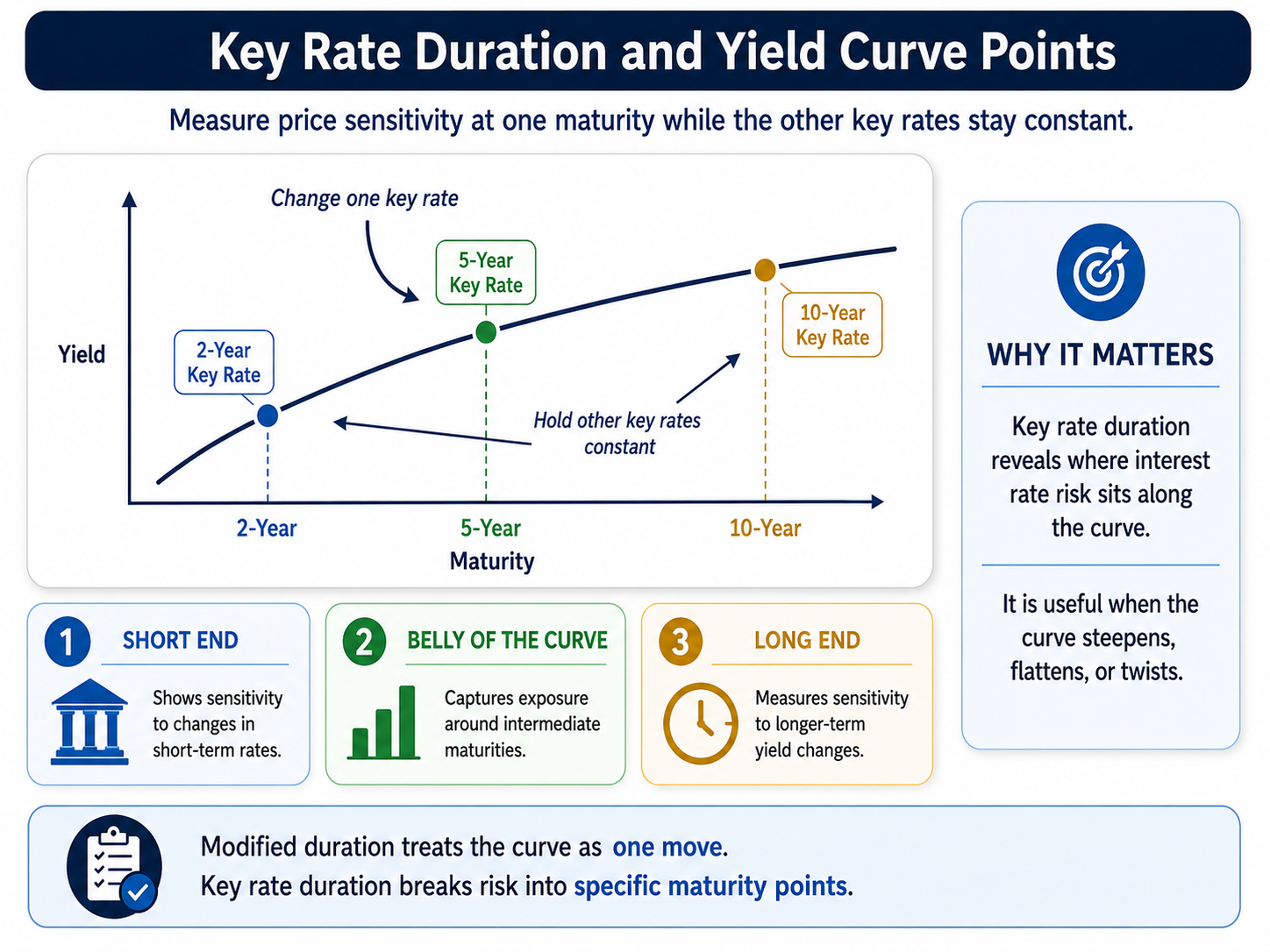
Key rate duration breaks the curve into selected maturities, often points like the 2-year, 5-year, and 10-year, and measures sensitivity at each one separately. The result is a profile rather than a single figure. You can see which maturity the bond leans on most, which is the whole point of the measure.
Key Rate Duration Formula and Interpretation
The key rate duration at a chosen maturity comes from repricing the bond twice: once with that single rate nudged down, and once with it nudged up.
Here is what each input means in plain terms:
Input | Meaning |
|---|---|
Price when the key rate falls | The bond's estimated price after the chosen maturity rate decreases, with all other key rates held constant |
Price when the key rate rises | The bond's estimated price after the chosen maturity rate increases, with all other key rates held constant |
Initial price | The bond's price before the key rate moves |
Change in key rate | The size of the rate move at the chosen maturity, entered as a decimal |
Once you have the values, reading them is straightforward:
Result | What It Means |
|---|---|
Higher key rate duration | The bond reacts more strongly to a change in that maturity's rate |
Lower key rate duration | The bond has less exposure to that maturity |
Highest key rate duration on the curve | The main source of the bond's yield curve risk |
Similar values across maturities | Interest rate exposure is spread fairly evenly across the curve |
Key Rate Duration vs Modified Duration
These two measures answer different questions, and the exam likes to test whether you know which is which.
Area | Key Rate Duration | Modified Duration |
|---|---|---|
Focus | One maturity point on the curve | The whole curve moving together |
Best used for | Non-parallel curve shifts | A parallel change in yields |
Question it answers | Where is the interest rate risk? | How sensitive is the bond overall? |
Common trap | Treating all maturity rates as if they move together | Ignoring the shape of the curve |
Think of modified duration as the summary and key rate duration as the breakdown. The summary tells you the total; the breakdown tells you where it comes from.
Example of Key Rate Duration
Suppose a fixed income portfolio has these key rate durations: 0.8 at the 2-year point, 2.1 at the 5-year point, and 4.0 at the 10-year point.
Maturity Point | Key Rate Duration |
|---|---|
2-year | 0.8 |
5-year | 2.1 |
10-year | 4.0 |
The 10-year value is the largest by a wide margin, so the portfolio's price is most sensitive to moves in the 10-year rate.
Now say the 10-year rate rises by a small amount while the 2-year and 5-year rates hold steady. Because the largest key rate duration sits at the 10-year point, this is the move that hits the portfolio hardest. The same rise applied only to the 2-year rate would barely register, since that point carries the smallest duration.
The takeaway is practical. If you wanted to reduce this portfolio's interest rate risk, the 10-year exposure is where you would start, because that is where the sensitivity is concentrated.
Common Exam Traps
Confusing key rate duration with modified duration. One isolates a single maturity; the other measures the whole curve moving together.
Assuming the curve always shifts in parallel. Key rate duration only earns its place when the shift is uneven, so watch for that wording in the question.
Forgetting that key rate duration looks at one maturity at a time. Each value is measured with the other key rates held constant.
Reading the highest key rate duration as the highest yield. It marks the point of greatest price sensitivity, not the richest rate.
Ignoring the direction of the rate change. A rate rise and a rate fall push the price in opposite directions, so the sign matters when you interpret the impact.
Practice Question
A bond has the following key rate durations:
Maturity Point | Key Rate Duration |
|---|---|
2-year | 1.2 |
5-year | 3.5 |
10-year | 1.0 |
Which yield curve change would most likely have the largest effect on the bond's price?
A 25 basis point rise in the 2-year rate only
A 25 basis point rise in the 5-year rate only
A 25 basis point rise in the 10-year rate only
Correct Answer: B
The bond's largest key rate duration is 3.5 at the 5-year point, so a rate change there moves the price more than the same change at any other maturity. A higher key rate duration means greater sensitivity to that specific rate.
Option A. Answer A points to the 2-year rate, where the duration is only 1.2, so the price effect would be smaller.
Option C. Answer C points to the 10-year rate, which has the lowest duration of the three at 1.0, making it the weakest of the three effects.
Since each option applies the same 25 basis point move, the maturity with the highest key rate duration drives the biggest price change.
Still Sitting Your Current Exam Window?
Use structured lessons, practice questions, mock exams, and progress tracking to focus the time you have left.
FAQs About Key Rate Duration
What is key rate duration in CFA Level I?
Key rate duration measures how much a bond's price changes when the rate at one specific maturity point on the yield curve moves, while the other key rates stay constant. It shows where a bond's interest rate risk sits along the curve.
Why is key rate duration useful?
Key rate duration measures how much a bond's price changes when the rate at one specific maturity point on the yield curve moves, while the other key rates stay constant. It shows where a bond's interest rate risk sits along the curve.
What is key rate duration in CFA Level I?
Key rate duration measures how much a bond's price changes when the rate at one specific maturity point on the yield curve moves, while the other key rates stay constant. It shows where a bond's interest rate risk sits along the curve.
How is key rate duration different from modified duration?
Modified duration measures a bond's broad price sensitivity to a yield change across the whole curve. Key rate duration isolates the sensitivity to one maturity point at a time, so it pinpoints where the risk is concentrated.
What does a higher key rate duration mean?
A higher key rate duration at a given maturity means the bond's price reacts more strongly to a change in that maturity's rate. The point with the highest value is usually the main source of the bond's yield curve risk.