
Updated for the 2026-2027 CFA® Level I curriculum.
Every behavioral bias in the CFA curriculum falls into one of two categories: cognitive errors or emotional biases. The split matters because it tells you where the bias comes from and how an advisor should respond to it.
Level I questions often describe an investor's behavior and ask you to classify it, then identify the correct response. Getting the category right is the whole question.
Quick Answer
A cognitive error comes from faulty reasoning or flawed information processing. An emotional bias comes from feelings, impulses, or intuition rather than logic.
This distinction matters on the CFA Level I exam because it determines the fix. Cognitive errors can usually be moderated with better information and reasoning. Emotional biases are harder to correct, so advisors typically adapt portfolios and advice around them instead.
Key Takeaways About Cognitive Errors vs Emotional Biases
Cognitive errors stem from reasoning mistakes; emotional biases stem from feelings and impulses.
Cognitive errors split into two subtypes: belief perseverance errors and information-processing errors.
Emotional biases have no clean subtypes. They arise directly from psychology, not a reasoning process.
Cognitive errors respond better to moderation, such as education, checklists, or decision frameworks.
Emotional biases are usually adapted to, not eliminated, because they resist correction through information alone.
The exam tests classification and response together. Naming the bias type is only half the answer.
What You Need to Know for CFA Level I
Know that all individual behavioral biases fall under two parent categories: cognitive errors and emotional biases.
Be able to name the two subtypes of cognitive errors: belief perseverance and information-processing errors.
Recognize that emotional biases arise from impulse or intuition, not from a flawed reasoning process.
Understand why cognitive errors are generally easier to moderate than emotional biases.
Understand why emotional biases are typically adapted to rather than corrected.
Practice classifying short investor statements as cognitive or emotional using context clues, not just keywords.
Connect each classification to the matching advisor response: moderate for cognitive, adapt for emotional.
Where This Fits: The Behavioral Biases of Individuals
The CFA curriculum organizes individual behavioral biases into a simple hierarchy.
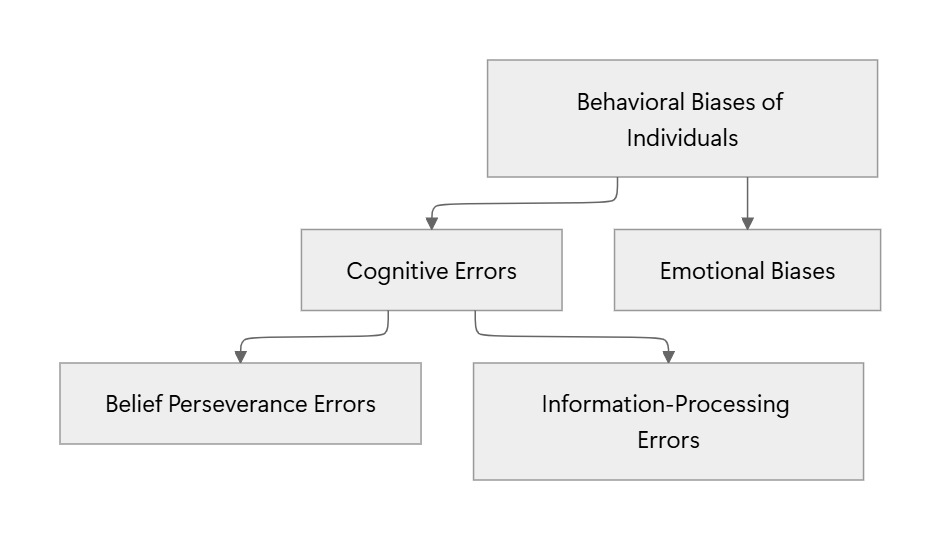
Cognitive errors and emotional biases sit at the same level. Neither is a subtype of the other. Belief perseverance and information-processing errors are the only two subtypes, and both sit under cognitive errors only. Emotional biases do not have subtypes in the curriculum. This structure is worth memorizing because exam questions sometimes test the hierarchy directly, not just the definitions.
Cognitive Errors: Belief Perseverance and Information-Processing Errors
A cognitive error happens when an investor reasons incorrectly. The investor is not driven by feeling. The investor's logic, statistics, or memory process breaks down somewhere.
Belief perseverance errors happen when an investor holds onto an original belief even after receiving new information that contradicts it. The investor is not ignoring the new data by accident. The investor is actively resisting it to protect an existing view.
Information-processing errors happen when an investor processes information in a way that leads to an illogical conclusion, even without clinging to a prior belief. The distortion happens in how the data is handled, not in a refusal to update.
Both subtypes are still cognitive because the root problem is reasoning, not emotion. Detailed lists of specific biases in each subtype (such as conservatism, anchoring, or mental accounting) are covered on the Common Behavioral Biases and Financial Decision-Making note. This note focuses on the category-level distinction the exam tests directly.
Emotional Biases
An emotional bias comes from feelings, impulses, or intuition rather than a reasoning error. The investor is not misusing information. The investor is reacting.
Emotional biases are harder to spot in a written question because they often look like ordinary human behavior: reluctance to sell a losing position, comfort with a familiar holding, or resistance to change. The signal is usually a stated feeling (fear, comfort, regret, attachment) rather than a stated fact or belief. When a question stem centers on how an investor feels, expect an emotional bias. When it centers on how an investor reasoned, expect a cognitive error.
Source and Correction Difficulty: The Key Difference
The most testable distinction between the two categories is how they respond to correction.
Cognitive errors can usually be moderated. Since the root cause is a reasoning process, better information, education, or a structured decision checklist can often fix the error. An advisor walks the client through the flawed logic and shows a better way to reach a conclusion.
Emotional biases are usually adapted to, not eliminated. Since the root cause is feeling rather than logic, presenting more information rarely helps and can even create resistance. Advisors typically build a portfolio or plan that works around the bias instead of trying to argue the client out of it.
This moderate-versus-adapt framework is the fastest way to answer classification questions. Identify the source of the behavior first. If it is a reasoning mistake, expect moderation. If it is a feeling, expect adaptation.
Cognitive Errors vs Emotional Biases at a Glance
The table below summarizes the distinction candidates need for Level I. Specific bias names and definitions are covered on the Common Behavioral Biases note, not here.
Dimension | Cognitive Errors | Emotional Biases |
|---|---|---|
Origin | Faulty reasoning or flawed information processing | Feelings, impulses, or intuition |
Subtypes | Belief perseverance errors; information-processing errors | None; treated as a single category |
How they show up | Investor cites a belief or misreads data | Investor describes a feeling or reaction |
Correction difficulty | Usually easier to correct | Usually harder to correct |
Typical advisor response | Moderate (education, checklists, better information) | Adapt (adjust the plan or portfolio around the bias) |
Worked Example
Maria, a CFA candidate, is reviewing notes from three client meetings. She wants to classify each statement as a cognitive error or an emotional bias, then decide whether the advisor should moderate or adapt.
Statement 1
"I already decided tech stocks will outperform this year, so I'm not interested in the report showing weaker earnings."
Step 1: Identify the source. The client is holding onto an existing belief despite contradicting data.
Step 2: Classify. This is a belief perseverance error, a cognitive error.
Step 3: Match the response. The advisor should moderate by walking through the new earnings data directly.
Statement 2
"I can't sell my father's old stock. It would feel like losing him twice."
Step 1: Identify the source. The reaction is driven by emotional attachment, not a belief about performance.
Step 2: Classify. This is an emotional bias.
Step 3: Match the response. The advisor should adapt, perhaps by keeping a small position while diversifying the rest of the portfolio.
Statement 3
"I'm putting my bonus in a separate account so I don't think of it as part of my real savings."
Step 1: Identify the source. The client is processing money into artificial categories rather than treating it as one pool.
Step 2: Classify. This is an information-processing error, a cognitive error.
Step 3: Match the response. The advisor should moderate by showing how the accounts function as one portfolio.
Two of the three statements are cognitive because they involve a belief or a data-processing pattern. One is emotional because it involves a feeling. The advisor's response changes based on that classification, which is exactly what Level I questions test.
Common Exam Traps
Treating every bias as emotional
Many candidates default to "emotional" whenever a question sounds irrational. Check whether the investor cites a belief or a data pattern first. That signals cognitive, not emotional.
Assuming cognitive errors are always easy to eliminate
Some cognitive errors, especially deep belief perseverance patterns, take real effort to moderate. "Easier to correct than emotional biases" does not mean "always simple to fix."
Confusing a bias category with a specific bias
Knowing that overconfidence or loss aversion exists is not the same as knowing which parent category it sits under. The exam can ask about the category without naming a specific bias at all.
Adding therapy or clinical claims
The curriculum discusses cognitive and emotional biases as decision patterns, not psychological diagnoses. Avoid answer choices that suggest clinical treatment or diagnosis language.
Skipping the response step
Classifying the bias correctly is only half the question. Many exam items also ask what the advisor should do next, so always connect the category to moderate or adapt.
Practice Questions
An advisor meets with a client who says, "I know the fund's returns have been weak for three years, but I still believe it will outperform once the market turns. I don't need to see the fund's report."
Which classification and advisor response best fits this statement?
Emotional bias; the advisor should adapt the portfolio to accommodate the client's comfort with the fund.
Cognitive error; the advisor should moderate the belief by reviewing the fund's performance data with the client.
Emotional bias; the advisor should moderate the belief through repeated exposure to positive market news.
Correct Answer: B
The client is holding onto an existing belief despite available contradicting information (weak returns for three years) and refusing to review new data. This is a belief perseverance error, a type of cognitive error. Because the root cause is a reasoning pattern, the advisor should moderate it directly with the fund's performance data.
Option A: Misclassifies the bias as emotional. The client's statement centers on a belief about future performance, not a feeling or attachment.
Option C: Correctly identifies moderation as useful but misclassifies the bias as emotional and pairs it with an unsupported technique (repeated exposure to news) that is not the curriculum's standard mitigation for this pattern.
Continue Your CFA Level I Prep With KeyPoint
Use structured lessons, practice questions, mock exams, and progress tracking to focus on the time you have left
FAQs About Cognitive Errors vs Emotional Biases
What is the basic difference between a cognitive error and an emotional bias?
A cognitive error comes from a reasoning mistake, such as clinging to a belief or misprocessing data. An emotional bias comes from a feeling or impulse rather than a logic error.
Are cognitive errors always easier to fix than emotional biases?
Generally yes, since they stem from reasoning and respond to better information. Some cognitive errors still take real effort to moderate, so "easier" does not mean "simple."
Why do advisors adapt to emotional biases instead of correcting them?
Emotional biases come from feelings, not flawed logic. Presenting more information rarely changes a feeling and can create resistance, so advisors usually adjust the plan instead.
Do emotional biases have subtypes like cognitive errors do?
Detailed answer text goes here. You can format this text or add links.