
Updated for the 2026-2027 CFA® Level I curriculum.
Every organization that takes financial risk needs a clear answer to one question: how much risk are we willing to accept? Risk tolerance in risk management is the organizational answer to that question. It shapes everything from position limits to escalation rules.
CFA Level I tests whether you understand how a stated tolerance turns into working controls, not just whether you can define the term.
Quick Answer
Risk tolerance in risk management describes the overall level of risk an organization is willing to accept while pursuing its objectives. It sits inside a broader risk management profile that also includes risk capacity, or the organization's financial ability to absorb losses.
Level I questions test whether candidates can trace tolerance down to specific limits and escalation procedures, and whether they can spot when a stated tolerance and actual practice do not match.
Key Takeaways About Risk Tolerance in Risk Management
Organizational risk tolerance sets the outer boundary for acceptable risk-taking across the firm.
Risk capacity is the objective, financial ability to bear losses. Risk tolerance is the willingness to accept risk, which can be more subjective and can shift over time.
A risk management profile links tolerance, capacity, and specific risk limits into one coherent framework.
Limits translate tolerance into numbers that traders, portfolio managers, and risk officers can act on.
Escalation procedures determine what happens when a limit is breached, which is where many organizations fail in practice.
Governance bodies, not individual managers, are usually responsible for setting and revising organizational tolerance.
What You Need to Know for CFA Level I
Define organizational risk tolerance and explain how it differs from risk capacity.
Identify where risk tolerance fits within a broader risk management profile.
Explain how tolerance is translated into measurable risk limits.
Recognize the role of escalation procedures when limits are breached.
Connect risk tolerance to risk budgeting and governance oversight.
Distinguish organizational risk tolerance from individual investor willingness to take risk, which is a separate topic.
Organizational Risk Tolerance: The Starting Point
Risk tolerance is the amount and type of risk an organization is willing to accept in pursuit of its goals. A pension fund, an insurance company, and a hedge fund each set different tolerances because their objectives, liabilities, and stakeholders differ.
Tolerance is not fixed. Boards and senior management review it periodically and adjust it when the organization's objectives, regulatory environment, or financial condition changes. A firm that reduces staff or faces new capital requirements may lower its risk tolerance even if nothing else about its strategy has changed.
Risk Capacity and Risk Appetite: Where the Curriculum Draws the Line
Level I candidates often blur three related terms. Each has a distinct meaning.
Term | What It Measures | Who Sets It |
|---|---|---|
Risk capacity | The objective financial ability to absorb losses without threatening solvency or core objectives | Determined by financial position, not by preference |
Risk tolerance | The willingness to accept risk in pursuit of objectives | Set by governance bodies, often reviewed periodically |
Risk appetite | The specific amount and type of risk an organization chooses to take on, given both capacity and tolerance | Expressed through policy and risk limits |
Capacity acts as a ceiling. An organization cannot rationally set tolerance above what its capacity allows, even if management is willing to take more risk. A well-capitalized insurer with strong reserves has high capacity. If its board sets a conservative tolerance anyway, actual risk-taking stays well below the ceiling that capacity would permit.
Risk Profile: Putting the Pieces Together
A risk management profile combines capacity, tolerance, and appetite into a single reference point for decision-making. It typically includes:
A description of the organization's financial capacity to absorb losses
A statement of tolerance approved by the board or risk committee
Specific risk appetite statements by risk type (market, credit, operational, liquidity)
Measurable limits derived from that appetite
The profile gives risk managers a consistent standard to measure proposed trades, exposures, or business decisions against.
From Tolerance to Limits and Escalation
A stated tolerance means little without limits that enforce it day to day. Limits are quantitative thresholds, expressed as items such as maximum position size, value at risk, or maximum drawdown, that keep actual risk-taking inside the boundary tolerance sets.
Limits alone are not enough. An effective framework also specifies escalation procedures: what happens when a limit is approached or breached, who is notified, and what corrective action follows. Without escalation rules, a limit breach can go unaddressed until losses become material.
Tolerance-to-Limits Hierarchy
Risk governance translates organizational objectives into progressively more specific risk constraints. The process moves from the organization’s overall capacity and willingness to take risk to measurable limits and procedures for responding when those limits are breached.
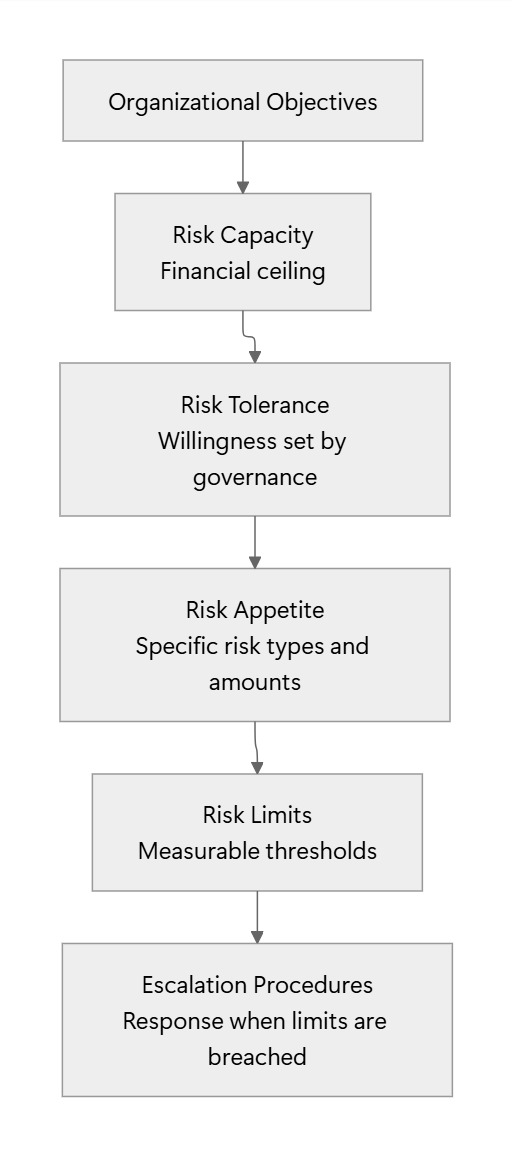
This hierarchy connects directly to risk budgeting and governance. Risk budgets allocate approved risk across business units, portfolios, or strategies, while governance bodies set risk tolerance, review exposures, and hold management accountable for operating within established limits.
Worked Example
Scenario: Meridian Insurance's board has approved a risk management profile with an overall risk tolerance described as "moderate, prioritizing capital preservation over growth." The firm's risk capacity, based on current capital reserves, would technically support a value at risk (VaR) of up to $50 million at a 95% confidence level over one month.
The board has approved firm-wide market risk limits of $20 million VaR at the same confidence level. Last month, the trading desk's positions produced a measured VaR of $23 million.
Step 1: Compare capacity to the approved limit
Capacity supports $50 million. The board-approved limit is $20 million. The lower limit reflects the moderate tolerance, not a capacity constraint.
Step 2: Compare actual exposure to the approved limit
Actual VaR of $23 million exceeds the $20 million limit by $3 million.
Step 3: Apply escalation procedures
The breach should trigger the firm's escalation policy: notification to the risk committee, an explanation from the trading desk, and a required plan to bring exposure back within $20 million, or a formal, documented exception approved by the appropriate governance body.
Meridian has capacity to take on much more risk than it has chosen to accept. The board deliberately set a tighter limit because its tolerance is moderate. When actual risk-taking exceeds that limit, the issue is a limit breach requiring escalation, not a capacity problem.
A CFA Level I question testing this scenario checks whether candidates can separate the capacity ceiling from the tolerance-based limit and correctly identify that a breach calls for escalation, not a capacity review.
Common Exam Traps
Confusing organizational tolerance with investor willingness
This note covers organizational risk tolerance, which governance bodies set for a firm. Investor willingness and ability to take risk is a separate concept tested in a different topic area. Exam questions sometimes mix the two to test whether candidates know the distinction.
Treating tolerance as a single number
Tolerance is usually expressed as a qualitative statement (conservative, moderate, aggressive) that then gets translated into multiple quantitative limits across risk types. Do not expect one figure to represent tolerance.
Setting limits without escalation rules
A question may describe an organization with clear limits but no defined escalation process. This is a framework weakness, not a compliant risk management structure.
Ignoring changes in capacity
Tolerance should adjust when capacity changes. A candidate who assumes tolerance stays fixed regardless of financial condition will miss questions that test this link.
Practice Question
An investment firm's risk committee has approved a risk management profile stating: "The firm maintains a conservative risk tolerance to protect client capital during periods of market stress." The firm's risk capacity, based on its capital base, could support significantly higher risk-taking than its current limits allow. Which statement best describes this situation?
The firm's risk limits are set incorrectly because they should match its risk capacity.
The firm has chosen a tolerance below its capacity, which is a valid governance decision.
The firm's risk profile is inconsistent because tolerance and capacity must always be equal.
Correct Answer: B
Risk capacity is a ceiling, not a target. An organization can rationally choose a tolerance and set limits well below what its capacity would technically allow. This firm's conservative tolerance, approved by its risk committee, reflects a deliberate governance choice to prioritize capital protection, which is fully consistent with a sound risk management profile.
Option A: This assumes limits must always match capacity, which ignores that tolerance is a separate, deliberate choice made by governance bodies.
Option C: This incorrectly assumes tolerance and capacity must be equal. Capacity sets the outer boundary; tolerance can sit anywhere at or below that boundary based on the organization's objectives and preferences.
Continue Your CFA Level I Prep With KeyPoint
Use structured lessons, practice questions, mock exams, and progress tracking to focus on the time you have left
FAQs About Risk Tolerance in Risk Management
Is risk tolerance the same as risk appetite?
No. Risk tolerance is the general willingness to accept risk. Risk appetite is the specific amount and type of risk an organization chooses to take, expressed through policy and limits, once both tolerance and capacity are considered.
Who sets an organization's risk tolerance?
A board of directors or risk committee typically approves organizational risk tolerance, based on the firm's objectives, financial position, and stakeholder obligations.
How is this different from investor risk tolerance?
Investor risk tolerance describes an individual's or a fund's willingness and ability to accept investment risk. Organizational risk tolerance in this note applies to how a firm manages risk across its operations and is set through governance, not individual client circumstances.