
Updated for the 2026-2027 CFA® Level I curriculum.
Big data, artificial intelligence, machine learning, and fintech describe different parts of a technology-driven financial process. Big data provides information, artificial intelligence describes the broader field of computer-based decision systems, and machine learning gives those systems a way to learn from data. Fintech is the financial setting in which these tools are used.
For CFA Level I, focus on keeping those roles separate. You should also understand the main types of financial data and the preparation required before the information can support an analysis.
Quick Answer
Fintech applies technology to financial services, including the gathering and analysis of financial data. Big data refers to data sets whose volume, speed, variety, or complexity require more advanced processing. Artificial intelligence is the broad field of systems performing tasks associated with human intelligence, while machine learning is an AI approach that identifies patterns and improves its outputs using data.
Key Takeaways About Big Data, AI, Machine Learning, and Fintech
Fintech applies technology to activities such as payments, lending, investing, trading, risk management, and financial-data analysis.
Big data can involve high volume, rapid arrival, varied formats, or complex processing requirements.
Data quality determines whether a large or fast-moving data set can support a useful conclusion.
Financial information may be structured, semi-structured, or unstructured.
Raw data normally requires cleaning, integration, and transformation before analysis.
Artificial intelligence is the broad field, while machine learning is one approach within AI.
Supervised learning uses known outcomes, while unsupervised learning looks for patterns or groups without predefined labels.
Technology-driven analysis still depends on human decisions about data selection, preparation, modeling, and interpretation.
Biased inputs and changing relationships can weaken a model even when its historical results appear strong.
What You Need to Know for CFA Level I
For CFA Level I, you should be able to:
Explain how fintech supports the gathering and analysis of financial data.
Describe the features that can make a data set difficult to manage using conventional methods.
Distinguish structured, semi-structured, and unstructured data.
Explain why data must be organized and processed before it is analyzed.
Describe the relationship between artificial intelligence and machine learning.
Distinguish supervised learning from unsupervised learning using straightforward examples.
Explain how poor data quality, biased samples, and unstable relationships can affect the result.
Connect the technology to a practical financial use without treating the output as certain.
What Is Fintech?
Fintech is the application of technology to financial services. In this reading, the main focus is how technology changes the way financial data is collected, stored, processed, analyzed, and delivered to decision-makers.
Examples include digital payment systems, online lending platforms, automated investment tools, algorithmic trading systems, fraud monitoring, and regulatory reporting. Each application uses technology to change how a financial activity is completed or experienced.
Fintech describes the financial application. A fintech system may use artificial intelligence or machine learning, but it can also rely on conventional software and predefined rules.
What Is Big Data?
Big data refers to data sets that require advanced methods because of their scale, speed, variety, or complexity. A useful framework considers the following characteristics:
Volume. The quantity of data being stored and analyzed.
Velocity. The speed at which the data is created, received, and processed.
Variety. The range of formats, including tables, text, audio, images, and sensor data.
Veracity. The accuracy, completeness, consistency, and general reliability of the information.
Different data sets create different challenges. A live stream of market quotes places pressure on processing speed, while thousands of earnings-call transcripts require methods that can interpret unstructured text.
Veracity affects every application. Increasing the quantity of unreliable information gives the analyst more unreliable information to process. Data quality must therefore be reviewed before the size or speed of the data can add value.
What Types of Data Are Used in Financial Analysis?
Financial data can be grouped according to how much structure it already contains.
Data Type | Definition | Financial Examples | Typical Preparation |
|---|---|---|---|
Structured | Organized using a predefined format, usually rows and columns | Daily prices, trade records, financial statement line items | Checking values, definitions, and missing observations |
Semi-structured | Partly organized using tags, fields, or markers | XBRL filings, JSON data feeds, email metadata | Parsing the fields into a consistent structure |
Unstructured | Has no fixed predefined organization | Earnings-call transcripts, news articles, analyst notes, audio, and satellite images | Extracting and converting the information into usable variables |
Structured data is usually easier to store, compare, and analyze because its format is already defined. Even then, differences in units, dates, accounting definitions, and identifiers may require additional work.
Semi-structured data provides some built-in organization. For example, tags in an XBRL filing identify individual financial items, although those items still need to be extracted and aligned across companies.
Unstructured data requires more preparation. Text, images, and audio must be translated into features that an analytical method can process.
How Is Big Data Organized and Processed?
Big data management and processing normally involve several stages before modeling begins.
Collection. Gathering data from exchanges, filings, vendors, company systems, sensors, or online sources.
Storage. Keeping the information in a system that can support the amount of data and the required access speed.
Cleaning. Reviewing missing values, duplicate records, unusual observations, and clear errors.
Normalization. Converting variables into consistent units or scales.
Integration. Combining sources that use different identifiers, periods, definitions, or formats.
Transformation. Turning the prepared information into variables that an analytical model can use.
These stages require judgment. Removing every record with a missing value may appear efficient, but it can change the composition of the sample. The effect becomes more serious when missing observations share a common characteristic.
Analysts should understand how each preparation decision affects the final data set. A model can only work with the information it receives, including any errors or biases created during processing.
What Is Artificial Intelligence?
Artificial intelligence is the broad field of developing computer systems that can perform tasks associated with human intelligence. These tasks may include recognizing patterns, interpreting language, processing images, making predictions, or selecting an action.
AI describes the overall capability or field. The methods used to create that capability can vary depending on the task and the available information.
In finance, AI may support document analysis, fraud detection, customer service, investment research, trading, and risk monitoring. The usefulness of the system depends on the quality of its inputs and how well its method fits the problem.
What Is Machine Learning?
Machine learning is an approach within artificial intelligence in which an algorithm learns patterns from data. Instead of receiving a complete set of instructions for every possible situation, the system adjusts its model based on examples.
The trained model can then apply the learned relationship to new observations. Its performance should be checked on information that was not used during training.
Supervised Learning
Supervised learning uses training data with known outcomes or labels. The algorithm studies the relationship between the input variables and the target outcome, then uses that relationship to make a prediction or classification.
For example, an analyst might train a model using historical bond issuers whose default outcomes are already known. The model can then estimate the default risk of another issuer based on similar input variables.
Unsupervised Learning
Unsupervised learning uses data without known outcome labels. The algorithm looks for patterns, similarities, or groups within the observations.
For example, an asset manager may group companies according to profitability, leverage, growth, and valuation characteristics. The algorithm forms the groups from the data rather than receiving predefined company categories.
How Do Big Data, AI, Machine Learning, and Fintech Fit Together?
A useful way to remember the concepts is to ask what role each one plays.
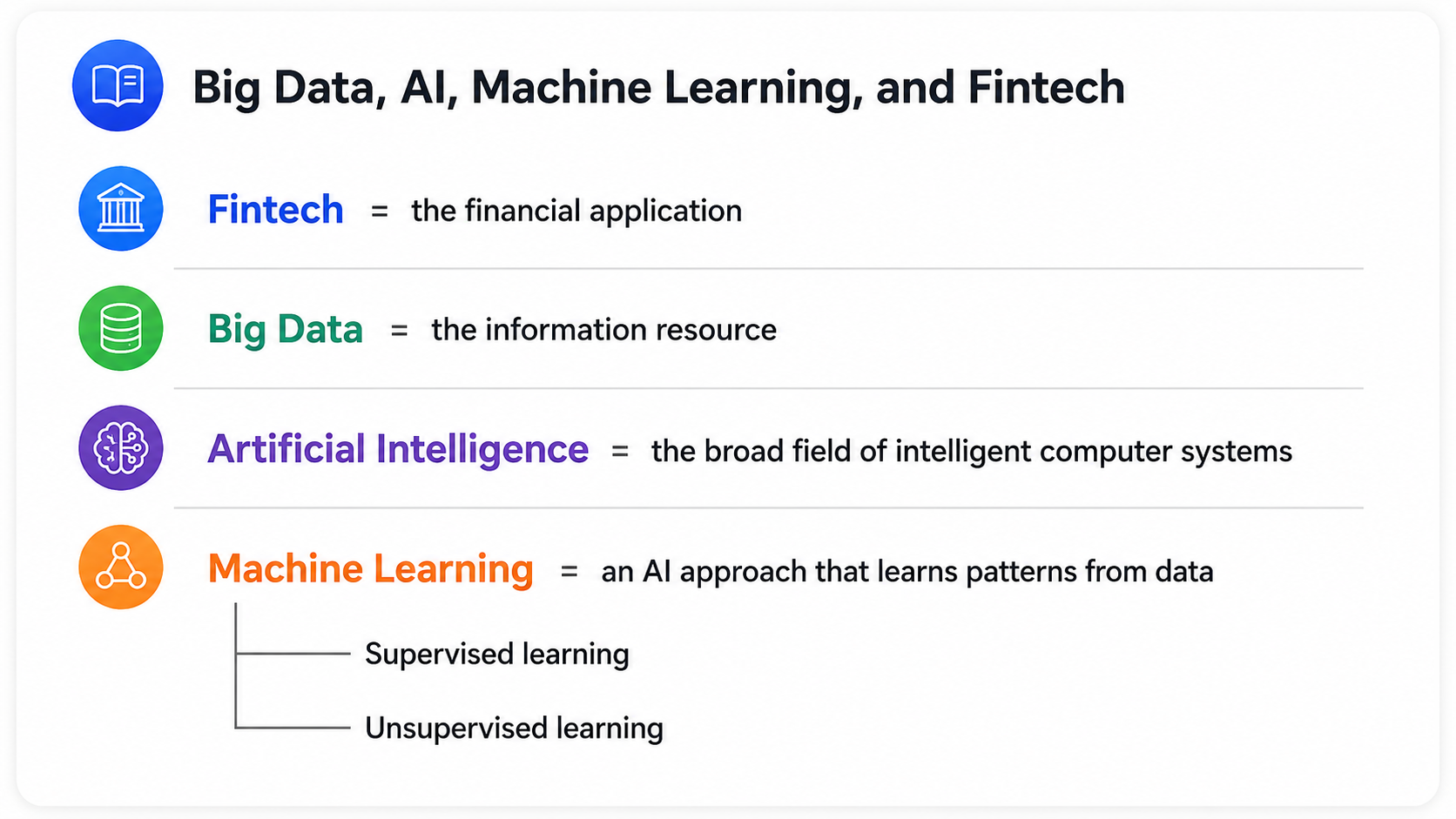
big-data-ai-machine-learning-fintech-framework.png - Relationship among Big Data, artificial intelligence, machine learning, and fintech for CFA Level I
Big data provides information that an analytical system may use. Machine learning provides one way to find patterns in that information. Artificial intelligence is the broader field that includes machine learning, while fintech describes the financial service or activity being supported.
The concepts often appear in the same application, but each answers a different question:
Fintech: Where is the technology being used?
Big data: What type of information is being handled?
Artificial intelligence: What type of computer capability is being developed?
Machine learning: How does the system learn patterns from data?
Worked Example: Classifying a Bank’s Data and Methods
A commercial bank uses three sources in a customer-retention project:
Transaction records stored as dated rows with an account identifier, amount, merchant category, and payment channel.
Customer-service messages made up of email bodies and chat transcripts.
Market-data feeds delivered as JSON files with tagged fields for the instrument, price, and timestamp.
Classifying the Data
The transaction records are structured because they follow a fixed table format.
The customer-service messages are unstructured because the free text has no predefined organization. The market-data feeds are semi-structured because the JSON tags provide some organization even though the information does not begin as a conventional table.
Preparing the Data
The transaction records require checks for duplicates, reversed transactions, and missing identifiers. The customer messages need to be converted into usable features, such as common topics or the presence of certain terms.
The JSON files must be parsed into fields that can be compared and joined with the bank’s other data. Dates and identifiers also need to follow a consistent format.
Classifying the Machine-Learning Task
The bank wants to predict which customers are likely to close their accounts during the next quarter. It has three years of historical records showing whether each customer stayed or left.
This is supervised learning because the training data includes a known outcome for each observation.
A different project might ask the algorithm to group customers according to similar transaction behavior without assigning categories in advance. That would be an unsupervised-learning task.
Identifying the Fintech Application
The bank is using technology to gather, process, and analyze financial data so it can improve a financial service. The full customer-retention project is therefore a fintech application.
The data types and machine-learning approach describe individual parts of the project rather than separate definitions of fintech.
Common Exam Traps
Treating fintech and big data as interchangeable. Fintech describes the financial application, while big data describes the information being processed.
Treating artificial intelligence and machine learning as identical. Machine learning is one approach within the broader AI field.
Defining big data only by volume. Velocity, variety, complexity, and data reliability may create the greater processing challenge.
Classifying all digital information as structured. Free-form text, images, and audio are unstructured.
Treating tagged files as fully structured. Formats such as JSON and XBRL are generally semi-structured because tags provide partial organization.
Skipping data preparation. Missing values, inconsistent units, and mismatched identifiers can change the result.
Assuming automation removes bias. A model can reproduce bias found in the data or introduced during preparation.
Confusing supervised learning with clustering. Clustering normally looks for groups without predefined outcome labels, making it an unsupervised task.
Assuming a trained model stays accurate. Changes in markets, customers, or data sources can weaken the relationship the model learned.
Practice Question
An asset manager collects quarterly earnings-call transcripts for 500 companies. The transcripts have no outcome labels. An algorithm groups the companies according to similarities in the language used by management, without receiving predefined company categories.
The technique is best described as:
Supervised learning applied to structured data
Unsupervised learning applied to unstructured data
Supervised learning applied to semi-structured data
Correct Answer: B
The transcripts contain free-form text without a predefined table or tagging structure, so they are unstructured data.
The algorithm receives no known outcomes or categories. It identifies groups by finding similarities among the observations, which is an unsupervised-learning task.
Option A is incorrect because supervised learning requires labeled outcomes. The transcripts are also unstructured rather than structured.
Option C is incorrect because no target label is supplied, and ordinary free-form transcripts do not become semi-structured merely because they are stored digitally.
Continue Your CFA Level I Prep With KeyPoint
Use structured lessons, practice questions, mock exams, and progress tracking to focus on the time you have left
FAQs About Big Data, AI, Machine Learning, and Fintech
What is big data in the CFA Level I curriculum?
Big data refers to information whose volume, speed, variety, or complexity requires more advanced storage, processing, and analytical methods. Data reliability also affects whether the information can support a useful conclusion.
What is the difference between artificial intelligence and machine learning?
Artificial intelligence is the broader field of computer systems performing tasks associated with human intelligence. Machine learning is an AI approach in which algorithms identify patterns and improve their outputs using data.
Machine learning therefore sits within artificial intelligence, while AI can include a wider range of methods and systems.
What is the difference between structured and unstructured data?
Structured data follows a predefined format, such as rows and columns containing prices or financial statement values. Unstructured data has no fixed organization, such as articles, audio recordings, analyst notes, or images.
Semi-structured data falls between the two. Tags or fields provide some organization, as they do in JSON and XBRL files.
How does fintech use big data?
Fintech systems use large or complex data sets to support financial services such as digital payments, lending, fraud monitoring, trade execution, investment research, and automated advice.
The data must still be collected, cleaned, organized, and interpreted before it can support a decision.
Does more data automatically improve a financial model?
More data can improve a model when the information is relevant, accurate, representative, and prepared properly. A large data set may still produce a weak result when it contains biased observations, inconsistent definitions, or relationships that no longer hold.
The quality and suitability of the information determine whether the additional volume adds value.