
Updated for the 2026-2027 CFA® Level I curriculum.
Private capital investing allocates to private equity and private debt alongside public stocks and bonds. Level I asks you to explain the diversification channels and recognize when reported benefits are overstated. This note connects the return drivers to illiquidity, leverage, vintage concentration, and appraisal-based valuation.
Quick Answer
Private capital investing can diversify a portfolio because private equity and private debt draw on different companies, credit terms, and return drivers than public stocks and bonds. Spreading commitments across vintage years adds a second layer of diversification by varying entry timing and market conditions. Reported low correlations often reflect appraisal-based, smoothed valuations rather than true economic independence. Treat these benefits as real but conditional, not guaranteed.
Key Takeaways
Private equity and private debt draw on return drivers not fully captured in public equity and bond indexes.
Private equity investors gain exposure to private companies and active ownership value creation.
Private debt investors gain exposure to negotiated, often floating-rate credit outside public bond markets.
Spreading commitments across vintage years reduces concentration in one market environment.
Reported low correlations between private and public assets often reflect appraisal smoothing, not genuine independence.
Illiquidity, leverage, manager selection, and capital-call timing limit how much diversification benefit an investor actually realizes.
No single private capital allocation guarantees improved risk-adjusted return.
What You Need to Know for CFA Level I
Identify return drivers in private equity and private debt that differ from listed equity and bonds.
Explain how private company access, active ownership, and negotiated credit create distinct exposure.
Explain vintage-year diversification and why deployment timing changes market exposure.
Distinguish a measured low correlation from genuine economic diversification.
Recognize illiquidity, leverage, concentration, and manager risk as limits on the stated benefit.
Avoid concluding that any single private capital allocation improves portfolio efficiency automatically.
How Private Equity Can Diversify a Portfolio
Private equity gives investors access to companies that never trade on public exchanges. That access is the first diversification channel. A pension plan holding only listed stocks misses smaller, earlier-stage, or closely held businesses that make up a large share of the real economy.
Active ownership is the second channel. Private equity managers often sit on portfolio company boards, adjust management teams, and redirect capital spending. Returns come partly from this operational involvement, not just from market price movement. Long holding periods and manager-controlled exit timing form a third channel, since private equity returns depend on deal-level events rather than daily price quotes.
Exposure | Return Driver | Diversification Channel | Limitation |
|---|---|---|---|
Private companies | Growth and operational improvement | Access to firms outside public indexes | Business cycle exposure often still overlaps public equity |
Active ownership | Governance and strategic change | Value creation independent of market price swings | Depends heavily on manager skill |
Long holding period | Exit value at sale or IPO | Return timing detached from daily market moves | Illiquid until exit occurs |
Distinct exposure can diversify a portfolio, but the underlying companies still sell into the same economy as public firms. A recession that hurts public equity earnings usually hurts private equity portfolio companies too.
How Private Debt Can Diversify a Portfolio
Private debt lends directly to borrowers who cannot or choose not to access public bond markets. This creates access to a private credit segment with negotiated terms, covenants, and collateral that public bondholders rarely get.
Many private debt loans carry floating rates. That changes interest-rate sensitivity compared with fixed-rate public bonds, since coupon payments adjust with reference rates. It does not remove credit risk. A borrower under financial stress can still default whether the loan is fixed or floating.
Exposure | Return Driver | Diversification Channel | Limitation |
|---|---|---|---|
Private borrowers | Contractual interest and fees | Credit segment outside public bond indexes | Underwriting quality varies by manager |
Negotiated terms | Covenants and collateral protection | Downside protection not available in public bonds | Enforcement depends on lender leverage in negotiation |
Floating rates | Rate resets tied to reference rates | Different interest-rate sensitivity than fixed bonds | Credit-cycle risk remains fully in place |
Private debt broadens the credit exposures available to a portfolio. It does not create immunity from a weakening economy or a rise in defaults.
Vintage Year and Commitment Diversification
A vintage year is the year a private fund begins making investments. Two funds launched in different vintage years enter different market conditions. A fund that deploys capital during a market peak faces different entry prices than one that deploys during a downturn.
Commitment pacing means spreading capital commitments across several vintage years instead of one. This reduces the risk of concentrating an entire private capital allocation in a single market environment. It works alongside the J-curve, the pattern where private fund returns are often negative in early years due to fees and unrealized investments, then improve as portfolio companies mature.
A simple three-vintage timeline:
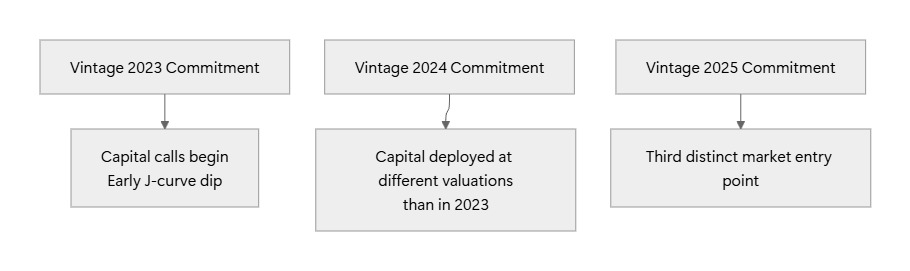
Spreading commitments this way diversifies entry timing. It does not diversify away the underlying asset class risk in private equity or private debt.
Limits of Reported Diversification
Private assets are usually valued through periodic appraisals rather than continuous market pricing. This creates appraisal smoothing, where reported values change more slowly than true underlying value. Smoothed values produce statistically low correlations with public markets that overstate real diversification.
Leverage adds another caveat. Many private equity deals and some private debt structures use borrowed capital, which increases sensitivity to the same interest-rate and credit-cycle forces that affect public markets. Concentration risk also matters, since private portfolios often hold fewer positions than public index funds, and manager selection drives a wider range of outcomes. Capital calls add uncertainty, since investors must fund commitments on a schedule they do not fully control.
Reported Benefit | Economic Caveat |
|---|---|
Low correlation with public equity | Smoothed appraisal values, not necessarily true independence |
Distinct return driver | Leverage ties returns back to broad credit and rate cycles |
Broader opportunity set | Concentrated positions increase manager-specific risk |
Long-term return potential | Capital calls create liquidity demands at unpredictable times |
Measured correlation can understate true co-movement with public markets. Candidates should treat a low reported number as a starting point for further analysis, not a conclusion.
Worked Example
Meridian Retirement Fund commits capital to three private funds launched in consecutive years: a 2022 vintage private equity fund, a 2023 vintage private debt fund, and a 2024 vintage private equity fund. Each fund invests in a different set of companies and credit borrowers.
Step 1: Identify the diversification channels
The 2022 and 2024 private equity funds add exposure to private companies and active ownership value creation. The 2023 private debt fund adds negotiated, floating-rate credit exposure. All three funds enter markets at different points because of their different vintage years.
Step 2: Check the benefit against limitations
The private equity funds report low correlation with Meridian's public equity holdings. Both funds use leverage in several portfolio companies, and their valuations come from quarterly appraisals rather than market prices. The private debt fund's floating rate reduces interest-rate sensitivity but leaves full exposure to borrower defaults if the economy weakens.
Meridian gains real diversification from different exposures and staggered vintage timing. The benefit is smaller than the reported correlation suggests, because appraisal smoothing and leverage tie these funds back to the same economic cycle that drives Meridian's public holdings.
Common Exam Traps
Treating reported low correlation as proof of independence
Appraisal-based pricing smooths private asset values, which mechanically lowers measured correlation without confirming true economic separation from public markets.
Ignoring leverage and shared business-cycle exposure
Leveraged private equity and private debt structures remain sensitive to the same rate and credit forces that move public markets, even when reported returns look distinct.
Confusing vintage diversification with asset-class diversification
Spreading commitments across vintage years diversifies entry timing. It does not replace the need for exposure across genuinely different asset classes.
Assuming private debt has no interest-rate or credit risk
Floating rates change interest-rate sensitivity. They do not eliminate the risk that a borrower defaults during a downturn.
Ignoring illiquidity and capital-call timing
An investor who cannot meet a capital call on schedule faces penalties or forfeited commitments, which is a real cost of the private capital structure.
Promising improved risk-adjusted return
The LOS asks you to describe benefits, not guarantee outcomes. Level I answer choices that promise certain improvement are incorrect.
Practice Question
An analyst reviews a plan sponsor's portfolio report. The report shows a low correlation between the plan's private equity holdings and its public equity index fund. All the private equity capital was committed to funds with the same 2023 vintage year, and fund values are updated quarterly using manager appraisals.
Which statement best describes the diversification benefit shown in this report?
The low correlation confirms that the private equity holdings are economically independent of public equity markets.
The reported benefit may be overstated because appraisal-based valuations smooth reported returns, and all commitments share one vintage year.
The private equity holdings provide no diversification benefit because they are illiquid and cannot be sold on demand.
Correct Answer: B
The reported low correlation likely reflects valuation smoothing rather than true economic independence. Because every commitment shares the same 2023 vintage year, the portfolio also lacks the timing diversification that spreading commitments across multiple vintages would provide.
Option A. This choice mistakes a statistical result for economic proof. Low measured correlation from appraisal-based pricing does not confirm independence from public markets.
Option C. This choice overstates the limitation. Illiquidity is a real constraint, but it does not erase every diversification benefit from different underlying exposures.
Continue Your CFA Level I Prep With KeyPoint
Use structured lessons, practice questions, mock exams, and progress tracking to focus on the time you have left
FAQs About Diversification Benefits of Private Capital
How can private capital diversify a portfolio?
Private capital investing adds exposure to private companies and negotiated credit that public markets do not fully capture. This can broaden the return drivers in a portfolio, though the underlying economic exposure often still overlaps with public equity and credit markets during downturns.
What is a vintage fund?
A vintage fund is a private fund defined by the year it begins investing capital. Two funds with different vintage years enter markets under different valuation and economic conditions, which is why spreading commitments across vintage years is a distinct diversification tool.
Why can private asset correlations look low?
Private equity returns by vintage year and other private asset returns are usually based on periodic appraisals instead of daily market prices. This appraisal smoothing reduces reported volatility and correlation with public markets, which can overstate the true diversification benefit.