
Updated for the 2026 CFA® Level I curriculum.
Hedge fund investors can access the same manager through very different legal and operational structures. The vehicle an investor chooses changes how much control, transparency, and customization they get, and how much operational work falls on their own team. CFA Level I tests whether you can match an investor's constraints to the right vehicle, not just recite definitions.
Quick Answer
Investors access hedge funds directly through commingled limited partnerships, funds of one, or separately managed accounts, or indirectly through funds of hedge funds.
A hedge fund master feeder structure lets domestic and offshore feeder funds pool investor capital into one master fund that executes all trading. Fund of one and managed account structures offer more control and transparency but require more investor resources. Funds of hedge funds add diversification and manager selection, but layer on extra fees and reduce transparency.
Key Takeaways
Commingled funds pool capital from multiple investors into one limited partnership with shared terms.
A master-feeder structure lets separate feeder funds (often domestic and offshore) invest investor capital into one common master fund.
A fund of one is a dedicated vehicle for a single investor, still structured as a fund.
A separately managed account holds assets directly in the investor's own account under a customized mandate.
Funds of hedge funds invest in a portfolio of underlying hedge funds, adding a manager-selection layer and an extra fee layer.
Greater control and transparency generally require greater investor scale and operational capacity.
Vehicle choice affects cost, liquidity, and diversification, but it does not change the underlying hedge fund strategy.
What You Need to Know for CFA Level I
Describe how commingled funds and limited partnerships provide pooled access to a hedge fund manager.
Explain how domestic and offshore feeder funds invest through a common master fund.
Differentiate a fund of one from a separately managed account at a practical level.
Explain how funds of hedge funds provide indirect, diversified access to multiple managers.
Compare vehicles on customization, transparency, control, fees, operational burden, and diversification.
Keep hedge fund strategy classification and risk-return analysis separate from vehicle mechanics.
Commingled Hedge Funds and Limited Partnerships
A commingled hedge fund pools capital from many investors into a single portfolio. The manager runs one investment program under one set of offering terms. Investors buy limited partnership interests and receive the same treatment as everyone else in the fund.
This is the baseline access point for most hedge fund investors. Capital flows from the investor into the vehicle, and the vehicle flows into the manager's trading book:

Because everyone shares the same terms, commingled funds achieve economies of scale on operations and reporting.
The tradeoff is limited customization. An individual investor cannot adjust position limits, exclude specific holdings, or negotiate unique liquidity terms. Transparency is also limited to whatever reporting the fund provides to all investors, typically periodic performance and risk summaries rather than full position-level detail.
Master-Feeder Hedge Fund Structure
A hedge fund master feeder structure solves a specific problem: investors from different tax and regulatory backgrounds want access to the same trading strategy without forcing everyone into one legal entity.
Under this structure, separate feeder funds accept capital from distinct investor groups. A domestic feeder might serve U.S. taxable investors, while an offshore feeder serves non-U.S. or tax-exempt investors. Each feeder then invests its pooled capital into one common master fund, which holds the actual trading portfolio.
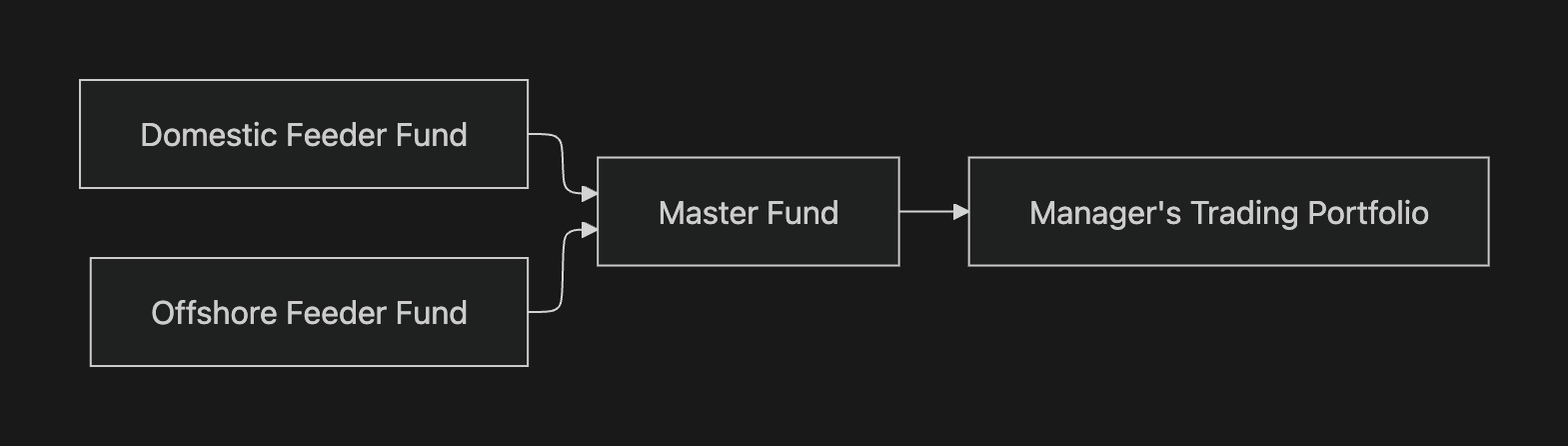
The manager trades one portfolio at the master level, which keeps execution and operations unified. Each feeder can still be structured to fit its investors' legal or tax context, though the details of that fit go beyond what Level I requires. The key exam point is the flow: feeders are entry vehicles, and the master is where trading actually happens.
Fund of One vs Separately Managed Account
Both structures give one investor a dedicated relationship with a manager, but they differ in legal form.
A fund of one is still organized as a fund. The investor is the sole limited partner, and the manager runs it as a customized version of the standard fund structure. The investor can negotiate specific terms, such as position limits or reporting frequency, without sharing the vehicle with anyone else.
A separately managed account (SMA) is different. The investor's own account, not a fund, holds the assets directly. The manager trades the account under an agreed mandate, but the investor retains legal ownership of the underlying securities.
Feature | Fund of One | Separately Managed Account |
|---|---|---|
Legal ownership of assets | Fund holds assets | Investor holds assets directly |
Customization | High, within fund structure | High, within account mandate |
Position-level transparency | Fund-level reporting | Often full transparency |
Portability of assets | Limited | Investor can reassign or liquidate directly |
Operational burden on investor | Moderate | Higher, requires internal infrastructure |
Both structures demand more from the investor than a commingled fund. An investor needs scale and internal operational capacity to negotiate and monitor either arrangement effectively.
Funds of Hedge Funds
A fund of hedge funds invests in a portfolio of underlying hedge funds rather than trading directly. The fund-of-funds manager selects underlying managers, monitors them, and builds a diversified multi-manager portfolio for the end investor.
This structure suits investors who want hedge fund exposure without building internal manager-selection and due diligence capability.
Benefit | Tradeoff |
|---|---|
Diversification across managers and strategies | Added fee layer on top of underlying fund fees |
Professional manager selection and due diligence | Reduced transparency into underlying positions |
Access to managers that might otherwise be closed | Potential liquidity mismatch between fund and underlying funds |
The diversification benefit is real, but it comes bundled with cost and an extra layer of risk that the investor does not directly control.
Worked Example: Matching Investors to Vehicles
Three institutional investors are each choosing a hedge fund vehicle.
Investor A, a small foundation, wants hedge fund exposure but has no internal staff to evaluate individual managers. It prefers one decision that delivers diversified exposure.
Investor B, a large pension fund, wants assets held in its own custodial account, full position transparency, and the ability to set specific risk limits.
Investor C, a mid-sized endowment, wants access to a single manager's core strategy through standard fund terms, without building custom infrastructure.
Reasoning
Investor A lacks the resources for manager selection, so a fund of hedge funds fits. It trades a fee layer for diversification and due diligence it cannot perform internally.
Investor B wants direct ownership, full transparency, and custom risk limits. A separately managed account fits because assets stay in its own account under a negotiated mandate.
Investor C wants simple, standard access without negotiating a custom mandate. A commingled fund fits, since it accepts shared terms in exchange for lower operational burden.
Interpretation: Vehicle choice follows investor resources and priorities, not just the desire for higher control. More control and transparency require more operational commitment from the investor.
Common Exam Traps
Confusing the feeder fund with the master fund
The feeder is the entry point for investor capital. The master fund is where the manager actually trades. A question describing "the fund that trades all the assets" points to the master, not the feeder.
Treating fund of one and managed account as identical
Both serve one investor, but a fund of one is still a fund vehicle. An SMA holds assets directly in the investor's own account. Watch for language about "the investor's account" versus "the investor's interest in the fund."
Ignoring the extra fee layer in a fund of funds
Candidates sometimes evaluate diversification benefits without weighing the added fee layer on top of underlying fund fees. Both matter for the tradeoff.
Assuming a commingled fund can customize every investor's terms
Commingled funds operate under one set of offering terms for all investors. Customization belongs to fund of one or managed account structures.
Choosing a vehicle without considering operational resources
A vehicle offering more transparency and control, such as an SMA, also demands more from the investor's own operations team. The exam may test whether a stated investor actually has the resources to support that choice.
Practice Question
A large pension fund wants its hedge fund allocation held in an account under its own name, with full visibility into individual positions and the ability to set custom risk limits with the manager. Which vehicle best fits this investor's requirements?
A commingled hedge fund organized as a limited partnership
A separately managed account
A fund of hedge funds
Correct Answer: B
The investor wants direct ownership of assets, full position transparency, and custom risk limits. A separately managed account holds assets in the investor's own account under a negotiated mandate, which directly matches all three requirements.
Option A. A commingled fund shares offering terms across all investors and does not provide custom risk limits or direct asset ownership for one investor.
Option C. A fund of hedge funds adds a manager-selection and diversification layer, but it reduces position-level transparency and does not give the investor direct account ownership.
Continue Your CFA Level I Prep With KeyPoint
Use structured lessons, practice questions, mock exams, and progress tracking to focus on the time you have left
FAQs About Hedge Fund Investments
What is a hedge fund master feeder structure?
A master feeder structure lets separate feeder funds, often organized domestically and offshore, accept capital from different investor groups. Each feeder invests its pooled capital into one common master fund, which holds the actual trading portfolio. This keeps trading unified while accommodating different investor bases.
What is the difference between a fund of one and a separately managed account?
A fund of one is a dedicated fund vehicle for a single investor, so the fund itself holds the assets. A separately managed account holds assets directly in the investor's own account, with the manager trading under an agreed mandate.
What is a fund of hedge funds?
A fund of hedge funds invests in a portfolio of underlying hedge funds rather than trading directly. It offers diversification and professional manager selection, but adds an extra fee layer and reduces transparency into underlying positions.