
Updated for the 2026-2027 CFA® Level I curriculum.
Monetary policy and fiscal policy rarely operate in isolation. Each authority sets its own stance, but both act on the same economy at the same time. This note explains how those stances combine, reinforce, or offset each other, and how the resulting policy mix affects output, inflation, interest rates, exchange rates, debt, and private-sector activity.
Quick Answer
Monetary and fiscal policy interact through their combined stance, known as the policy mix. Four combinations are possible: both expansionary, both contractionary, or one expansionary while the other is contractionary.
When both stances point the same direction, effects reinforce. When they point in opposite directions, effects partly offset. The net result depends on relative size, timing, transmission speed, prevailing economic conditions, and market expectations, not on direction alone.
Key Takeaways
The policy mix is the combined monetary and fiscal stance, not either policy analyzed alone.
Reinforcing expansion (both expansionary) tends to boost growth but raises inflation risk.
Reinforcing contraction (both contractionary) tends to slow growth and ease inflation, but can overcorrect.
Offsetting combinations are not inconsistent. Each authority can target a different objective.
Fiscal expansion raises borrowing needs, which can raise interest rates and crowd out private investment.
Monetary accommodation can lower financing costs and reduce, but not eliminate, that crowding out.
Central-bank independence and relative policy strength determine which effect dominates.
What You Need to Know for CFA Level I
Classify the monetary stance and the fiscal stance separately before combining them.
Use a 2x2 matrix to map the four possible mixes and their likely effects.
Explain how monetary accommodation reduces fiscal crowding out through lower borrowing costs.
Recognize that offsetting policies often target different goals, such as growth versus inflation.
Never state a certain net outcome. Always tie conclusions to stated assumptions about magnitude and timing.
Understand that central-bank independence limits automatic coordination between the two authorities.
Why Monetary and Fiscal Policy Interact
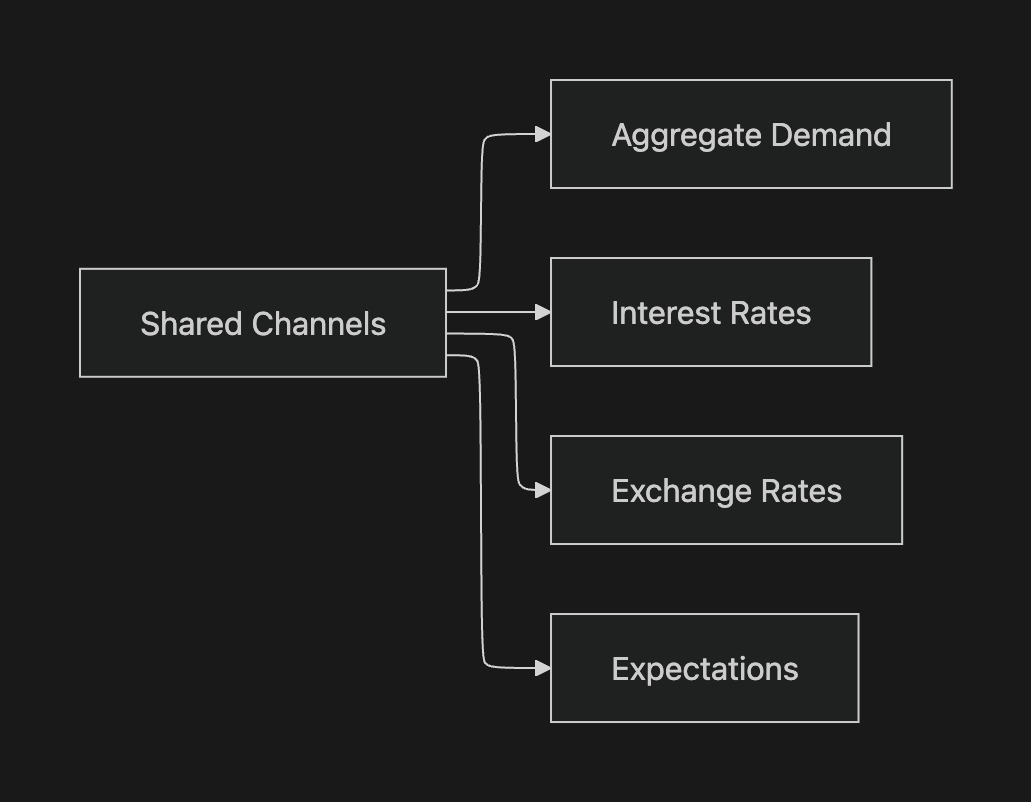
Monetary and fiscal authorities are separate, but they share the same transmission variables: aggregate demand, financial conditions, borrowing costs, exchange rates, and expectations. A fiscal deficit affects bond supply and interest rates. A central bank's rate decision affects the cost of financing that deficit. Neither operates in a closed system.
When Monetary Policy Transmission Is Blocked

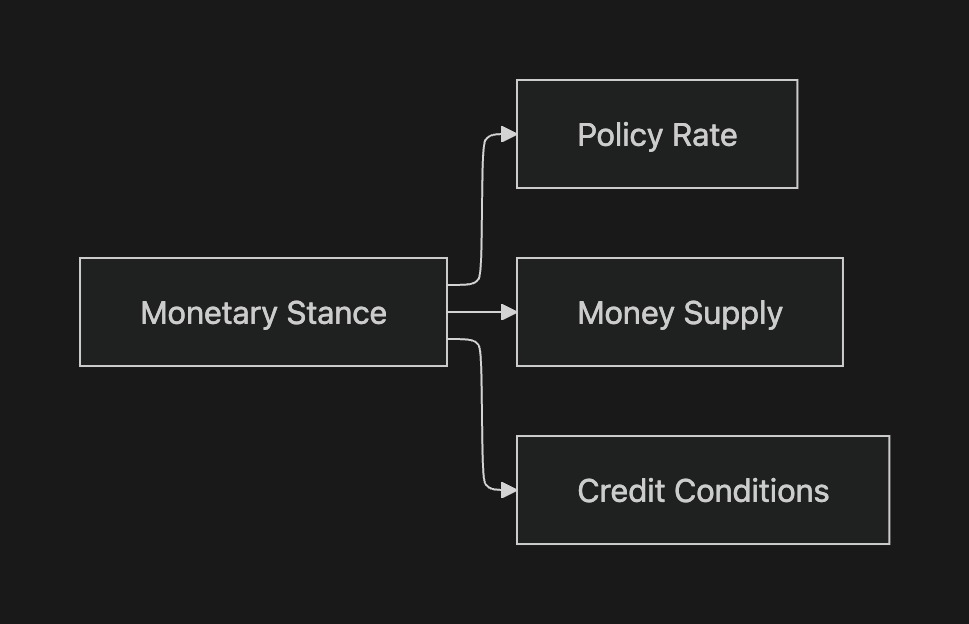
Monetary Policy Stance and Its Main Levers
Shared Transmission Channels of Monetary and Fiscal Policy
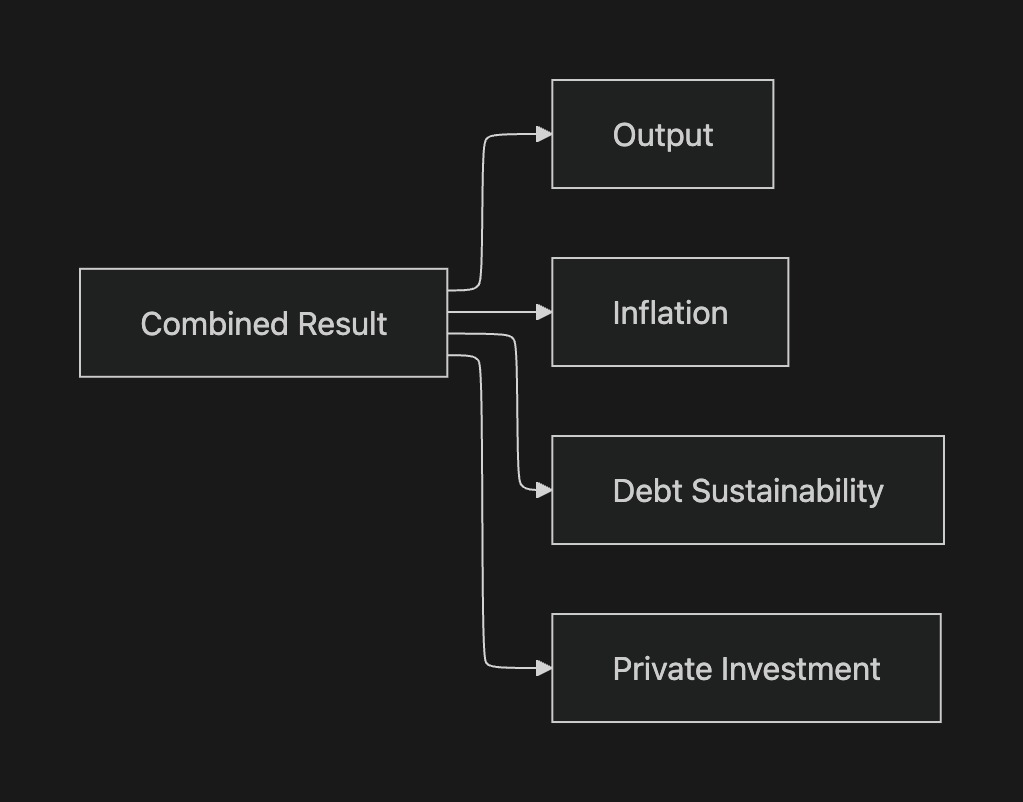
Combined Macroeconomic Effects of Monetary and Fiscal Policy
Institutional independence matters here. Most central banks set policy without direct fiscal instruction. This means the two stances can align by coincidence, diverge by design, or shift independently as conditions change. The exam tests whether you can separate the two decisions before judging their combined effect.
The Four Monetary-Fiscal Policy Mixes
Every policy mix reduces to four base combinations. Treat this matrix as a starting point, not a guaranteed outcome, because real effects depend on scale and timing.
Fiscal Stance | Monetary Stance | Likely Growth | Likely Inflation | Likely Rates | Likely Currency | Debt Pressure |
|---|---|---|---|---|---|---|
Expansionary | Expansionary | Higher | Higher | Lower to start | Weaker | Rising |
Contractionary | Contractionary | Lower | Lower | Higher relative to easing case | Stronger | Falling |
Expansionary | Contractionary | Mixed, depends on which dominates | Contained, depends on fiscal size | Higher | Stronger, depends on rate differential | Rising, financed at higher cost |
Contractionary | Expansionary | Mixed, depends on which dominates | Contained to moderate | Lower | Weaker | Slower rise |
Two mixes reinforce in one direction. Two mixes offset, and those are the combinations Level I candidates most often misjudge. An offsetting mix is not a policy error. Each authority may be responding to a different problem, such as a central bank fighting inflation while a government supports a lagging region or sector.
Coordination, Crowding Out, and Financing Conditions
When a government runs a larger deficit, it issues more debt. Higher bond supply can push interest rates up, which raises the cost of private borrowing. This is crowding out.
Conditional chain, unaccommodated case

Conditional chain, accommodated case

Monetary accommodation lowers the cost side of the equation. It does not remove the underlying competition for savings, and it does not guarantee that private investment stays flat. Credibility matters too. If markets doubt the central bank's commitment to price stability, risk premiums can rise even with an accommodative stance, offsetting some of the intended relief.
Do not assume direct deficit monetization unless a scenario explicitly states the central bank is financing the deficit. Most Level I scenarios describe accommodation through rates or asset purchases, not direct monetization.
How to Analyze a Policy-Mix Scenario
Use this six-step checklist whenever a question presents both fiscal and monetary actions.
Identify the fiscal authority's action and classify it as expansionary or contractionary.
Identify the monetary authority's action and classify it as expansionary or contractionary.
Note the timing. Are both actions current, or is one anticipated?
Assess the transmission channel each policy uses, such as rates, spending, or credit.
Compare relative strength. A small rate cut rarely offsets a large deficit increase, and the reverse is also true.
State your conclusion with the assumptions attached. Avoid declaring a single certain outcome.
This checklist keeps you from collapsing a mixed scenario into one label before you have compared magnitude and timing.
Worked Example
Scenario. Country Alto faces inflation running two percentage points above target. The government launches an expansionary fiscal package: increased infrastructure spending funded by new bond issuance equal to three percent of GDP. At the same time, the central bank raises its policy rate by 100 basis points to fight inflation.
Step 1: Classify each stance. Fiscal policy is expansionary. Monetary policy is contractionary. This is an offsetting mix.
Step 2: Trace the fiscal channel. The spending increase supports output directly and adds to aggregate demand, which works against the inflation goal.
Step 3: Trace the monetary channel. The rate increase raises borrowing costs economy-wide, including for the government's new debt. Debt servicing costs rise faster than they would have under stable rates.
Step 4: Trace the exchange-rate channel. Higher rates in Alto attract foreign capital seeking yield, which tends to strengthen the currency. A stronger currency partly offsets inflation from the fiscal side by making imports cheaper, but it can also hurt export competitiveness.
Step 5: Weigh magnitude. If the fiscal package is large relative to the economy and the rate increase is modest, output support likely dominates near term, and inflation stays elevated. If the rate increase is large relative to the fiscal package, tighter credit likely dominates, and growth slows despite the spending increase.
Plain-language interpretation. Alto's policies point in opposite directions. Neither is wrong. Fiscal policy targets employment and infrastructure. Monetary policy targets price stability. The net effect on output and inflation depends on which policy is larger relative to the economy and which transmits faster, not on the fact that they disagree.
Common Exam Traps
Assuming two policies always move together. Fiscal and monetary authorities respond to different mandates and can move in opposite directions without any coordination failure.
Treating an offsetting mix as internally inconsistent. An expansionary-contractionary pairing often reflects two authorities targeting two different problems, not a policy mistake.
Ignoring central-bank independence. Many candidates assume the central bank will automatically support fiscal expansion. Independent central banks set policy based on their own mandate, which can conflict with the fiscal stance.
Assuming monetary accommodation eliminates all crowding out. Accommodation lowers borrowing costs and reduces crowding out. It does not remove the effect entirely.
Inferring the net outcome without comparing magnitude and timing. The direction of each policy tells you the type of mix. The size and speed of each policy tell you which effect is likely to dominate.
Practice Question
A country's government increases spending equal to two percent of GDP while inflation sits well above target. In response, the central bank raises its policy rate by 150 basis points. Which statement best describes the likely interaction between these two policies?
The policies are contradictory, so their combined effect on the economy cancels out completely.
The mix is offsetting. The net effect on output and inflation depends on the relative size and speed of the fiscal expansion versus the monetary tightening.
Because the central bank is raising rates, the government's spending increase will have no effect on aggregate demand.
Correct Answer: B
The fiscal action is expansionary and the monetary action is contractionary, producing an offsetting mix. The framework in this note requires comparing relative magnitude and timing before concluding which effect dominates. Neither policy is automatically canceled out.
Option A. This assumes a certain, complete cancellation, which contradicts the requirement to compare relative size and timing before drawing a conclusion.
Option C. This ignores that fiscal spending still adds to aggregate demand directly. A higher policy rate raises borrowing costs but does not zero out the spending channel.
Continue Your CFA Level I Prep With KeyPoint
Use structured lessons, practice questions, mock exams, and progress tracking to focus on the time you have left
FAQs About Interaction of Monetary and Fiscal Policy
How do monetary and fiscal policy interact?
They interact through shared channels such as aggregate demand, interest rates, and exchange rates. The combined stance, called the policy mix, determines whether the two policies reinforce each other or partly offset each other.
What happens when fiscal policy expands while monetary policy tightens?
Government spending supports output and demand, while higher rates raise borrowing costs and can slow private investment. The net effect on growth and inflation depends on which policy is larger relative to the economy and which one transmits faster.
Does an offsetting policy mix mean one authority made a mistake?
No. Fiscal and monetary authorities often target different objectives, such as employment versus price stability. An offsetting mix can reflect two authorities correctly pursuing separate mandates.