
Updated for the 2026-2027 CFA® Level I curriculum.
A central bank changes a policy rate, but that decision does not move the economy directly. It moves through a chain of financial variables first. This note traces that chain, from the policy action to financial conditions, and from financial conditions to growth, inflation, interest rates, and exchange rates. Level I tests whether you can follow that chain and identify where it breaks down.
Quick Answer
The monetary transmission mechanism is the process by which a change in the policy rate spreads through market interest rates, bank credit, asset prices, expectations, and exchange rates, and from there into spending, investment, output, and inflation.
Each channel works through a different link: interest rates change borrowing costs, credit channels change loan supply, asset prices change wealth, expectations change confidence, and exchange rates change trade flows. The strength and speed of transmission depend on bank health, borrower demand, market structure, and how much slack exists in the economy.
Key Takeaways
The interest-rate channel links the policy rate to market rates, which change borrowing costs for households and firms.
The credit (bank-lending) channel works through bank funding costs and lending standards, not just the price of credit.
The asset-price (balance-sheet) channel changes the value of stocks, bonds, and real estate, which changes household and firm wealth.
The expectations channel shifts confidence and expected future rates, which can move spending before any rate actually changes.
The exchange-rate channel connects relative interest rates and capital flows to currency value, exports, and imports.
Easing typically supports growth and inflation; tightening typically restrains both, but the size of the effect depends on the channel's strength.
Transmission works with lags, and a slow response does not necessarily mean the policy failed.
What You Need to Know for CFA Level I
Trace easing and tightening through each channel, not just through the policy rate.
Separate the nominal policy rate from real borrowing conditions faced by households and firms.
Explain why a lower relative interest rate typically weakens a currency, based on capital flow direction.
Connect financial conditions to output and inflation with a time lag, not an instant response.
Recognize when a channel is weak or blocked, such as cautious banks or heavily indebted borrowers.
Avoid confusing the policy tool itself with the transmission channel it triggers.
From Policy Action to Financial Conditions
A policy rate change is the starting point, not the outcome. The first stage of transmission moves through financial markets before it touches the real economy.
Stage one flow

Each arrow represents a real economic relationship, not an assumption. When a central bank cuts its policy rate, banks that fund themselves at that rate see lower funding costs. That can lower the rates banks charge on loans, but only if banks choose to pass the saving through. The yield curve reflects expected future policy, so a rate cut that markets expect to continue often lowers longer-term rates too, which matters more for mortgages and corporate bonds than the overnight rate itself.
This stage sets up every channel that follows. Tool mechanics, such as open market operations or reserve requirements, belong on Monetary Policy Tools and Implementation. This page starts from the point where the rate decision becomes a financial condition.
Main Monetary Transmission Channels
Each channel moves through a different part of the financial system. They do not all move at the same speed or with the same force.
Channel | Trigger | Typical Response |
|---|---|---|
Interest-rate | Policy rate falls or rises | Market borrowing and deposit rates adjust, changing the cost of loans and mortgages |
Credit (bank-lending) | Bank funding costs and reserve conditions change | Banks loosen or tighten lending standards, changing loan supply independent of price |
Asset-price (balance-sheet) | Discount rates used to value assets shift | Stock, bond, and property prices adjust, changing household and firm net worth |
Expectations | Central bank signals a policy path | Households and firms revise spending and investment plans before rates fully move |
Exchange-rate | Relative interest rates and capital flows shift | Currency appreciates or depreciates, changing export and import competitiveness |
The interest-rate channel is the one most candidates learn first, but it is not always the strongest. In an economy with heavily regulated banks or reluctant lenders, the credit channel can matter more than the posted interest rate.
The asset-price channel depends on how much wealth is held in financial assets.
The expectations channel can move markets even before the central bank acts, based on guidance alone.
The exchange-rate channel depends on how open the economy is to capital flows and trade.
Effects on Growth, Inflation, Interest Rates, and Exchange Rates
Once financial conditions shift, the effects move into the real economy through spending decisions.
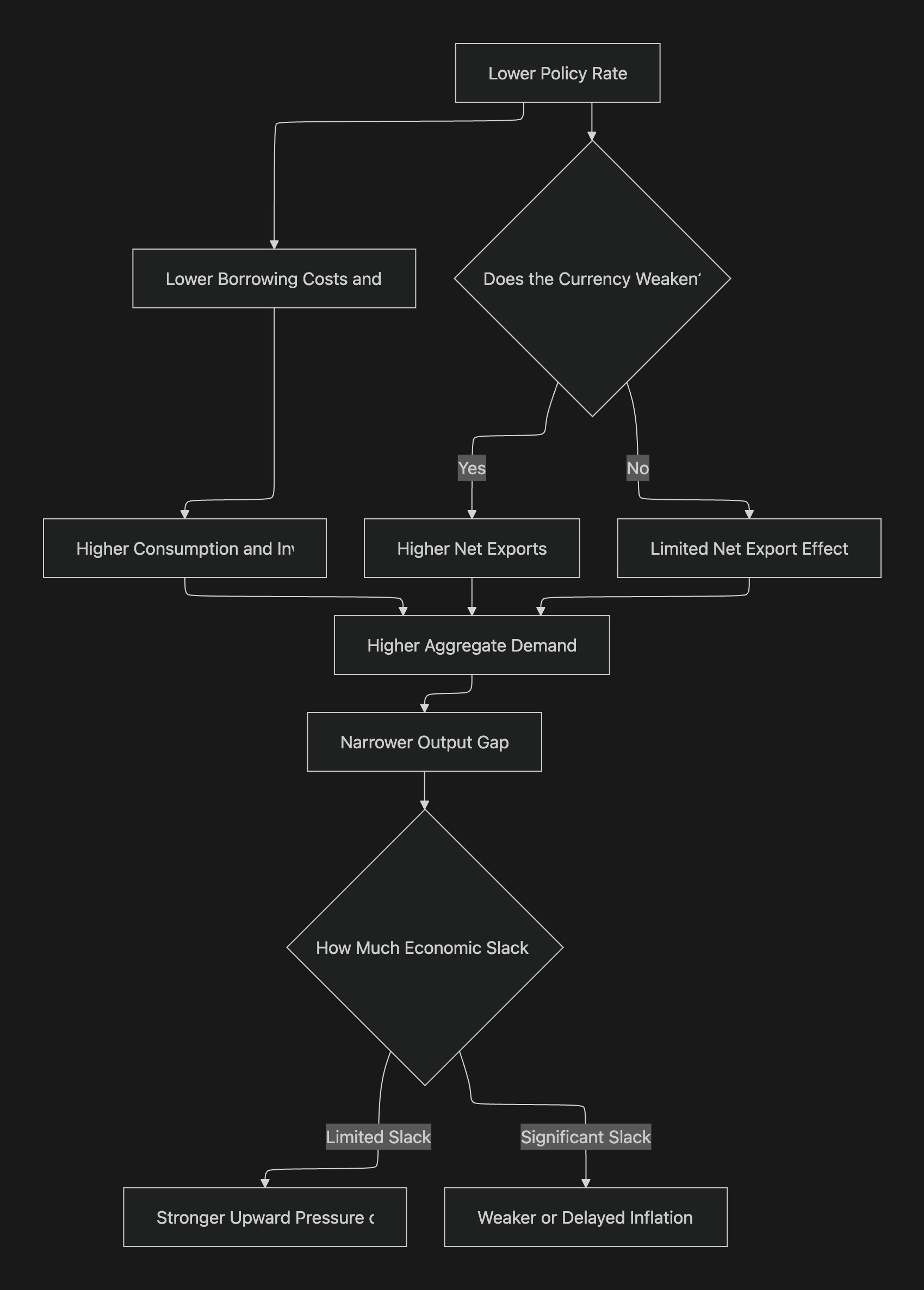
Directional chain, monetary easing
Directional chain, monetary tightening
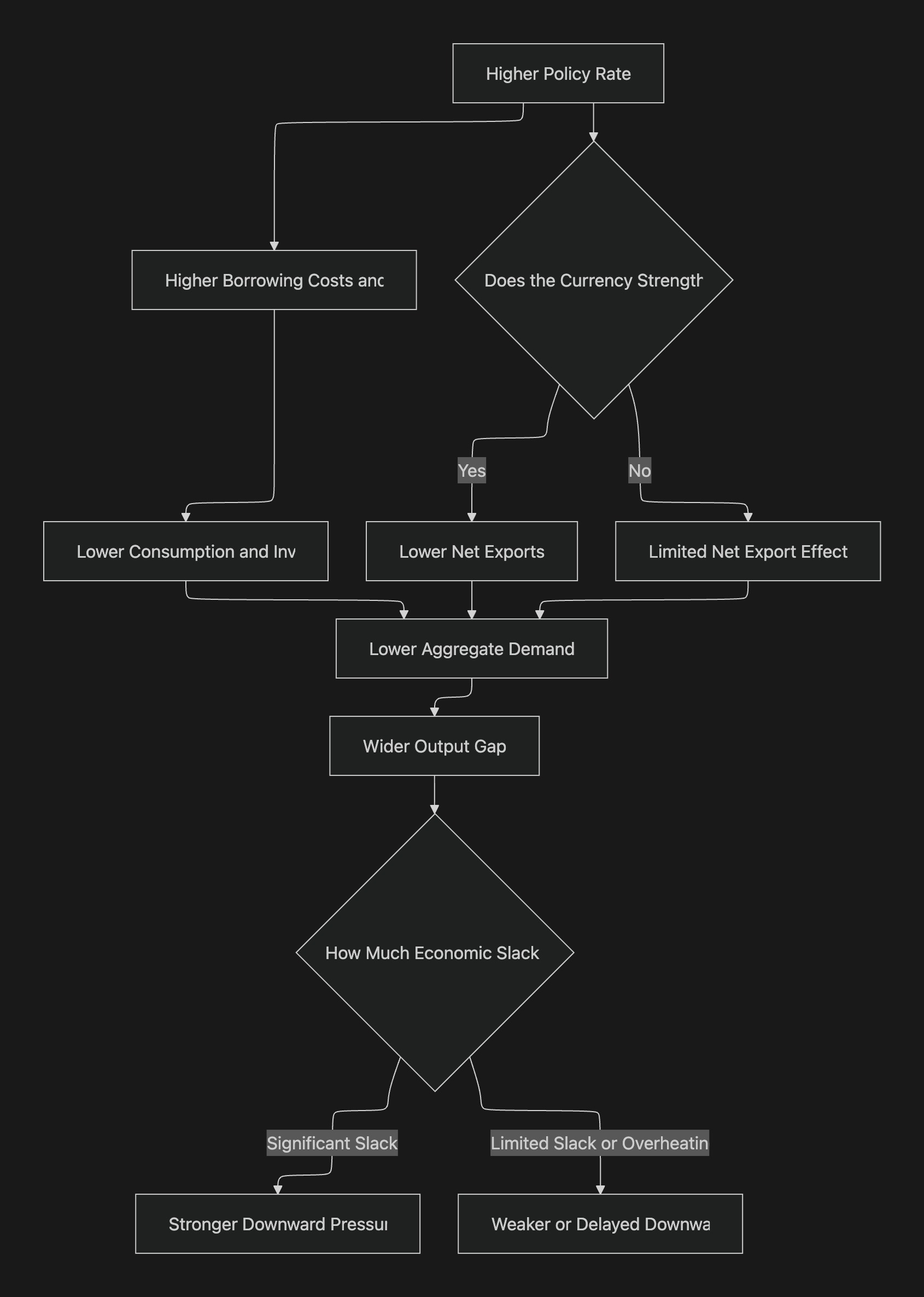
The word "conditional" matters. If an economy already operates near full capacity, higher demand from easing shows up mostly as inflation. If there is significant slack, such as high unemployment, the same demand increase shows up more as higher output and employment before inflation responds.
The exchange-rate link also runs in a specific direction: a policy rate cut that lowers a currency's relative yield tends to weaken that currency, all else equal, because investors seek higher returns elsewhere. A weaker currency supports net exports, adding to the growth effect from easing.
Why Transmission Varies
The same policy action does not produce the same result in every economy. Several factors determine channel strength.
Condition | Strong Transmission | Weak Transmission |
|---|---|---|
Borrower debt structure | Mostly floating-rate debt | Mostly fixed-rate debt |
Bank health | Well-capitalized, willing to lend | Weak balance sheets, cautious lending |
Consumer and business confidence | High confidence, spending follows rate moves | Low confidence, saving persists despite lower rates |
Economic openness | High trade and capital flow exposure | Closed economy, limited capital mobility |
Exchange-rate regime | Floating rate, exchange-rate channel active | Fixed or managed rate, exchange-rate channel muted |
Existing slack | High slack, demand raises output first | Low slack, demand raises inflation first |
A rate cut in an economy with mostly fixed-rate mortgages moves slower through household cash flow than the same cut in an economy with mostly floating-rate mortgages. A full limitation taxonomy, including liquidity traps and policy credibility problems, belongs on Limitations of Monetary Policy. Here, the point is narrower: recognize which condition weakens which channel.
Worked Example
Meridia's central bank cuts its policy rate from 4.5% to 3.5%. Most Meridian mortgages carry variable rates tied to short-term benchmarks, so household borrowing costs should fall quickly. However, Meridian's banks are still repairing balance sheets after a prior downturn and remain cautious about new lending.
Step 1: Interest-rate channel
Market rates fall alongside the policy rate. Variable-rate mortgage payments drop for existing borrowers within one or two rate-reset cycles, freeing up household cash flow.
Step 2: Credit channel
Even though funding costs fall for banks, cautious banks tighten lending standards rather than loosen them. New borrowers face slower loan approval and larger down payment requirements. The credit channel offsets part of the interest-rate channel's benefit.
Step 3: Exchange-rate channel
Meridia's lower relative rate makes its currency less attractive to foreign investors seeking yield. Capital outflows put downward pressure on the currency, which should support exports over time.
Step 4: Spending and inflation
Existing homeowners increase spending from lower mortgage payments, supporting consumption. New lending stays constrained because banks remain cautious, so investment growth lags behind what the rate cut alone would suggest. Inflation pressure builds gradually, tied more to the spending from existing borrowers than to new credit expansion.
The interest-rate and exchange-rate channels function as expected, but the credit channel is weakened by bank caution. The overall transmission is real but muted, illustrating that the mechanism is a specific product of financial conditions, not a fixed one-to-one relationship between the policy rate and macro outcomes.
Common Exam Traps
Assuming every market rate moves one-for-one with the policy rate. Market rates reflect expectations, credit risk, and term premiums. A policy rate cut does not guarantee an equal move in mortgage or corporate bond rates.
Reversing the currency effect of a relative rate decline. A lower relative policy rate tends to weaken, not strengthen, the domestic currency, because it reduces the relative return available to foreign capital.
Skipping from a tool to inflation without intermediate channels. The exam tests the full chain. Jumping directly from a rate change to an inflation outcome skips the interest-rate, credit, asset-price, expectations, and exchange-rate steps that actually connect the two.
Treating a lagged effect as policy failure. Monetary policy works with a delay, often measured in quarters. A rate change that has not yet shown a growth or inflation effect after a few months is not evidence that transmission failed.
Ignoring bank health and borrower demand. A policy rate cut only works as strongly as the willingness of banks to lend and borrowers to borrow. Weak banks or reluctant borrowers can blunt the entire mechanism even when the policy rate moves as expected.
Practice Question
An economy's central bank cuts its policy rate. Market interest rates fall in response, and consumer confidence rises following the announcement. However, the country's banking sector remains undercapitalized and continues to restrict new business loans despite lower funding costs.
Which of the following best describes the likely outcome of this policy action?
The credit channel will fully offset the interest-rate channel, and the policy action will have no net effect on demand.
The interest-rate and expectations channels will support demand, but the credit channel will weaken overall transmission because banks are not passing through looser conditions to new lending.
The exchange-rate channel will reverse the effect of the rate cut, causing the domestic currency to strengthen and offsetting the stimulus.
Correct Answer: B
The interest-rate channel is functioning, since market rates fell, and the expectations channel is functioning, since confidence rose on the announcement. The credit channel is impaired because undercapitalized banks are restricting new lending regardless of lower funding costs. This produces a mixed and weakened, not fully blocked or fully effective, transmission outcome.
Option A. This assumes total offset, which is not supported. The interest-rate and expectations channels are still working; the credit channel weakens the outcome but does not erase it.
Option C. This reverses the standard exchange-rate relationship. A policy rate cut typically weakens, not strengthens, the domestic currency, because it reduces the relative yield available to foreign investors.
Continue Your CFA Level I Prep With KeyPoint
Use structured lessons, practice questions, mock exams, and progress tracking to focus on the time you have left
FAQs About Monetary Transmission Mechanism
What are the main channels of monetary policy transmission?
The main channels are the interest-rate channel, the credit (bank-lending) channel, the asset-price (balance-sheet) channel, the expectations channel, and the exchange-rate channel. Each channel moves policy effects into the economy through a different mechanism, and they often work at different speeds.
Why can monetary transmission be weak?
Transmission weakens when banks are undercapitalized or cautious, when borrowers carry mostly fixed-rate debt that does not reprice quickly, when confidence is low despite rate cuts, or when an economy has limited exposure to trade and capital flows. Existing economic slack also affects whether demand changes show up first in output or in inflation.