
Updated for the 2026-2027 CFA® Level I curriculum.
Companies return value to shareholders through cash dividends, stock dividends, stock splits, and share repurchases. Each action changes shares outstanding, share price, or reported equity in a different way, and CFA Level I tests your ability to tell them apart.
This note also covers the dividend payment chronology, the sequence of dates that determines who actually receives a dividend. After reviewing this note, you should be able to distinguish these distribution methods and place the key dividend dates in the correct order.
Quick Answer
A regular cash dividend is a recurring cash payment; an extra or special dividend is nonrecurring.
Stock dividends and stock splits increase shares outstanding without paying cash, while reverse splits reduce shares outstanding.
A repurchase returns cash by buying shares back.
Dividend entitlement involves the declaration, ex-dividend, record, and payment dates, but the ex-dividend date is not always one business day before the record date; under current U.S. T+1 settlement, the two dates are usually the same for ordinary cash dividends.
Key Takeaways About Dividends, Stock Splits, Share Repurchases, and Dividend Payment Chronology
A regular cash dividend recurs on a predictable schedule; an extra (special) dividend is a one-time payment that does not signal a permanent increase.
A stock dividend distributes additional shares instead of cash, and total shareholders' equity does not change.
A stock split increases shares outstanding and lowers price per share proportionally, with no change in market capitalization.
A reverse stock split decreases shares outstanding and raises price per share proportionally.
A share repurchase reduces shares outstanding by buying back stock instead of distributing cash as a dividend.
Declaration comes first and payment comes last. The relationship between the ex-dividend and record dates depends on market settlement rules; under current U.S. T+1 settlement, they are usually the same day for ordinary cash dividends.
Buying a share on or after the ex-dividend date means the buyer does not receive the upcoming dividend.
What You Need to Know for CFA Level I
Distinguish a regular cash dividend from an extra (special) dividend and explain what each signals about company cash flow.
Explain how a stock dividend and a stock split each affect shares outstanding, share price, and total shareholders' equity.
Explain how a reverse stock split differs from a stock split in its effect on shares outstanding and share price.
Describe how a share repurchase differs from a cash dividend as a way to return value to shareholders.
Explain the declaration, ex-dividend, record, and payment dates, including how settlement rules determine the relationship between the ex-dividend and record dates.
Determine, given a purchase date, whether an investor is entitled to receive an upcoming dividend.
Regular and Extra Cash Dividends
A regular cash dividend is a cash payment a company expects to continue paying on a set schedule, usually quarterly. Investors treat a cut or suspension of a regular dividend as bad news because it signals reduced confidence in future cash flow.
An extra dividend, also called a special dividend, is a one-time cash payment on top of, or instead of, the regular dividend. Companies pay extra dividends when they generate cash beyond what they need for operations and growth, such as after selling a business unit. Management does not intend an extra dividend to repeat, so the market does not treat it as a signal about future regular dividends.
Stock Dividends, Stock Splits, and Reverse Stock Splits
These actions change a company’s share structure in different ways. For CFA Level I, focus on how each affects shares outstanding, share price, par value, and shareholder ownership.
Stock Dividends
A stock dividend distributes additional shares to existing shareholders instead of cash. A 5% stock dividend on 1,000 shares gives an investor 50 more shares.
No cash leaves the company. Total shareholders' equity stays the same; the company reclassifies an amount from retained earnings into common stock and additional paid-in capital. Each shareholder's proportional ownership stays the same, so a stock dividend does not create new wealth. Share price adjusts downward to reflect the larger share count.
Stock Splits
A stock split increases shares outstanding by a fixed ratio, such as 2-for-1 or 3-for-1, and reduces par value per share proportionally.
Price per share falls in the same proportion, so market capitalization and total shareholders' equity are unchanged. Companies split stock to bring the share price into a more typical trading range, often after strong price appreciation.
Reverse Stock Splits
A reverse stock split reduces shares outstanding by a fixed ratio, such as 1-for-5, and share price rises proportionally.
Companies may use a reverse split to raise the share price, often to meet a stock exchange's minimum listing price or make the stock appear less distressed.
Action | Effect on Shares Outstanding | Effect on Price per Share | Effect on Total Equity |
|---|---|---|---|
Cash dividend (regular or extra) | No change | Decreases by the dividend amount at the ex-dividend date | Decreases |
Stock dividend | Increases | Decreases proportionally | No change |
Stock split | Increases | Decreases proportionally | No change |
Reverse stock split | Decreases | Increases proportionally | No change |
Share repurchase | Decreases | No formulaic change; depends on price paid relative to value | Decreases |
Share Repurchases
A share repurchase, or buyback, is when a company buys back its own outstanding shares, using cash instead of paying a cash dividend. Repurchases reduce shares outstanding, which increases EPS if net income stays the same. Companies execute repurchases through:
Open market purchases, the most common method, buying shares on the exchange over time.
Fixed-price tender offer, buying a set number of shares at a stated price by a deadline.
Dutch auction tender offer, where shareholders submit price and quantity offers and the company sets a single clearing price.
Direct negotiation with a major shareholder.
Compared to a cash dividend, a repurchase gives management more flexibility since it is not expected to recur, and it lets shareholders choose whether to sell, and pay tax, or hold. A dividend distributes cash pro rata to all shareholders regardless of their preference. The effect on book value per share depends on the repurchase price relative to book value per share before the buyback. Repurchasing above book value per share reduces BVPS. Repurchasing below book value per share increases it.
Dividend Payment Chronology and the Sequence of Key Dates
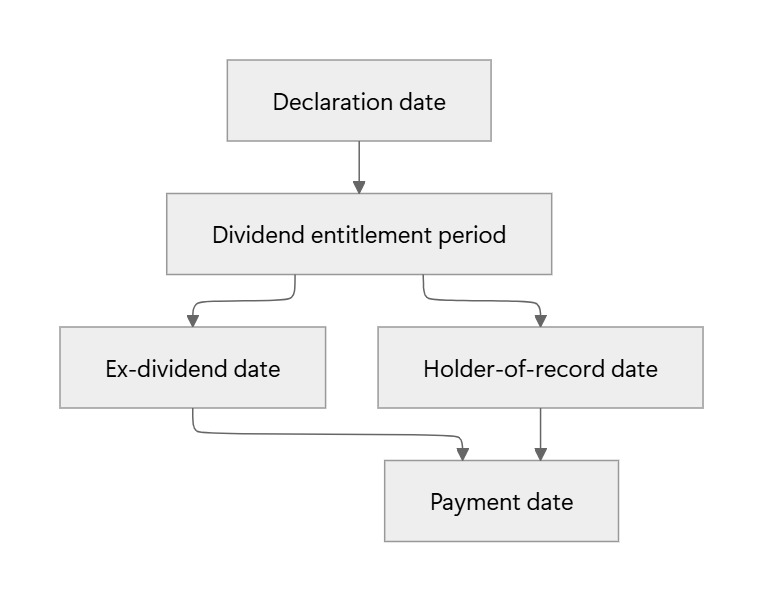
The dividend timeline has four dates that occur in a fixed order.
Declaration date. The board of directors formally approves the dividend and announces the amount, record date, and payment date.
Ex-dividend date. The first date a share trades without the right to the announced dividend. An investor who buys on or after the ex-dividend date does not receive the dividend; the seller keeps that right.
Holder-of-record date (record date). The company uses its records on this date to identify eligible shareholders. Settlement timing determines the related ex-dividend date. Under current U.S. T+1 settlement, the ex-dividend date is usually the record date for an ordinary cash dividend; special distributions and stock dividends may follow different rules.
Payment date. The date the company actually distributes the dividend to shareholders of record.
Sequence to understand: declaration comes first, payment comes last, and settlement rules determine whether the ex-dividend date precedes or coincides with the record date.
Worked Example: Stock Split and Share Repurchase
Setup: Vantage Robotics has shares outstanding at per share and net income of .
Step 1: Stock split
The board declares a 4-for-1 stock split.
Step 2: Share repurchase
Six months later, Vantage repurchases 2,000,000 shares at $20 each, spending $40,000,000.
The stock split alone did not change Vantage's total value or earning power. It only changed the number of shares and the price per share. The repurchase reduced shares outstanding at that point in time, mechanically raising EPS even though net income did not improve.
Future share issuance could reverse some or all of that reduction, so a post-repurchase EPS increase is not evidence of stronger operating performance.
Common Exam Traps
Confusing a stock dividend with a cash dividend
A stock dividend distributes more shares and leaves total shareholders' equity unchanged. A cash dividend distributes cash and reduces both cash and total shareholders' equity.
Reversing stock split and reverse stock split effects on shares outstanding
A stock split increases shares outstanding and lowers price per share. A reverse stock split decreases shares outstanding and raises price per share.
Treating a repurchase as identical to a dividend
A repurchase is optional, reduces share count, and lets shareholders choose whether to participate. A dividend distributes cash to every shareholder pro rata.
Treating the ex-dividend and record dates as having one universal spacing rule
Declaration comes before entitlement is determined and payment comes later, but settlement conventions determine whether the ex-dividend date precedes or coincides with the record date. Buying on or after the ex-dividend date generally means missing the upcoming dividend.
Assuming a repurchase automatically improves value
Repurchasing at a price above book value per share reduces BVPS. The effect depends on the price paid relative to value, not just the fact that a repurchase happened.
Practice Question
Delta Industries declares an ordinary cash dividend on March 1. The ex-dividend and record dates are both March 15 under the applicable T+1 settlement convention, and the payment date is April 5. Marta buys 200 shares on March 15. Does Marta receive the upcoming dividend?
Yes, because she purchased on the record date.
No, because she purchased on the ex-dividend date, so the seller retains the right to the dividend.
Yes, because dividend rights are determined by who holds shares on the payment date.
Correct Answer: B
Marta bought on the ex-dividend date, so the shares traded without the right to the announced dividend. She is not entitled to it; the seller retains the right. Under the stated T+1 convention, the ex-dividend and record dates coincide.
Option A: Confuses the record date with the entitlement rule. A purchase on the ex-dividend date is already ex dividend, even when that date coincides with the record date.
Option C: Confuses the payment date, when cash is distributed, with the date that determines who is entitled to receive it.
Continue Your CFA Level I Prep With KeyPoint
Use structured lessons, practice questions, mock exams, and progress tracking to focus on the time you have left
FAQs About Dividends, Stock Splits, Share Repurchases, and Dividend Payment Chronology
What is the difference between a stock split and a stock dividend?
Both increase shares outstanding without paying cash. A stock split changes par value per share and is usually expressed as a ratio, like 2-for-1. A stock dividend is expressed as a percentage of existing shares, like a 5% stock dividend. Both leave total shareholders' equity unchanged.
Does a share repurchase always increase EPS?
A repurchase increases EPS mechanically when net income stays the same and shares outstanding fall. It does not reflect improved operating performance. If net income declines during the same period, EPS may not increase.
Does the ex-dividend date always come before the holder-of-record date?
No. The relationship depends on settlement rules. Under current U.S. T+1 settlement, the ex-dividend date is usually the same day as the record date for an ordinary cash dividend; some special or stock distributions follow different rules.