
Standard I(D): Misconduct addresses professional dishonesty and conduct that damages trust in you as a professional. It has two parts: a ban on dishonesty, fraud, and deceit, and a broader rule against acts that reflect adversely on your professional reputation, integrity, or competence. The hard part on the CFA® Level I exam is judging when personal conduct crosses into professional misconduct, and when it does not.
Quick Answer
Standard I(D) prohibits any professional conduct involving dishonesty, fraud, or deceit. It also prohibits any act that reflects adversely on your professional reputation, integrity, or competence, even if that act is legal. Not every personal offense or unfavorable outcome is professional misconduct. The question is whether the conduct involves dishonesty or meaningfully undermines professional trust.
Key Takeaways About Professional Misconduct
Dishonesty, fraud, deceit, lying, cheating, or stealing in professional activities are clear violations.
Personal conduct can violate the Standard when it has a real connection to professional trust, integrity, or competence.
A lawful act can still breach the Standard, and an arrest or minor offense does not by itself prove a violation.
A poor investment result is not misconduct when the professional acted honestly and competently.
A common trap is treating every illegal act, or every bad outcome, as automatic misconduct.
What You Need to Know for CFA Level I
The first branch is straightforward. Dishonesty, fraud, deceit, lying, cheating, or stealing tied to your professional work violates the Standard. The second branch is where judgment comes in. Personal conduct matters when it has a meaningful connection to professional trust, integrity, or competence, and it can matter even if the conduct was legal.
Direction runs both ways. An arrest or a minor offense does not automatically establish a violation, and a losing investment is not proof of misconduct if the work behind it was honest and competent. Misconduct also overlaps with other Standards, so the same act can engage Knowledge of the Law, Misrepresentation, Loyalty, or Competence at the same time.
What Does Standard I(D) Require?
You must not engage in professional conduct involving dishonesty, fraud, or deceit, and you must not commit any act that reflects adversely on your professional reputation, integrity, or competence. Separate the two branches. The first targets dishonest professional conduct directly. The second is broader and reaches acts, sometimes outside work, that damage trust in you as a professional. Professional trust is the thread running through both.
What Is Professional Misconduct?
Professional misconduct centers on dishonesty in how you do your job. Falsifying expense claims, treating clients deceptively, creating fraudulent records, cheating on a professional exam, and stealing all qualify. Because one act can break several rules, misconduct often appears alongside other Standards. A simple performance mistake, made honestly and without deceit, is not misconduct just because the result disappointed.
When Does Personal Misconduct Violate the Standard?
Use a short test rather than a blanket assumption.
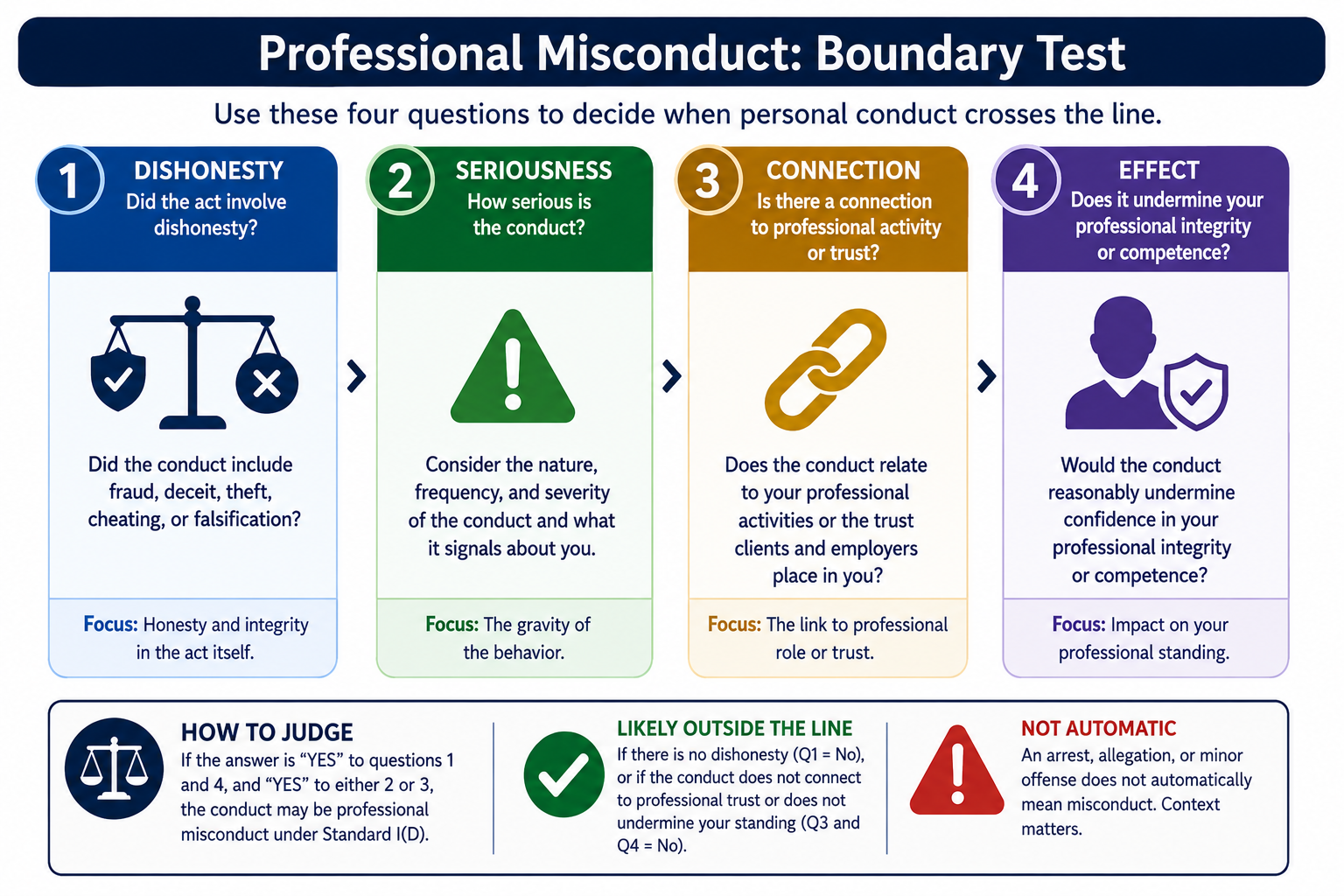
Dishonesty: did the act involve fraud, deceit, or theft?
Seriousness: how serious is the conduct, and what does it signal?
Connection: does it connect to professional activity or to the trust clients place in you?
Effect: does it undermine your professional integrity or competence?
Private conduct that does not touch professional trust generally falls outside the Standard. Fraudulent or deceptive personal conduct that does touch it can fall inside. An allegation or an arrest on its own is not a proven violation.
What Does Not Automatically Count as Misconduct?
Several situations look risky but are not violations by themselves. A poor investment outcome after reasonable work is one. Personal beliefs, peaceful civic activity, or unpopular views, with no dishonesty and no professional impairment, are another. Ordinary mistakes corrected in good faith do not qualify. Neither do minor personal matters that have no meaningful connection to professional integrity or competence.
Recommended Procedures for Compliance
Firms reduce misconduct risk by adopting and enforcing a clear code of ethics. Set explicit expectations for honesty in expenses, records, client communications, and workplace behavior. Use fair investigation and escalation procedures rather than acting on accusations alone, and document remedial steps when conduct may affect professional responsibilities.
Compliant Scenario
Situation: Marcus, a CFA candidate, joins a peaceful weekend rally about a local zoning decision. Police issue him a minor citation for blocking a footpath. There is no violence, no dishonesty, and no link to his work or his clients.
Issue: A citation appears on his record, which raises the question of whether it reflects adversely on his professional integrity or competence.
Correct action: Marcus treats the citation as a personal civic matter, handles it through the normal process, and does not misrepresent anything related to it at work.
Why it complies: The conduct involved no dishonesty and no professional impairment. A minor citation from lawful civic activity does not, by itself, reflect adversely on his professional reputation, integrity, or competence.
Violation Scenario
Situation: Lena forgot to claim a legitimate $180 client-meeting expense last quarter, and the window to submit it has closed. To recover the money, she creates a fake receipt from a vendor for a different, never-incurred expense of roughly the same amount and submits it.
Violation: The fabricated receipt is dishonest and deceptive, which breaches the first branch of Standard I(D).
Required alternative: Lena should raise the missed legitimate expense with her manager or finance team through the proper exception process and accept the outcome, rather than fabricating a document.
Why the original action fails: Believing the dollar amount is "fair" does not remove the dishonesty. She knowingly created a false record, and that is misconduct regardless of the math.
Common Exam Traps
Equating any arrest with a violation. Legality is not the test. Dishonesty and adverse reflection are.
Asking only whether it happened at work. Personal conduct can violate the Standard when it connects to professional trust.
Reading a bad outcome as misconduct. An honest, competent process that loses money is not a violation.
Excusing dishonesty because the result feels fair. Intent to deceive still counts even when the dollar figure seems even.
Missing overlap. The same act can also engage Standard I(A), I(C), or I(E).
Practice Question
An analyst is involved in three separate situations. First, she makes a good-faith error in a discounted cash flow model that a reviewer later catches and she promptly corrects. Second, she receives a minor citation at a lawful neighborhood protest unrelated to her work. Third, she submits an expense report with a deliberately inflated mileage figure to claim more reimbursement than she is owed. Which action most clearly violates Standard I(D)?
The good-faith modeling error that she corrected.
The minor citation from the lawful protest.
The deliberately inflated expense claim.
Correct Answer: C
Inflating the expense claim is dishonest and deceitful, which directly violates Standard I(D).
Why A is wrong: An honest mistake, corrected in good faith, is not misconduct. It shows no dishonesty and no broader competence problem.
Why B is wrong: A minor citation from lawful civic activity, with no dishonesty or professional impact, does not by itself reflect adversely on professional integrity.
Continue Your CFA Level I Prep With KeyPoint
Use structured lessons, practice questions, mock exams, and progress tracking to focus on the time you have left
FAQs About Standard I(D): Misconduct
Can personal misconduct violate CFA Standard I(D)?
Yes, when it involves dishonesty or has a meaningful connection to professional trust, integrity, or competence. Private conduct with no such connection generally falls outside the Standard.
Is an investment loss evidence of professional misconduct?
No, not on its own. If you acted honestly and competently and the outcome still disappointed, that is not misconduct. The Standard looks for dishonesty or adverse reflection, not for a losing result.
Does every illegal act count as professional misconduct?
No. Legality is not the test. A minor or personal offense with no dishonesty and no connection to professional trust may not violate Standard I(D), while a lawful act involving deceit still can. The questions are whether the act involved dishonesty and whether it reflects adversely on your professional reputation, integrity, or competence.