
Standard I(A): Knowledge of the Law sets the floor for professional conduct. It asks you to understand the laws, rules, and regulations that govern your work, follow the strictest one when they conflict, and step away from any violation you know about. On the CFA® Level I exam, the knowledge of the law questions usually test which rule controls across jurisdictions and when staying silent turns into taking part.
Quick Answer
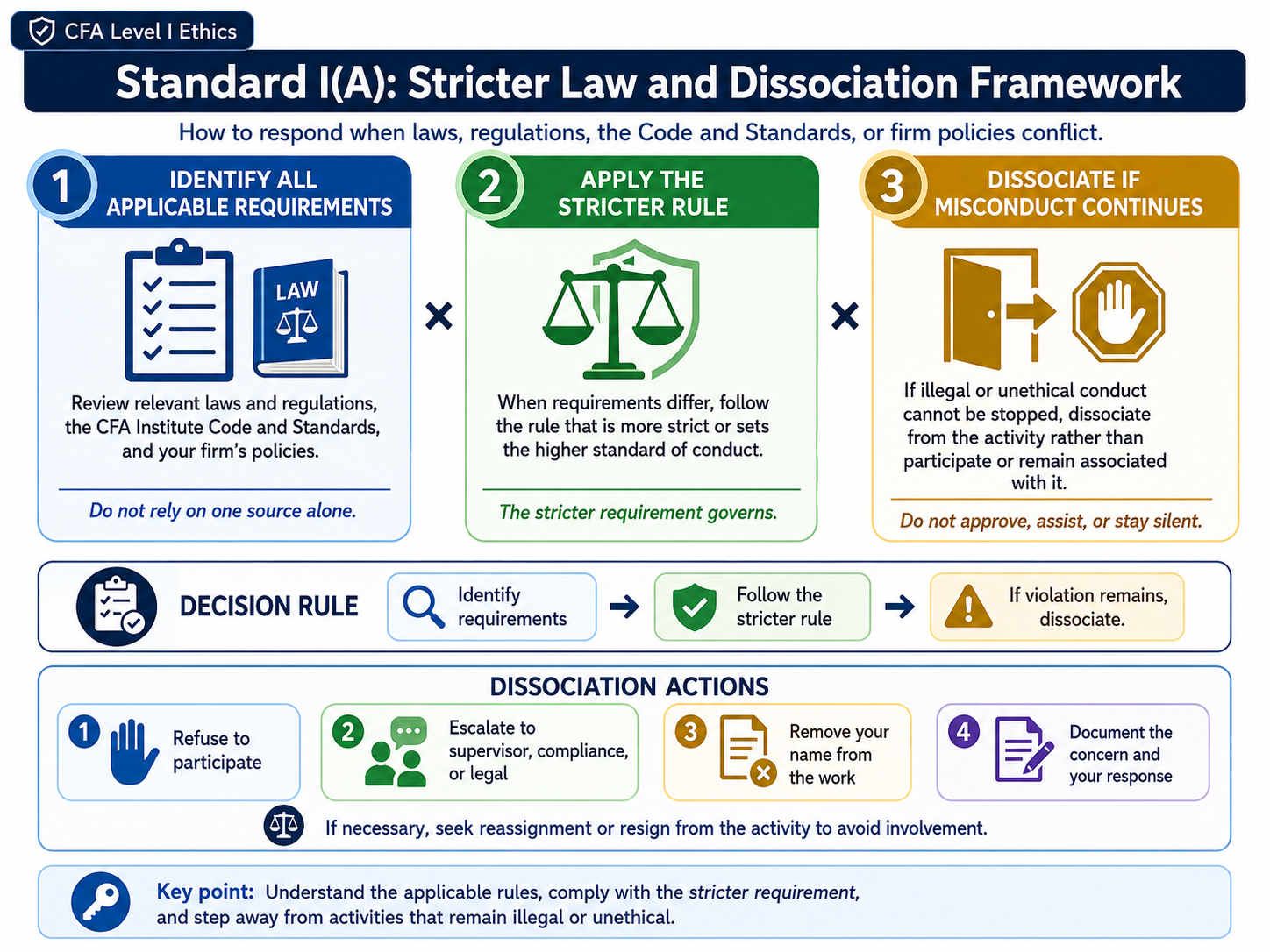
Standard I(A) requires you to understand and comply with all applicable laws, rules, and regulations governing your professional activities, including the CFA Institute Code and Standards. When two rules conflict, you follow the stricter one. You must not knowingly help a violation, and if it continues, you have to dissociate from it.
Key Takeaways
The rule covers government law, regulators, licensing bodies, professional associations, and CFA Institute requirements that apply to your activities.
When requirements conflict, the stricter rule wins. "Stricter" means greater restriction or a higher protective duty, not the harsher penalty.
Where no law applies, the Code and Standards still govern your conduct.
You are not expected to be a lawyer, but you must make a reasonable, good-faith effort to stay informed and ask the right people when unsure.
Once you know about a violation, you must stop participating, and dissociate if it is not corrected. A common trap is reporting it internally, then carrying on with the work anyway.
What You Need to Know for CFA Level I
"Applicable law" depends on the facts and the jurisdiction that governs the conduct, not on where you happen to live. Conduct can be legal under one set of rules and still breach the Code if the Code asks more of you. When no law speaks to the situation, the Code and Standards fill the gap.
You do not need to memorize every statute. You do need a working knowledge tied to your responsibilities, and the judgment to consult legal or compliance experts when a question is outside your depth. The moment you know a violation is happening, inaction stops being neutral. Continuing to associate with the activity can be read as participation, so you must stop and, if nothing changes, dissociate.
What Does Standard I(A) Require?
In plain terms, you must know the rules that apply to your work and comply with them, and when government law and the Code point in different directions, you follow whichever asks more. You also must not knowingly participate in or assist a violation.
A few definitions help here. Applicable law is the law that actually governs the conduct in question. A stricter requirement is the one that places a greater restriction or a greater duty of care on you. Knowing participation means you are aware of the violation and still take part or help it along. Compliance with the law is the minimum, not always the full extent of your ethical duty.
How Do You Apply the Stricter-Requirement Rule?
Work through the conflict in a set order rather than reaching for the rule you know best. First identify which law governs the conduct. Then compare that law against the Code and Standards. Apply whichever is stricter. If you are unsure which rule controls, get guidance before you act.
Situation | Which rule applies |
|---|---|
Governing local law is stricter than the Code | Follow the local law |
The Code is stricter than local law | Follow the Code and Standards |
No applicable law exists | Follow the Code and Standards |
Jurisdiction is unclear | Pause and confirm with compliance or counsel before acting |
Remember that "stricter" turns on restriction and protection, not punishment. A rule with a smaller fine can still be the stricter rule if it limits your conduct more.
What Should You Do When You Discover a Violation?
Start by raising the issue through the right internal channel, usually a supervisor or the compliance department. Stop taking part in the activity and refuse to help it continue. If corrective action is not taken, dissociate by removing your name, your work, or your participation. In serious cases that may mean resigning. Reporting to an outside regulator is a separate question that depends on what the law requires of you, so do not assume the Standard always demands it.
What Actions Comply With the Standard?
Compliant conduct looks practical. You keep working knowledge current for the responsibilities you actually hold. You use legal or compliance resources when a requirement is unclear, document the guidance you receive, and follow the stricter rule. When an activity is improper and does not get fixed, you take your name and your work off it.
What Counts as a Violation?
Violations usually involve choosing the easier rule or staying attached to bad conduct. Examples include ignoring a stricter requirement because a more permissive jurisdiction allows the activity, continuing to prepare or distribute work you know supports a violation, helping someone else's unlawful or unethical conduct, and letting your legal knowledge go stale after your role changes.
Recommended Procedures for Compliance
Firms support this Standard by keeping current laws, regulations, policies, and CFA Institute requirements accessible to staff. Periodic, role-specific compliance training helps people spot issues early. Clear escalation and documentation procedures give employees a route to raise concerns. When a question is genuinely legal, qualified advice beats a guess.
Compliant Scenario
Situation: Naomi structures a private bond placement for her firm, which is headquartered in one country, but the notes will be marketed to investors in another country where she travels for the deal. Her home country lets firms approach a broad pool of investors. The country where the investors live restricts solicitation to a narrower, qualified group.
Issue: The two regimes conflict, and the investor country's rule is the stricter one and governs the transaction.
Correct action: Naomi confirms with compliance which law governs, then limits the offering to the qualified investors allowed under the investor country's rule, even though her home country would have allowed a wider net.
Why it complies: She applies the stricter requirement of the jurisdiction that actually governs the conduct instead of defaulting to her home-country rule.
Violation Scenario
Situation: Theo helps prepare a fund's marketing deck. He learns that the headline return figures were generated using a data source the firm is not licensed to use for client materials, which makes the figures unlawful to publish.
Violation: Theo flags the problem to his manager, who tells him to leave it and finish the deck. Theo keeps building and circulating the materials.
Required alternative: After raising the concern, Theo should stop working on the deck and refuse to distribute it. If the firm will not correct the figures, he should dissociate by removing his name and his contribution, escalating further if needed.
Why the original action fails: Reporting once does not end his duty. By continuing to prepare and distribute work he knows is improper, his inaction becomes knowing participation.
Common Exam Traps
Assuming home-country law always controls. The governing jurisdiction depends on the facts, not on where the member is based.
Picking the harsher penalty instead of the stricter conduct rule. The test is which rule restricts you more or protects clients more, not which one punishes harder.
Treating "no local law" as permission. When no law applies, the Code and Standards still bind you.
Stopping at an internal complaint. Raising a concern and then continuing the work still counts as participation.
Assuming outside reporting is always required. Dissociation is the core duty. External reporting depends on what the law requires.
Practice Question
A portfolio manager works for a firm based in Country A, where soliciting retail investors for a new structured product is permitted. She is marketing the same product to investors located in Country B, where regulators prohibit soliciting retail investors for that product type. She tells her compliance officer about the conflict but plans to keep marketing to Country B retail investors because Country A allows it. Under Standard I(A), she should most appropriately:
Continue marketing to Country B retail investors, because her firm's home-country law permits it.
Stop soliciting Country B retail investors and follow Country B's stricter rule that governs the conduct.
Continue marketing, because she has already disclosed the conflict to compliance.
Correct Answer: B
The conduct is governed by Country B's law, which is stricter than Country A's. Standard I(A) requires the member to comply with the stricter applicable rule.
Why A is wrong: Home-country law does not control conduct that is governed by another jurisdiction. Country B's rule applies here.
Why C is wrong: Telling compliance about the conflict does not cure it. Continuing the prohibited solicitation is still a violation, regardless of disclosure.
Continue Your CFA Level I Prep With KeyPoint
Use structured lessons, practice questions, mock exams, and progress tracking to focus on the time you have left
FAQs About Standard I(A): Knowledge of the Law
Which rule applies when local law and the CFA Code and Standards conflict?
You follow the stricter one. If the governing local law restricts your conduct more than the Code, you follow the local law. If the Code asks more than the law, you follow the Code. Where no law applies, the Code and Standards govern.
Does Standard I(A) always require reporting a violation to regulators?
No. The Standard's core duty is to avoid participating and to dissociate from a violation that is not corrected. Reporting to an outside authority depends on whether the applicable law requires it.
What does dissociation mean under CFA Standard I(A)?
Dissociation means separating yourself from the violation so your continued involvement can't be read as taking part. It is different from reporting. The exact form depends on your role and can include removing your name from a report or recommendation, asking to be reassigned, refusing to take on or keep advising a client tied to the conduct, or resigning in serious cases.