
Standard I(C): Misrepresentation prohibits knowingly false or misleading statements in your professional work. It also covers omissions that make accurate information misleading, and plagiarism that passes off another person's work as your own. The misrepresentation examples on the CFA® Level I exam often hide the violation in a dropped caveat, a missing source, or a cherry-picked number rather than an outright lie.
Quick Answer
Standard I(C) prohibits knowingly making any misrepresentation related to your professional activities. A misrepresentation can be an outright false statement or an omission that makes otherwise accurate information misleading. Plagiarism is a form of misrepresentation, because using someone else's work or ideas without proper acknowledgment passes their effort off as yours.
Key Takeaways About Misrepresentation Examples
The rule covers written, spoken, digital, and social-media communications about your professional work.
It applies to credentials, firm capabilities, services, performance, research, and authorship.
Accurate numbers can still mislead when a material caveat, input, or weak account is left out.
Plagiarism includes direct copying, close paraphrasing, and reusing charts, tables, forecasts, or methods without credit.
A common trap is assuming only outright lies count. Knowingly distributing misleading content is enough, even without intent to deceive.
What You Need to Know for CFA Level I
The Standard reaches every professional channel, from a research report to a LinkedIn profile. Credentials, firm capabilities, services, performance history, and investment results all have to be described accurately. Removing a material caveat, a model input, or a poorly performing account can turn true figures into a misleading picture.
Attribution matters just as much as accuracy. Direct quotations, paraphrases, proprietary charts, forecasts, and methodologies generally require a credit. Research and models built inside a firm can remain firm property, and you may use them, but you must not falsely claim sole authorship of work that was not solely yours.
What Does Standard I(C) Require?
You must not knowingly make a misrepresentation in your professional activities. "Knowingly" means you are aware the statement or omission is false or misleading. A material misrepresentation is one that could affect a reasonable person's decision. A misleading omission leaves out a fact that the audience needs to read the information correctly. Plagiarism uses another's work or ideas as if they were yours. Intent to deceive is not the only trigger. Knowingly passing along misleading content can be enough on its own.
What Are Common Misrepresentation Examples?
It helps to sort misrepresentation by what is being misstated rather than memorizing a long list.
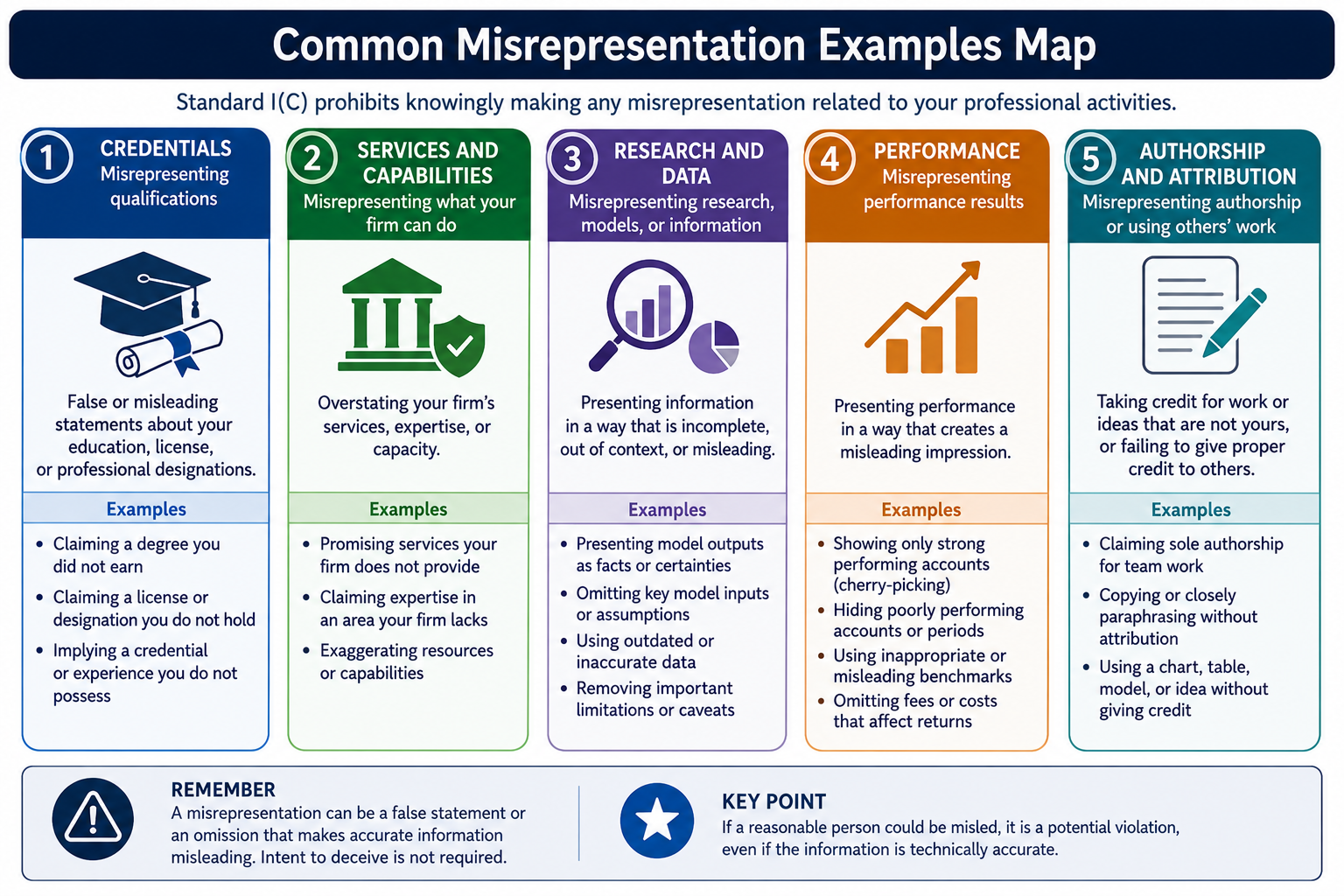
Credentials: claiming a degree, license, or designation you do not hold.
Services and capabilities: promising your firm can do something it cannot.
Research and data: presenting model outputs as facts or removing inputs that change the read.
Performance: showing only your strongest accounts while hiding the weak ones.
Authorship: claiming sole credit for work that came from a colleague, a former employee, or a third party.
The trickiest example is the accurate statement that misleads. A return figure can be true and still misrepresent the strategy if the caveat that explains it has been quietly dropped.
Misrepresentation of Credentials and Services
Describe your qualifications and your firm's capabilities exactly as they are. There is a clear line between listing the services you genuinely offer and claiming expertise or capacity you do not have. Overstating experience, exaggerating a track record, or implying a credential you have not earned all fall on the wrong side of that line.
Rules about how you describe the CFA® designation specifically live in Standard VII(B), so check there rather than treating designation claims as the same as general credential claims.
Misrepresentation of Data, Models, and Performance
Data and performance are where omissions do the most damage. Watch for omitted model inputs, outputs presented as certainties, cherry-picked accounts, misleading benchmarks, and removed limitations. Using third-party information does not transfer away your responsibility. If you knowingly pass along misleading content from someone else, you own that. Deeper rules on presenting performance fairly sit in Performance Presentation, and rules on disclosing methods and risks sit in Communication with Clients.
Plagiarism and Source Attribution
Plagiarism is broader than copying a paragraph. It includes close paraphrasing, unlabeled quotations, and reusing charts, tables, forecasts, or proprietary methods without credit. You can rely on recognized factual sources and on firm-owned work, but you must not overstate your authorship in the process. Keep records of your source material, and attribute quotations, summaries, statistics, and methodologies wherever credit is due. When you are unsure whether something needs a citation, cite it.
Recommended Procedures for Compliance
Keep an accurate, current summary of your qualifications and your firm's services. Review websites, biographies, proposals, and social profiles on a schedule so stale claims do not drift into misrepresentation. Hold on to copies of source material, and attribute the quotations, summaries, tables, statistics, and methods you use. Build review and correction processes for third-party research and for any errors you discover after publishing.
Compliant Scenario
Situation: Aisha inherits a valuation model that a former colleague built while employed at the firm. The model belongs to the firm. She refreshes the inputs, runs the updated analysis, and publishes a report under the firm's name.
Issue: She is using work she did not originate, so the question is whether her representation of authorship is honest.
Correct action: Aisha publishes under the firm's name, presents the analysis as the firm's work, and does not claim that she personally designed the model.
Why it complies: The model is firm property, which she may use, and she does not misstate her own role. There is no false claim of sole authorship.
Violation Scenario
Situation: A strategist finds a compelling chart in an external research note and wants to use it. He removes the original source line, drops a footnote that flagged a key data limitation, and inserts the chart into his own report as original analysis.
Violation: Two problems appear at once. Stripping the source is plagiarism, and removing the limitation is a misleading omission that changes how readers interpret the chart.
Required alternative: He should credit the external source, keep the limitation visible, and present the chart accurately rather than as his own work.
Why the original action fails: Using another's work without attribution misrepresents authorship, and cutting the caveat misrepresents the data even though the chart itself is accurate.
Common Exam Traps
Thinking only lies qualify. A misleading omission is misrepresentation even when every number shown is true.
Assuming accurate numbers cannot mislead. Drop the wrong caveat and accurate figures become a false picture.
Treating a paraphrase as original. Changing the wording does not remove the need to credit the source.
Outsourcing responsibility. Relying on third-party research does not excuse knowingly distributing misleading content.
Confusing I(C) with narrower rules. Performance presentation and use of the CFA designation have their own Standards.
Practice Question
A research note contains three actions. First, the analyst uses a forecasting model owned by her firm and presents the report as the firm's work. Second, she cites an external economist by name for a growth statistic she quotes. Third, she copies a competitor's risk chart, deletes the source, and removes the competitor's note that the data excludes a major market. Which action most likely violates Standard I(C)?
Using the firm-owned model and presenting the report as the firm's work.
Quoting the external economist's statistic with attribution.
Reusing the competitor's chart with the source and the limitation removed.
Correct Answer: C
Removing the source is plagiarism, and deleting the limitation is a misleading omission. Both breach Standard I(C).
Why A is wrong: Firm-owned work may be used and presented as the firm's, with no false authorship claim.
Why B is wrong: A properly attributed statistic credits the source, which is exactly what the Standard expects.
Continue Your CFA Level I Prep With KeyPoint
Use structured lessons, practice questions, mock exams, and progress tracking to focus on the time you have left
FAQs About Standard I(C): Misrepresentation
What is a material misrepresentation under CFA Standard I(C)?
It is a knowingly false or misleading statement, or a misleading omission, that could affect a reasonable person's decision. The misstatement is material when it would change how the audience understands or acts on the information.
Does paraphrasing require source attribution?
Yes, when you are using another person's ideas, analysis, or data. Changing the wording does not make the work yours. Credit the original source to stay within the Standard.
Can an analyst use research or models created by a former employee?
Yes, if the firm owns the work. You may use and update it, but you must not claim you personally created it. Present it as the firm's work and credit any external sources it relies on. Claiming sole authorship of someone else's model is a misrepresentation of your role.