
Your responsibilities as a CFA Institute member or candidate fall into two clear lanes. CFA® Standard VII(A) is about how you behave inside CFA Institute programs, including the exam. Standard VII(B) is about how you describe your status and your credentials to other people. Because both involve CFA Institute, candidates mix them up. The fix is simple: ask whether the issue is conduct within a program or a statement about your standing. Current CFA Institute rules and policies always control.
Quick Answer
CFA Standard VII has two parts.
VII(A) Conduct as Participants in CFA Institute Programs prohibits conduct that compromises CFA Institute, the CFA designation, or the integrity, validity, and security of its programs.
VII(B) Reference to CFA Institute, the CFA Designation, and the CFA Program prohibits misrepresenting or exaggerating your membership, candidacy, the designation, or what the program means.
Key Takeaways About CFA Standard VII
Cheating, circumventing rules, and sharing confidential exam content can violate VII(A).
Candidates may share opinions about the program as long as they do not reveal confidential information.
Candidate status has to be described accurately, for the specific exam you are registered for.
Passing one or more exam levels is not a partial designation.
Charterholders must keep the applicable right to use the designation active.
A factual statement is different from a claim of superior ability or guaranteed performance.
What You Need to Know for CFA Level I
Learn the names and order of VII(A) and VII(B). Understand program integrity and security, what counts as confidential exam information, and what opinion or general discussion is still allowed. Know how to describe candidate, member, and charterholder status, and the line between a proper and an improper designation reference. The most common overlap is with I(C) Misrepresentation, so watch for status claims that drift into false statements.
What Does CFA Standard VII Cover?
Standard VII covers program conduct and accurate references. The map below separates the two.
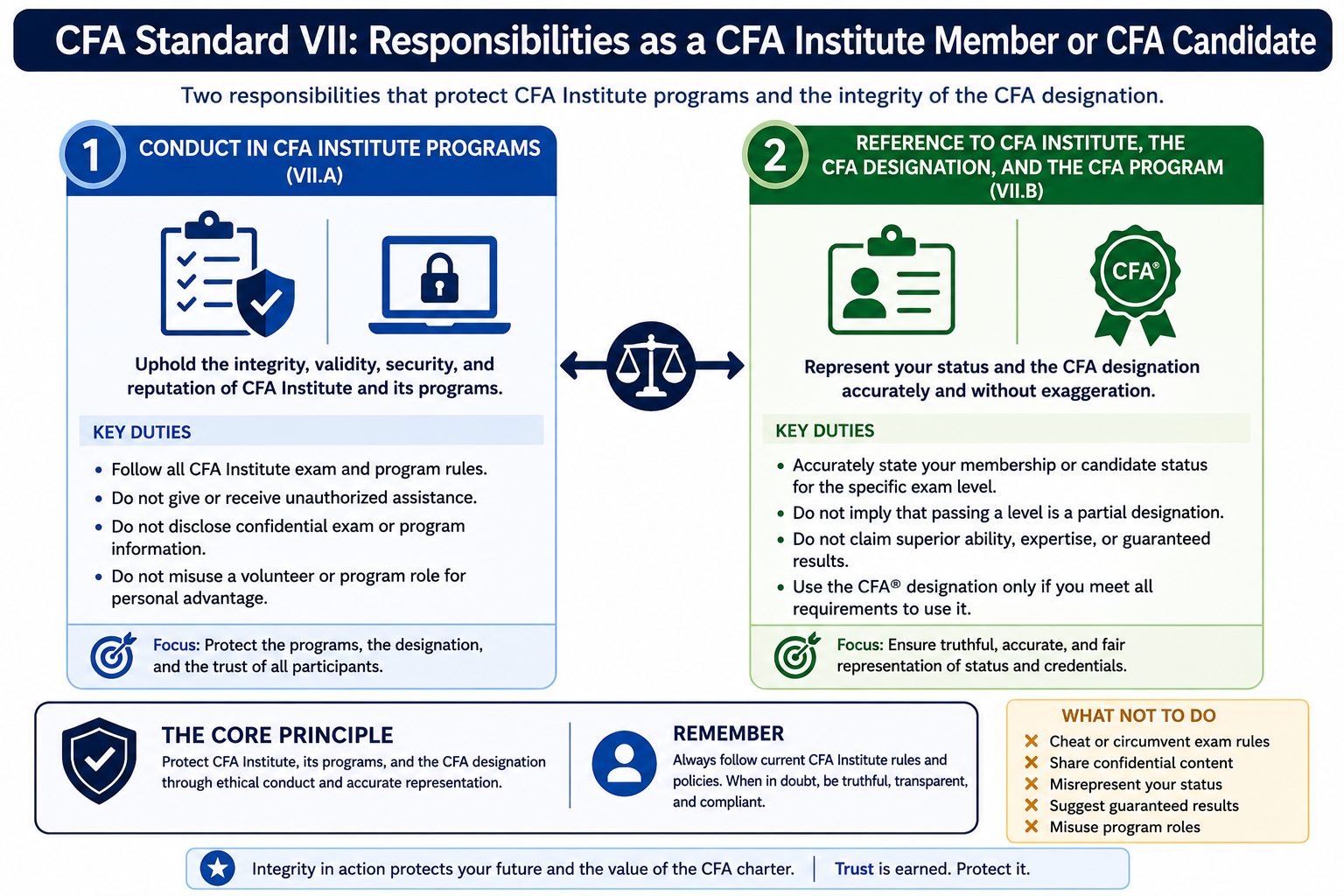
Standard VII(A): Conduct as Participants in CFA Institute Programs
Standard VII(A) protects the reputation and integrity of CFA Institute and the CFA designation, and the integrity, validity, and security of its programs. In practice, you follow current exam and program rules, you neither give nor receive prohibited assistance, and you do not disclose confidential exam or program information.
If you hold a volunteer or program role, you do not misuse it for an improper advantage. Importantly, cfa candidate conduct does not forbid criticism or opinion. You can say the exam was hard or a reading was dense, as long as you do not reveal confidential content.
Standard VII(B): Reference to CFA Institute, the CFA Designation, and the CFA Program
Standard VII(B) governs how you describe your standing. Factual statements may be fine. What is not fine is misrepresenting or exaggerating membership, candidacy, the designation, or what the program implies. Claims of superior skill, guaranteed results, or better investment performance because of the charter are prohibited.
Candidate references must match your current status, and passing levels does not create a partial designation. The right to use the designation depends on meeting current membership requirements. Correct cfa designation usage applies everywhere your name appears, including resumes, biographies, email signatures, websites, business cards, and social profiles.
Standard VII(A) vs Standard VII(B)
Area | Standard VII(A) | Standard VII(B) |
|---|---|---|
Main focus | Conduct within or affecting CFA Institute programs | Statements about CFA Institute, membership, candidacy, and designation |
Common trigger | Cheating, rule violation, confidential content, misuse of program role | Incorrect status, partial designation, exaggerated claim |
Core question | Did the conduct compromise program integrity, validity, security, or reputation? | Was the reference factual, accurate, and not exaggerated? |
Common overlap | Misrepresentation, misconduct | Misrepresentation and trademark or membership rules |
What Can Candidates Discuss After an Exam?
The line runs between your personal experience and the exam's confidential content. Current CFA Institute policies control, so check them directly.
Generally acceptable at a high level:
Your personal opinion about how hard the exam felt.
General feelings about how your preparation went.
Nonconfidential study experiences.
Information CFA Institute has publicly released about the curriculum.
Potentially prohibited:
Specific questions or answer choices.
Topics, formulas, or areas that were or were not tested, when treated as confidential.
Requesting or sharing recalled exam content.
Anything that tries to get around exam security or rules.
How to Use the CFA Designation and Candidate Status
For how to use cfa designation correctly, keep the rules plain and verify the details against the current official VII(B) page. A current charterholder may put "CFA" after their name while the right to use it is active. Do not place periods between the letters. Do not use the designation as a noun, and do not imply a firm itself holds the charter. Candidates should describe candidacy factually, tied to a specific exam where permitted. Do not write "CFA, Level II," "CFA expected," or anything that suggests a partial designation. Never tie the designation or your exam performance to guaranteed competence or investment results. Former status may be described factually when it is accurate.
Proper vs Improper References
These examples use original wording. Confirm formatting against the current official guidance before publishing.
Proper Reference | Why It May Comply |
|---|---|
"Maya Cole, CFA" when she has an active right to use the designation | Accurate designation use |
"I am registered for the August Level I CFA exam" when that is currently true | Accurate candidacy statement |
"The CFA Program deepened my grasp of investment analysis" | Personal experience without a superiority claim |
Improper Reference | Main Issue |
|---|---|
"Maya Cole, C.F.A." | Incorrect designation format with periods |
"CFA Level II" placed after a person's name | Implies a partial designation |
"CFA charterholders always deliver better returns" | Unsupported superiority claim |
"CFA expected 2028" | Implies a guaranteed future designation |
Mixed Standard VII Example
A candidate finishes the Level II exam and posts about it online. He writes that the exam was brutal, which is just an opinion. Then he lists three specific formulas he says appeared on the test. Later he updates his profile to read "CFA Level II" after his name and adds a line telling prospective clients to trust him because CFA candidates outperform other advisers.
Separate the issues. Posting the opinion that the exam was hard is generally acceptable. Listing specific formulas that appeared is a VII(A) breach of confidential exam information. Adding "CFA Level II" after his name implies a partial designation, a VII(B) problem. The claim that CFA candidates outperform other advisers is an unsupported superiority claim that raises both VII(B) and I(C) Misrepresentation.
Common Exam Traps
Treating any criticism of CFA Institute as automatically prohibited.
Sharing broad topic coverage because no exact question was quoted.
Assuming that passing Level I or II creates a partial designation.
Using inactive charterholder status as if it were current.
Accepting a true statement when it is attached to a superiority claim.
Applying outdated exam-policy examples without checking current rules.
Practice Question
Which professional reference is most likely compliant with Standard VII(B)?
"Priya Nair, CFA Level II" printed on a business card.
"I passed Level II of the CFA Program and am registered for the Level III exam in [month and year]."
"CFA candidates consistently outperform other advisers, so you can trust my advice."
Correct Answer: B
This is a factual statement of progress and current registration, which VII(B) permits. Option A places "CFA Level II" after the name, implying a partial designation that does not exist. Option C is an unsupported superiority claim that VII(B) prohibits and that also raises I(C) Misrepresentation.
Option A places "CFA Level II" after the name, implying a partial designation that does not exist.
Option C is an unsupported superiority claim that VII(B) prohibits and that also raises I(C) Misrepresentation.
Study Each Standard VII Subsection
Standard VII(A): Conduct as Participants in CFA Institute Programs
Standard VII(B): Reference to CFA Institute, the CFA Designation, and the CFA Program
Continue Your CFA Level I Prep With KeyPoint
Use structured lessons, practice questions, mock exams, and progress tracking to focus on the time you have left
FAQs About Guidance for Standard VII: Responsibilities as a CFA Institute Member or CFA Candidate
What is CFA Standard VII?
CFA Standard VII, Responsibilities as a CFA Institute Member or CFA Candidate, has two parts. VII(A) covers conduct within CFA Institute programs, and VII(B) covers accurate references to CFA Institute, membership, candidacy, and the designation.
Can candidates discuss the CFA exam after taking it?
Yes, at a high level. You can share your opinion on difficulty and your general experience. You cannot disclose confidential exam content such as specific questions or tested topics treated as confidential.
What is considered confidential CFA exam information?
It generally includes specific questions and answer choices, and topics or formulas tested or not tested when treated as confidential. Current CFA Institute policy defines the boundaries, so check it directly.
Who can call themselves a CFA candidate?
Someone who is enrolled and registered to sit for a specific CFA exam, consistent with current candidate requirements, may describe themselves as a candidate for that exam.
How should the CFA designation be used?
A current charterholder may use "CFA" after their name, without periods, and not as a noun. Candidates describe candidacy factually and never imply a partial designation or guaranteed performance.
Is passing CFA Level II a partial designation?
No. Passing one or more exam levels is progress through the program, not a partial designation. Writing "CFA Level II" after your name misrepresents your status.