
Duties to clients are the obligations that protect a client's interests across the whole professional relationship, from the moment you act on their behalf to the way you report results and handle their information. CFA® Standard III holds these duties together in five substandards. Most exam questions do not ask you to recite a rule. They ask which client interest was put at risk and what the professional should have done about it.
Quick Answer
CFA Standard III requires members and candidates to act loyally and prudently for clients, treat clients fairly, recommend suitable investments or follow the stated mandate, present performance fairly and completely, and preserve client confidentiality except where law, illegal client activity, or client permission allows disclosure. The five substandards work as one system that keeps the client's interest first.
Key Takeaways About Duties to Clients
Client interests generally come before your employer's interests and your own.
Fair dealing means a fair opportunity for clients, not identical service for everyone.
Suitability depends on the relationship, the client's objectives and constraints, and the role of the investment within the total portfolio.
Performance information must give a truthful picture, even when every number is technically correct.
Confidentiality continues after a client relationship ends and applies to prospective clients too.
A single scenario can involve more than one Standard III duty, and sometimes other Standards as well.
What You Need to Know for CFA Level I
For Level I, learn the names and order of III(A) through III(E) and the central trigger for each one. Know the client-first hierarchy, where the client's interest sits ahead of the firm and the professional. Be able to separate fair treatment from equal treatment, and advisory suitability from staying inside a fund's mandate. Understand the three high-level confidentiality exceptions. Finally, watch for the common cross-Standard overlaps, because duties to clients cfa scenarios often pull in a second Standard.
What Does CFA Standard III Cover?
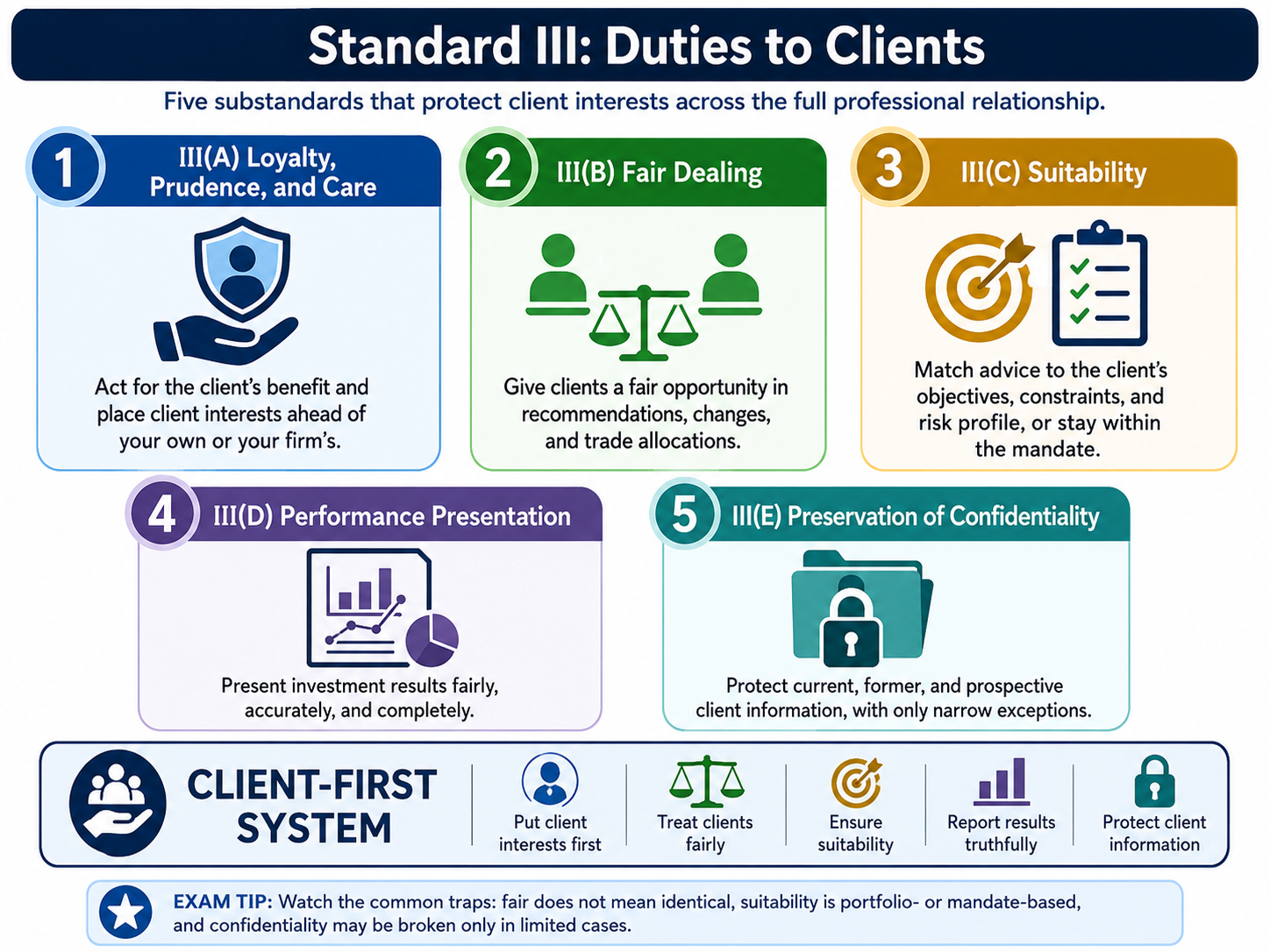
Standard III covers five duties that each protect a different client interest. Read them as stages of one relationship rather than five separate rules.
Standard III(A): Loyalty, Prudence, and Care
Standard III(A) asks you to act for the benefit of clients and place their interests ahead of your employer's and your own. You owe reasonable care and prudent judgment. When assets are managed for beneficiaries or under a mandate, part of the duty is identifying who the actual client is, since the person paying you is not always the one whose interest you must protect. Soft-dollar arrangements, proxy voting, and account handling all live here, and the child note covers them in full.
Standard III(B): Fair Dealing
Standard III(B) requires fair and objective treatment when you share recommendations, change a recommendation, or take investment action. The word that trips candidates up is fair. Fair dealing CFA scenarios do not demand that every client hears the same news at the same second or pays for the same level of service. Different service tiers can be acceptable when they are disclosed and offered on a fair basis. What you cannot do is run an allocation process that quietly disadvantages some clients.
Standard III(C): Suitability
Standard III(C) depends on the type of relationship. In an advisory relationship, you make reasonable inquiries into a client's experience, objectives, risk tolerance, and constraints, keep that information current, and judge each investment in the context of the total portfolio. For a fund or a defined mandate, suitability means staying inside the stated strategy, objectives, and constraints. Suitability standards never imply that a suitable investment cannot lose value. A loss does not, by itself, prove a suitability breach.
Standard III(D): Performance Presentation
Standard III(D) requires you to present investment performance fairly, accurately, and completely. The risk is selective or incomplete reporting, such as showing only your best accounts or dropping a weak period. The audience should be able to understand what the numbers actually represent. Detailed composite construction and GIPS distinctions belong on the child note, not here.
Standard III(E): Preservation of Confidentiality
Standard III(E) protects information about current, former, and prospective clients. Three high-level exceptions allow disclosure: the client is engaged in illegal activity, the law requires disclosure, or the client gives permission. Where a duty to keep information private collides with a duty to disclose, applicable law decides. Electronic records and vulnerable-client situations call for extra care.
Standard III Comparison Table
Substandard | Client Interest Protected | Common Scenario Clue | Main Candidate Question |
|---|---|---|---|
III(A) Loyalty, Prudence, and Care | Client benefit and prudent stewardship | Soft dollars, proxy voting, competing interests | Whose interest came first? |
III(B) Fair Dealing | Fair access to recommendations and actions | Selective release, allocation, service tiers | Did clients receive a fair opportunity? |
III(C) Suitability | Fit with client needs or portfolio mandate | IPS, risk tolerance, constraints, unsolicited trade | Does the investment fit the client or mandate? |
III(D) Performance Presentation | Truthful understanding of results | Cherry-picking, composites, omitted periods | Is the performance information fair and complete? |
III(E) Preservation of Confidentiality | Privacy and trust | Former client, legal demand, illegal activity | Is disclosure permitted or required? |
How to Identify the Relevant Standard III Subsection
When a question spans several facts, work through the client interests in order:
Is the professional putting personal or employer interests ahead of the client? Look at III(A).
Are some clients getting an unfair edge in a recommendation or allocation? Look at III(B).
Does the issue turn on objectives, constraints, risk, IPS information, or a portfolio mandate? Look at III(C).
Is performance being shown in a misleading or incomplete way? Look at III(D).
Is client information being shared or protected? Look at III(E).
Then ask whether another Standard also applies.
Common Standard III Overlaps
Standard III rarely shows up alone. A recommendation can be both unsuitable under III(C) and inconsistent with the client-first duty under III(A). Unfair allocation under III(B) can travel with a personal-trading problem under VI(B). Misleading performance under III(D) can also be misrepresentation under I(C). When confidentiality runs into a legal demand, I(A) Knowledge of the Law helps decide whether you protect or disclose the information. And prudent action for a client under III(A) assumes a reasonable analytical basis, which links to V(A).
Mixed Duties to Clients Example
A portfolio manager learns that a small allocation in a sought-after private placement will be available to her firm. She quietly gives two long-standing clients first access, with no disclosed service arrangement that would make this fair to others. She sets aside a block of the placement for her own account. She then recommends the placement to a conservative retiree without reviewing his income-focused policy statement.
Work through the issues separately. Routing the opportunity to favored clients without a fair, disclosed basis points to III(B). Allocating to her own account ahead of clients points to VI(B). Recommending a higher-risk placement to a conservative client without checking his constraints points to III(C). And placing her own interest near the front of the line raises III(A). One fact pattern, four distinct concerns.
Common Exam Traps
Assuming fair dealing requires identical treatment for every client.
Treating loyalty to the client as license to ignore the stated investment mandate.
Judging suitability for one holding in isolation instead of inside the whole portfolio.
Believing a suitable investment cannot lose money.
Treating a former client's information as no longer confidential.
Calling a performance presentation fair just because each number is mathematically correct.
Practice Question
An adviser manages a balanced mandate for a charitable endowment. The endowment's policy statement caps any single equity position at 5 percent of the portfolio. Convinced a technology stock will outperform, the adviser builds the position to 9 percent without amending the policy. The endowment's return improves that quarter.
Which Standard III subsection has the adviser most directly implicated?
III(B) Fair Dealing
III(C) Suitability
III(D) Performance Presentation
Correct Answer: B
In a managed mandate, suitability means staying within the stated objectives and constraints. Breaching the 5 percent cap violates the mandate, so III(C) applies, and the strong quarter does not cure the breach.
Option A. III(B) is about fair treatment across multiple clients, which is not the issue in a single mandate.
Option C. III(D) concerns how results are presented, which is not what went wrong here.
Continue Your CFA Level I Prep With KeyPoint
Use structured lessons, practice questions, mock exams, and progress tracking to focus on the time you have left
FAQs About Guidance for Standard III: Duties to Clients
What is CFA Standard III?
CFA Standard III, Duties to Clients, is the part of the Code and Standards that protects client interests through the relationship. It contains five substandards covering loyalty and care, fair dealing, suitability, performance presentation, and confidentiality.
What are the five duties to clients?
They are III(A) Loyalty, Prudence, and Care; III(B) Fair Dealing; III(C) Suitability; III(D) Performance Presentation; and III(E) Preservation of Confidentiality.
Does fair dealing require identical treatment?
No. Fair dealing requires a fair opportunity, not the same service for everyone. Different service tiers can be acceptable when they are disclosed and available on a fair basis.
What must suitability be based on?
In an advisory relationship, suitability is based on the client's objectives, constraints, risk tolerance, and the role of the investment within the total portfolio. For a fund or mandate, it is based on the stated strategy and constraints.
How long does the duty of confidentiality last?
It continues after the client relationship ends. The duty also extends to prospective clients, not only current ones.
Can client information be disclosed when required by law?
Yes. Disclosure is generally permitted when the law requires it, when the client is engaged in illegal activity, or when the client gives permission. Where confidentiality and a disclosure duty conflict, applicable law controls.