
Standard III(B) requires you to treat clients fairly and objectively when you provide analysis, send out recommendations, change them, or take investment action. The word that trips up candidates is "fair." Fair dealing does not mean identical treatment, and a scenario usually tests whether a difference between clients was acceptable or whether it gave some clients an unfair advantage. Getting fair dealing right starts with separating fair from equal.
Quick Answer
Fair dealing means treating all clients fairly and objectively when disseminating recommendations, making changes, or taking investment action. It does not require that every client get identical service at the same instant. Differences are acceptable when they are disclosed, available to eligible clients, and structured so they do not disadvantage anyone. Fair does not mean equal.
Key Takeaways About Fair Dealing
The Standard requires fair and objective treatment, not identical treatment.
Disseminate recommendations so relevant clients get a fair opportunity to act.
Premium services are allowed when disclosed and available, but cannot give advance access to market-sensitive recommendations.
Allocate limited opportunities with a documented, consistent process, not by fee size or favored status.
A common trap is assuming fair means every client must be reached at the same second.
What You Need to Know for CFA Level I
Dissemination should give relevant clients a fair opportunity to act, using an equitable process based on suitability and known interest. Material changes to a recommendation have to reach current clients, especially those affected by the earlier advice. Premium services are fine when disclosed and available to eligible clients, but favored clients cannot receive market-sensitive recommendations before everyone else.
Oversubscribed opportunities should be allocated fairly among suitable accounts using documented procedures. Personal and immediate-family purchases may need to be set aside when an issue is oversubscribed, though family accounts run like ordinary client accounts should not be unfairly excluded.
What Is Fair Dealing Under Standard III(B)?
Standard III(B) requires members and candidates to deal fairly and objectively with all clients across research, recommendations, material changes, and investment action. The scope is broad: it covers the full range of professional activities where one client could be advantaged over another.
Fair and objective treatment does not promise identical outcomes or identical timing. It promises a process that does not systematically favor some clients over others. The test is whether the way you handle recommendations and trades gives every relevant client a fair shot, not whether every client receives the same thing at the same moment.
Does Fair Dealing Mean Equal Treatment?
No. Reaching every client at precisely the same instant is often impossible, and the Standard does not demand it. Clients differ in their objectives, their suitability, and how they prefer to be contacted, so some variation is built into normal service.
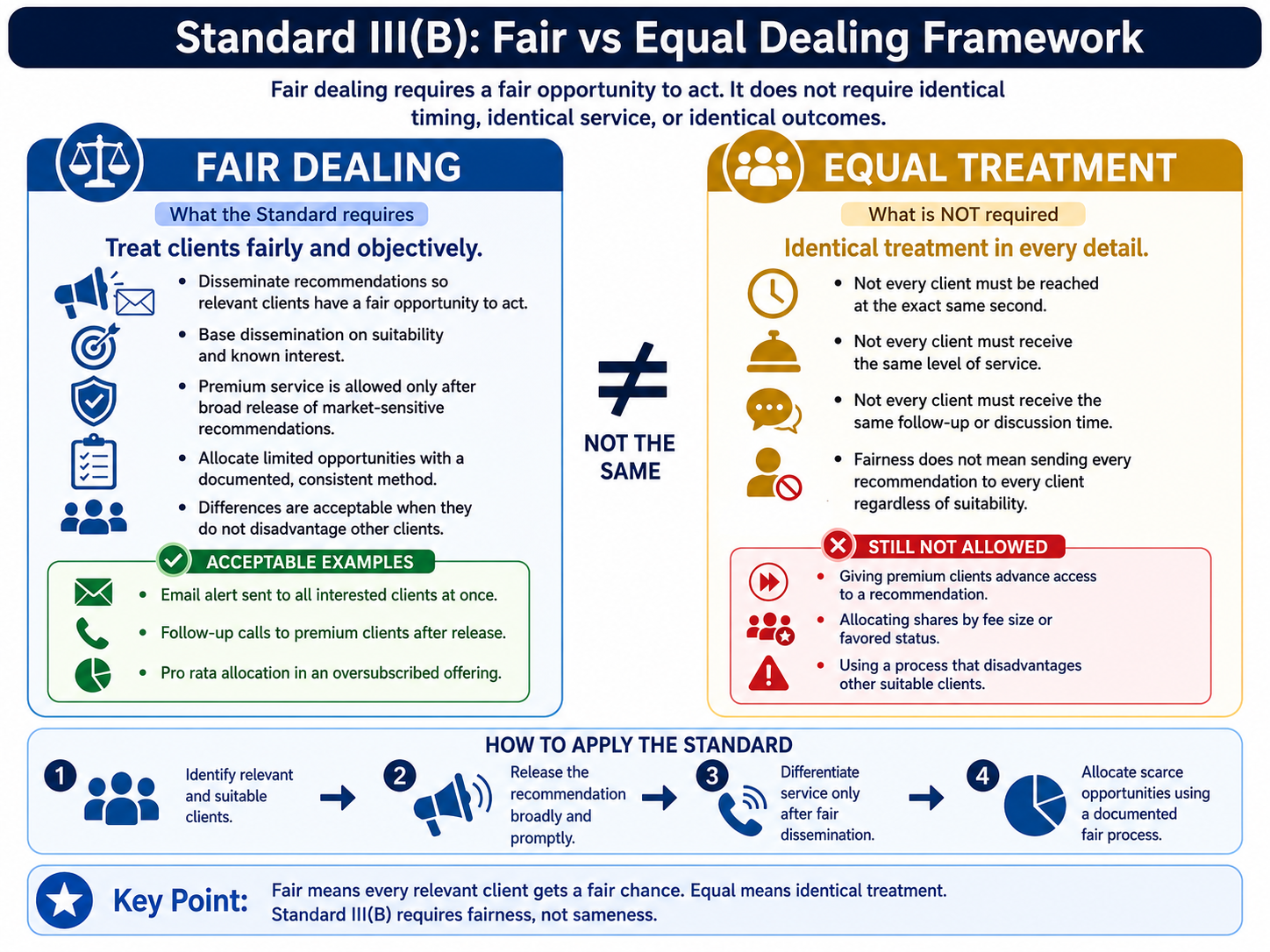
The line runs between acceptable differences and unfair advantage. It is acceptable that a client who reads email sees an alert before a client reached by phone, or that a more engaged client gets a longer follow-up call. It is not acceptable that some clients learn about a market-sensitive recommendation before others get the chance to act. The first is ordinary service variation. The second is advance access that disadvantages everyone left out.
How Should Recommendations Be Disseminated?
Use an equitable system based on each client's known interest and suitability, not on favored status. The goal is to reach all relevant clients close enough together that they have a fair opportunity to act before the recommendation moves the market.
Limit who knows about a recommendation before it goes out, keep the window between the decision and the release short, and distribute as close to simultaneously as your systems allow. Follow-up after the broad distribution is fine. The harder case is a material change to an existing recommendation, such as moving from buy to sell. That change has to reach current clients, especially the ones who acted on the earlier advice, and you have to watch for client orders still coming in based on the outdated recommendation.
Are Premium Service Levels Allowed?
Yes, premium or more personalized service levels are allowed when they are disclosed, available to clients on stated terms, and structured so they do not disadvantage other clients. A client can pay for deeper analysis or more frequent contact.
The boundary is timing of market-sensitive information. A scheduled one-on-one call after a recommendation has gone out to all interested clients is acceptable service differentiation. Telling premium clients about the recommendation before general dissemination is advance disclosure, and that disadvantages everyone else. Different service tiers are fine. Different access to the recommendation itself is not, and you do not need to charge every client the same fee or contact them all equally often.
How Should Investment Opportunities Be Allocated?
Allocate limited opportunities with a consistent, documented method based on suitability and indications of interest. For an oversubscribed offering, that usually means pro rata allocation across the suitable accounts that expressed interest, with sensible handling of round lots so small accounts are not squeezed out by rounding.
Average pricing and similar consistent methods can support fair block allocation, so that no account gets a better fill simply because it is favored. Personal and immediate-family accounts need care here. A purchase where you are the beneficial owner may have to be forgone when an issue is oversubscribed. But a family account that pays fees and is managed like any other client account should be treated like one, not automatically excluded.
Recommended Fair Dealing Guidelines
Follow and keep improving written firm policies, maintain lists of client interests and holdings, and control who has access to a recommendation before it is released. Document and disclose your service levels and allocation procedures so clients understand how decisions are made.
Review exceptions, disclose your allocation approach clearly, and escalate possible violations to management or compliance. The practical aim is a process you can show was applied consistently, rather than a series of one-off judgments that happen to favor the same accounts.
Compliant Scenario
Situation. Renata Silva's firm issues a new buy recommendation. It goes out to every interested and suitable client at the same time through the firm's standard electronic distribution system. Afterward, clients enrolled in a disclosed advisory tier receive scheduled one-on-one calls to discuss how the idea fits their portfolios.
Relevant issue. Some clients receive extra personal attention. The question is whether that disadvantages the others.
Correct action. The recommendation reaches all interested clients together, and the personalized calls happen only after that broad release.
Why it complies. Every client had a fair opportunity to act on the recommendation at the same time. The advisory-tier calls are disclosed service differentiation, not advance access to market-sensitive information.
Violation Scenario
Situation. A limited offering is oversubscribed. Greg Tan allocates most of the available shares to two accounts that pay his firm the highest fees, filling them before he applies the firm's standard allocation policy. Several smaller accounts that are suitable and expressed interest receive nothing.
Violation. Greg allocated a scarce opportunity by fee size rather than through the firm's fair, documented process, which disadvantaged suitable smaller clients.
Required alternative. He should have applied the firm's allocation policy first, allocating pro rata among the suitable accounts that indicated interest.
Why the original action fails. Fairness in allocation cannot be replaced by client value or fee size. A documented, consistent method has to govern who gets shares.
Common Exam Traps
Equating fair with identical. Fair dealing does not require the same service at the same second. It requires a process that gives every relevant client a fair opportunity.
Giving premium clients early access. Premium service is fine. Receiving a market-sensitive recommendation before general dissemination is not.
Sending every recommendation to every client. Dissemination should reflect suitability and known interest, not a blanket send to the entire book.
Excluding fee-paying family accounts. A family account managed like other client accounts should be treated like other client accounts, not automatically left out.
Thinking disclosure cures unfair allocation. Telling clients about a patently unfair allocation method does not make it fair. The method itself has to be fair.
Confusing fairness with priority of transactions. Fair dealing is about treating clients fairly among themselves. Putting client trades ahead of your own is Standard VI(B).
Practice Question
A firm releases a new sell recommendation on a widely held stock. The recommendation is pushed at the same time to all clients who have expressed interest in the stock, through an electronic alert. Within minutes of the alert going out, advisers place personal phone calls to several premium-tier clients to walk them through the change. No client received the recommendation before the alert.
Based on Standard III(B), the conduct:
complies, because all interested clients received the recommendation together before any personal calls were made.
violates the Standard, because the premium clients received personal calls that other clients did not.
violates the Standard, because premium clients should never receive different service from other clients.
Correct Answer: A
Every interested client received the recommendation at the same time through the alert, so all of them had a fair opportunity to act. The personal calls came after that broad dissemination and are acceptable service differentiation for a disclosed premium tier.
Option B is wrong because offering extra service to premium clients does not breach the Standard, as long as it follows fair dissemination of the recommendation itself.
Option C is wrong because differentiated service levels are allowed. The Standard restricts advance access to market-sensitive information, not the existence of premium tiers.
Continue Your CFA Level I Prep With KeyPoint
Use structured lessons, practice questions, mock exams, and progress tracking to focus on the time you have left
FAQs About Standard III(B): Fair Dealing
Does fair dealing mean all clients must be treated equally?
No. Fair dealing means treating clients fairly and objectively, not identically. Differences in timing and service are acceptable when they are disclosed, available to eligible clients, and do not give some clients an unfair advantage over others.
Can premium clients receive additional services?
Yes. Premium or more personalized service is allowed when it is disclosed and available on stated terms. The limit is that premium clients cannot receive a market-sensitive recommendation before it is disseminated to other interested clients.
How should an oversubscribed offering be allocated?
Through a documented, consistent process based on suitability and indications of interest, usually pro rata among the suitable accounts that expressed interest. Fee size and favored status cannot replace a fair allocation method.
Can a family account participate in a limited offering?
Yes, when the family account pays fees and is managed like any other client account. It should not be automatically excluded. The rules tighten only where the member or candidate is the beneficial owner of the account.