
Standard VII(B) governs how you describe your status with CFA Institute on a resume, a LinkedIn profile, a business card, or anywhere else. Correct CFA designation usage comes down to one idea. State your status accurately and never imply more than you have earned. For Level I candidates, the exam questions here are practical and wording-dependent, so small differences in phrasing decide the answer.
Quick Answer
Standard VII(B) says you must describe CFA Institute membership, the CFA designation, and your place in the CFA Program accurately. You cannot exaggerate your status, imply an endorsement, claim a partial designation, post an expected award date, or suggest the charter promises better investment performance. Passing an exam level is a real achievement, but it is not a designation and never becomes a partial one.
Key Takeaways: CFA Designation Usage Under Standard VII(B)
Passing a level is a fact you can state, but it is not a designation.
You are a candidate only while enrolled for a specific exam or awaiting results from one.
"CFA charterholder" is clearer and safer than using CFA as a noun.
The right to use the charter depends on meeting CFA Institute membership and good-standing rules each year.
Profiles and social media follow the same accuracy rules as formal documents.
What You Need to Know for CFA Level I
Start every question by pinning down the person's actual status today. Did they pass a level, are they currently registered, are they waiting on results, or do they hold the charter? Then read the exact words used in the communication. Ask whether those words imply a status the person has not earned, an endorsement from CFA Institute, or a promise of superior results. If the wording does any of that, it fails. The fix is almost always the plainest factual statement available.
What Does Standard VII(B) Require?
Standard VII(B) requires accurate, non-exaggerated references to CFA Institute, the designation, and Program candidacy. You may state facts about what you have achieved. You may not stretch those facts into claims about competence or performance.
You can say the CFA Program is rigorous, or that earning the charter improved your skills, because those are supportable statements or clearly your opinion. You cannot say the charter makes you a better investor than your peers, because that overstates what the designation means.
Who May Use the CFA Designation?
Only a charterholder in good standing may use the CFA designation. Passing all three exams is necessary, but it is not enough on its own. To hold and keep the right to use the charter, a person must also meet CFA Institute membership requirements each year.
Those annual requirements include filing a completed Professional Conduct Statement, paying membership dues, and remaining in good standing. If someone stops meeting them, they forfeit the right to use the designation until they reinstate membership. They may still say they held the charter in the past.
When May Someone Call Themselves a CFA Program Candidate?
You are a candidate only when you are properly enrolled for a specific exam, or when you have sat that exam and are still awaiting results. Acceptance of your application plus enrollment for a named exam is what creates candidate status.
This matters because candidacy is not permanent. If you pass a level but do not register for the next one, you are not currently a candidate. You can accurately say you passed that level, but you cannot call yourself a current candidate until you enroll again.
Correct and Incorrect CFA References
The safest references are factual and specific. The risky ones turn a passed level into a credential or add an expected date.
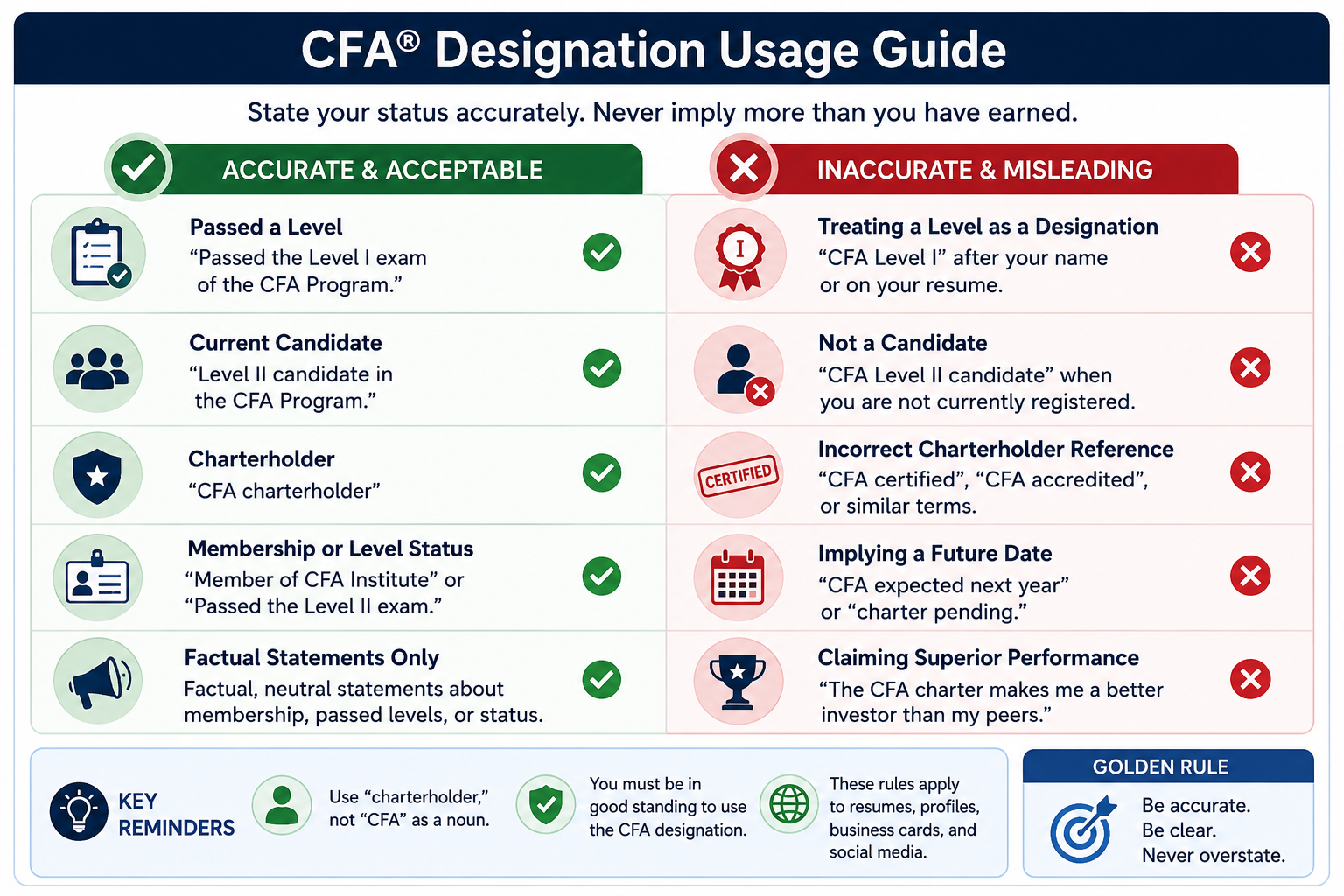
Accurate | Inaccurate or Misleading |
|---|---|
"Passed the Level I exam of the CFA Program" | "CFA Level I" placed after a name |
"Level II candidate in the CFA Program" when properly registered | "CFA Level II candidate" when not registered |
"CFA charterholder" | "CFA certified" |
A factual statement about membership or a passed level | "CFA expected next year" or "charter pending" |
Two formatting points help on exam day. CFA works as an adjective, as in "she is a CFA charterholder," not as a noun, so "she is a CFA" is wrong. And after a name, the letters appear in capitals with no periods, as in "Maria Santos, CFA," never "Maria Santos, C.F.A."
How to Use CFA References on LinkedIn, Resumes, and Business Cards
The rules are the same across every format, because the standard covers all public communication. On a resume, a candidate can list the levels completed and note participation in the CFA Program. A charterholder in good standing can place CFA after their name and describe their charterholder status in the certifications section.
What you cannot do is put a partial credential in a profile headline or add an "expected" date. A profile that reads "CFA Level II" after a name implies a designation that does not exist. The accurate version states the fact, such as "Passed Level II of the CFA Program."
Example Scenario
Situation. Marcus passed Level II in August and has not yet registered for Level III. He updates his LinkedIn headline to read "Marcus Lee, CFA Level III Candidate" and adds "CFA Level II" after his name in his email signature.
What the standard says. A person is a candidate only while enrolled for a specific exam or awaiting results. A passed level is a fact, but it is never a partial designation.
Outcome. Both references violate Standard VII(B). Marcus is not a Level III candidate, because he is not registered for that exam. And "CFA Level II" after his name implies a partial designation, which does not exist.
Why it matters. Marcus did earn something real by passing Level II, so he is allowed to say so. The accurate wording is "Passed Level II of the CFA Program." The violation is in the packaging, not the fact.
Common Exam Traps
Treating completion of one level as a credential you can place after your name.
Assuming a past candidate stays a current candidate forever, even without enrolling again.
Believing a plain factual statement about passing an exam is prohibited. It is not.
Missing an implied endorsement or a claim of superior performance.
Focusing only on punctuation while ignoring whether the underlying status is even true.
Practice Question
Devi is accepted into the CFA Program and is registered for the upcoming Level I exam. Which reference most likely complies with Standard VII(B)?
"Devi Rao, CFA Level I"
"Devi Rao, CFA candidate, charter expected 20XX"
"Candidate in the CFA Program, registered for the upcoming Level I exam"
Correct Answer: C
It states her status accurately. She is a registered candidate, and the wording claims nothing beyond that.
Option A places a passed-or-partial credential after her name, which implies a designation that does not exist.
Option B adds an expected charter date, which the standard prohibits.
Only Option C describes her real status without exaggeration.
Continue Your CFA Level I Prep With KeyPoint
Use structured lessons, practice questions, mock exams, and progress tracking to focus on the time you have left
FAQs About Standard VII(B): Reference Use
Can you put "CFA candidate" on LinkedIn?
You can, but only while you are registered for a specific exam or awaiting results. The reference must make clear you are a candidate, and you cannot place it in your profile headline as a credential or add an expected charter date.
Can you write "CFA Level I" after your name?
No. Placing "CFA Level I" after your name implies a partial designation, and there is no partial CFA designation. You can accurately state that you passed the Level I exam of the CFA Program instead.
When may someone use the CFA designation?
Only after earning the charter and while meeting CFA Institute membership requirements each year. That means filing a Professional Conduct Statement, paying dues, and staying in good standing. If those lapse, the person must stop using the designation until they reinstate membership.