
Standard VII(A) sets the rules for how you behave while you take part in any CFA Institute program, including the exam itself. It protects the reputation of the program and keeps the exam fair for everyone who sits it. For Level I candidates, the conduct and integrity of candidates is one of the most testable ideas in Ethics, because the questions hinge on judgment rather than a memorized label.
Quick Answer
Standard VII(A) says you must not do anything that damages the reputation of CFA Institute or the integrity, validity, or security of its programs. In practice, that means you cannot cheat, break testing rules, bypass security, give false information to CFA Institute, misuse your link to the organization, or share confidential exam content. Confidential content is broader than exact questions. It also covers which topics and formulas were, or were not, tested.
Key Takeaways: Conduct and Integrity of Candidates Under Standard VII(A)
Program integrity and exam security are the heart of the standard.
Confidential information includes far more than the wording of a question.
General study discussion is fine when it reveals nothing confidential.
You can criticize CFA Institute or the curriculum without breaking the rule, as long as you disclose no confidential content and make no false claims.
The standard reaches beyond exam day, including social posts and volunteer work.
What You Need to Know for CFA Level I
When a question tests Standard VII(A), work through it in order. First, identify the person's role and which CFA Institute program is involved. Next, ask whether the conduct threatens the validity, security, fairness, or reputation of that program. Then check whether any confidential exam or program information was shared. Separate a protected opinion from a disclosure or a false statement, since the standard treats those very differently. Finally, pick the most specific violation rather than reaching for a general misconduct label.
What Does Standard VII(A) Require?
Standard VII(A) requires you to protect the integrity, validity, and security of CFA Institute programs. The rule applies before, during, and after an exam, and it applies to candidates, members, and volunteers alike.
The standard is not limited to the testing room. It governs what you say in an online forum, what you send to a friend in another time zone, and how you act when you help run a program as a volunteer. The common thread is simple. Nothing you do should make the program less fair, less secure, or less trusted.
What Conduct Violates Standard VII(A)?
A violation is any act that compromises the program or discloses protected information. The curriculum groups the main categories like this.
Conduct Area | What It Covers |
|---|---|
Cheating or rule violations | Giving or receiving help, using unauthorized materials, or ignoring proctor instructions |
Confidential information | Exact questions, tested formulas, topic emphasis, or details about what was not tested |
Program security | Circumventing exam controls or sharing secure material |
False information | Misstating registration, identity, eligibility, or other facts to CFA Institute |
Improper association | Using a role or connection with CFA Institute in a misleading way |
A statement can break the standard even when it never repeats a single question. Revealing that a topic appeared heavily, or that a formula did not appear at all, is enough.
What May Candidates Discuss After an Exam?
You can discuss a great deal after the exam, as long as you stay away from confidential content. You may study with others, review public curriculum material, and describe your own preparation. You may also share a general opinion about how hard the exam felt.
You can say the exam was tougher than you expected. You can say you wish you had done more practice questions. You can even criticize CFA Institute or complain that the curriculum has too many readings. None of that reveals what was tested, so none of it breaks the standard.
Permitted Discussion vs Confidential Program Information
The line sits between a general impression and a specific disclosure. A general impression is allowed. A specific disclosure of tested or untested content is not.
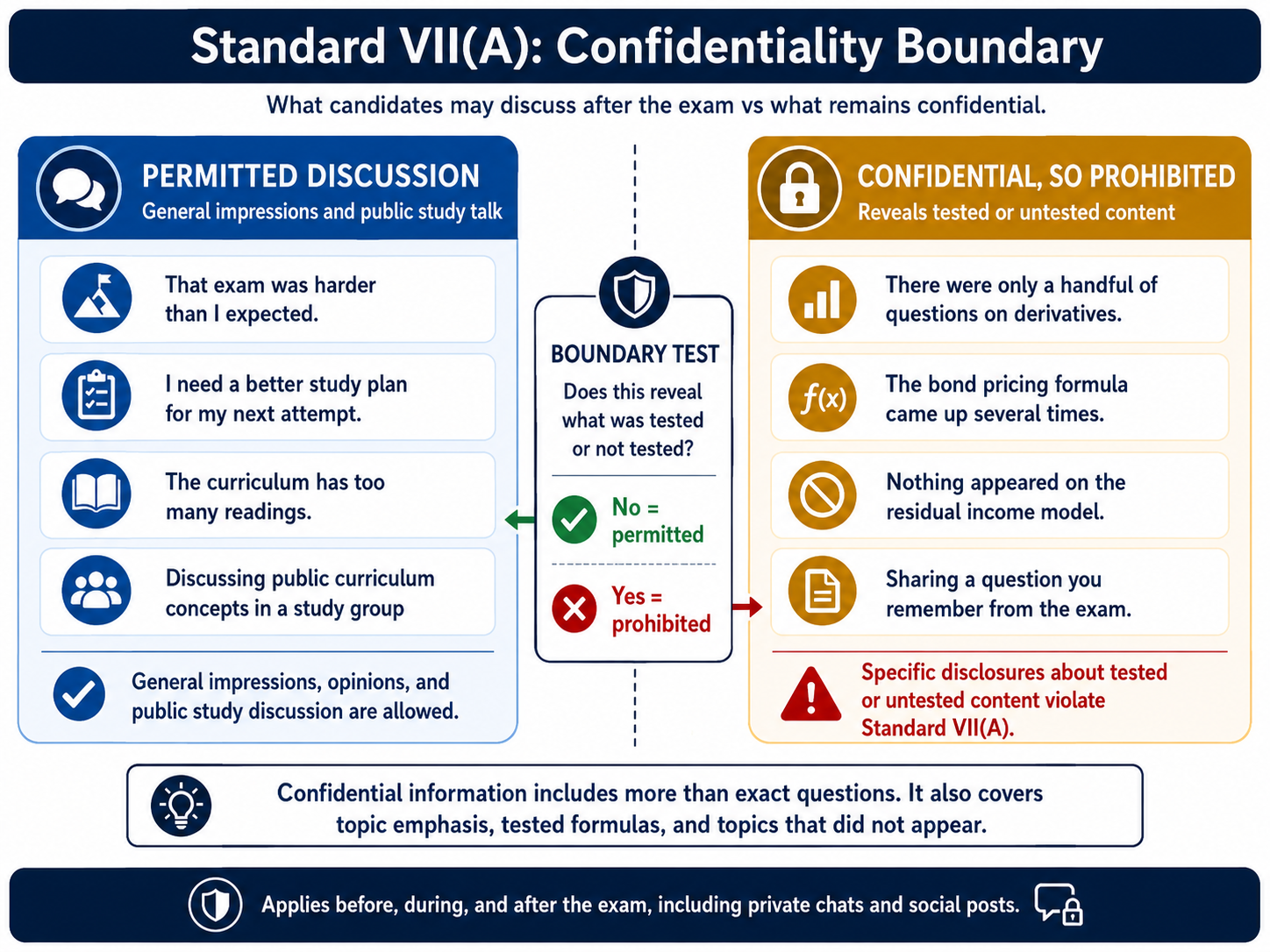
Permitted | Confidential, So Prohibited |
|---|---|
"That exam was harder than I expected." | "There were only a handful of questions on derivatives." |
"I need a better study plan for my next attempt." | "The bond pricing formula came up several times." |
"The curriculum has too many readings." | "Nothing appeared on the residual income model." |
Discussing public curriculum concepts in a study group | Sharing a question you remember from the exam |
Notice that the prohibited column is not about insults or complaints. It is about content. The moment you tell someone what was or was not on the exam, you have crossed the line.
How Does Standard VII(A) Apply to Volunteers and Other Program Participants?
Volunteers face the same duty, and often a sharper version of it. Members who help write, administer, or grade exams see confidential material that the public never does. They must not share questions under consideration, internal deliberations about the exam process, or details about how answers are scored.
The standard also covers misuse of a CFA Institute role. A volunteer who steers a society's speaking slots toward their own clients, or who hints that committee access gives their firm an edge, damages the reputation of the organization. That is a violation, even with no exam content involved.
Recommended Procedures to Prevent Violations
Keep your study conversations focused on public material and your own experience. Before you post anything after an exam, ask one question. Does this reveal what was tested or not tested? If the answer is yes, or even maybe, do not post it.
If you volunteer, treat everything you see as confidential until CFA Institute releases it. State your involvement factually and never imply that it gives your clients special access.
Example Scenario
Situation. Priya finishes the Level I exam and opens a private group chat with three coworkers who plan to sit a later window. She writes, "Survived it. The dividend discount model came up a lot, so drill that until it is automatic. Honestly, do not waste time on swaps, there was nothing on them."
What the standard says. Confidential information includes the topics and formulas that were tested and the ones that were not. Priya told her coworkers that one model appeared heavily and that another topic did not appear at all.
Outcome. Priya violated Standard VII(A). The private setting does not save her, because the standard protects the content no matter who sees it. She gave later candidates an unfair preview of the exam's emphasis, which damages the validity of the exam.
Why it matters. Priya never quoted a question, yet she still broke the rule. The disclosure of tested and untested content is the violation, not the wording of any single item.
Common Exam Traps
Assuming only the exact wording of a question is confidential. Topic counts, tested formulas, and omitted subjects are all protected.
Treating any criticism of CFA Institute as an automatic violation. Opinions alone are allowed.
Believing a private chat or closed study group makes disclosure acceptable. It does not.
Limiting the standard to exam day. It applies before, during, and after the exam.
Reaching for Standard I(D) Misconduct when Standard VII(A) speaks more directly to exam and program conduct.
Practice Question
After sitting the Level I exam, which post most likely violates Standard VII(A)?
"The exam ran long and I felt rushed. I'll fix my pacing before my next attempt."
"CFA Institute should build in more breaks. That was an exhausting day."
"Skip the residual income model in your review. It didn't show up at all."
Correct Answer: C
Telling other candidates that a topic did not appear reveals confidential exam coverage, which violates Standard VII(A).
Option A is a permitted comment about the candidate's own experience and pacing.
Option B is criticism of CFA Institute, which is an opinion and does not disclose any exam content. Only Option C shares what was, in this case was not, on the exam.
Continue Your CFA Level I Prep With KeyPoint
Use structured lessons, practice questions, mock exams, and progress tracking to focus on the time you have left
FAQs About Standard VII(A): Conduct
Can a CFA candidate discuss exam topics after the test?
You can discuss public curriculum topics and your own study experience at any time. What you cannot do is reveal what appeared on your exam, including which topics or formulas were tested or left out.
Does Standard VII(A) apply to social media posts?
Yes. The standard covers any channel, including forums, group chats, and public social media. CFA Institute monitors these spaces and removes content that discloses confidential exam information.
Can candidates criticize CFA Institute without violating the standard?
Yes. You are free to disagree with CFA Institute's policies or curriculum and to say so. The line is confidential content. As long as your criticism reveals nothing about what was tested, it does not break Standard VII(A).