
Standard II(A) tells you what to do when you hold information that could move a security's price and the market has not seen it yet. The rule protects market integrity by keeping people with an information advantage from trading ahead of everyone else. In a scenario question, your job is usually to decide two things: is the information material, and is it still nonpublic. Most of the difficulty in material nonpublic information questions comes from testing those two gates separately rather than as one judgment.
Quick Answer
Material nonpublic information is information that could affect an investment's value and has not been broadly released to the market. If you hold it, you must not trade on it, change a recommendation or investment action because of it, or cause anyone else to act on it. Mosaic theory still lets you reach a material conclusion by combining public information with nonmaterial nonpublic information.
Key Takeaways
The Standard applies only when information passes both gates: it is material and it is nonpublic.
Information is material if a reasonable investor would want it before deciding, or if its release would likely move the price.
Sharing information with a group of analysts does not make it public. Public means broadly disseminated to the market.
Once you hold material nonpublic information, stop, do not tip anyone, and notify compliance.
Mosaic theory is lawful. Trying to dilute one inside fact with public research is not.
What You Need to Know for CFA Level I
Materiality turns on likely price impact or whether a reasonable investor would treat the information as important. Specificity, reliability, the source, and how different the information is from what the market already knows all affect that judgment. Information stays nonpublic when it has gone only to a select group, even if that group holds several analysts or large investors. Public information combined with nonmaterial nonpublic observations can support a lawful material conclusion under mosaic theory. Once you receive material nonpublic information, you cannot act or cause others to act, and you should notify designated compliance personnel.
What Is Material Nonpublic Information?
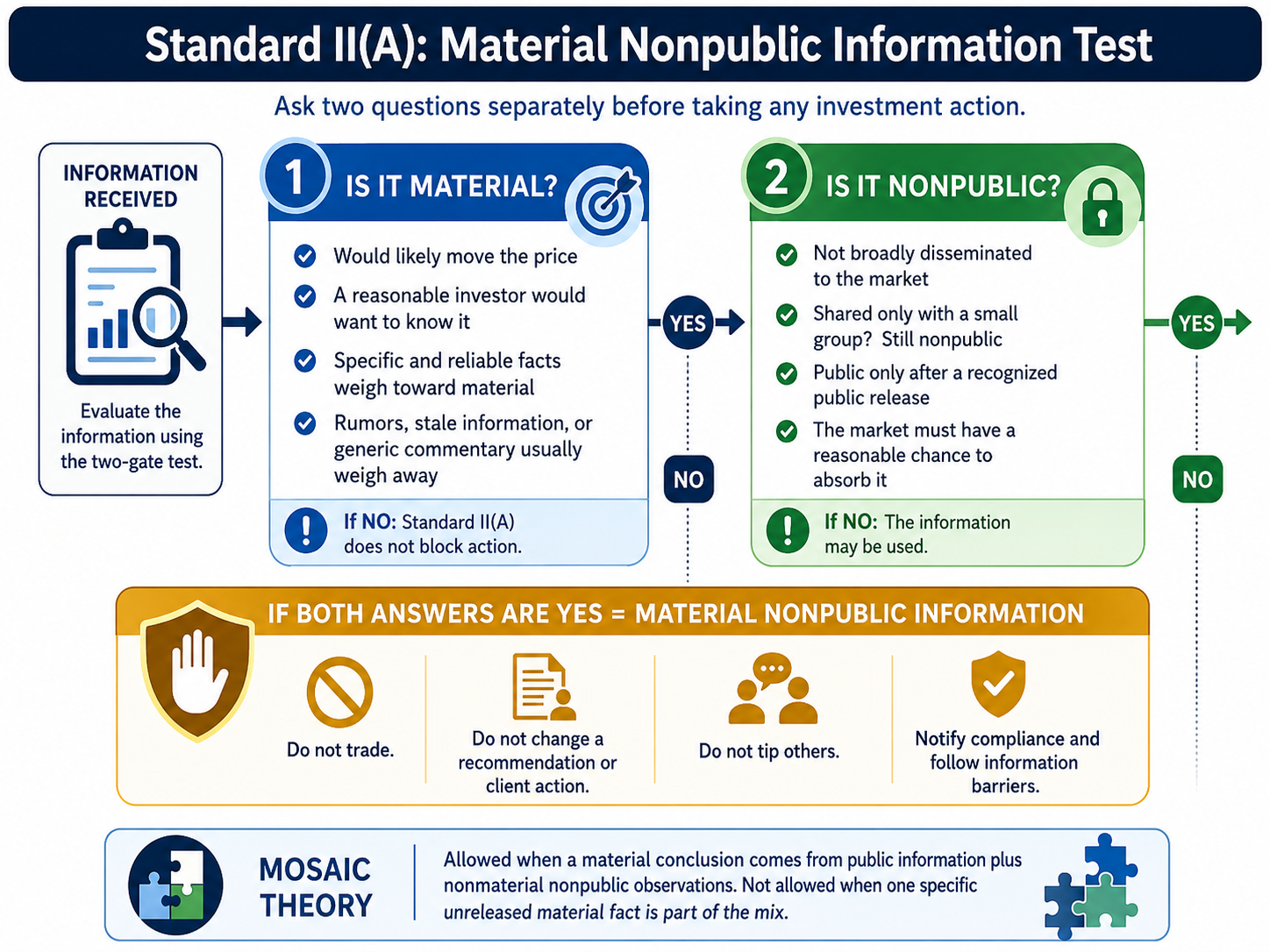
Standard II(A) prohibits members and candidates who hold material nonpublic information from acting on it or causing others to act on it. Two conditions both have to be true. The information has to be material, and it has to be nonpublic. If either gate fails, the Standard does not block you.
The prohibition reaches more than common stock. It covers bonds, derivatives, funds, and alternative investments, and it covers recommendations and actions taken for clients as well as trades in your own account. The form of the action does not matter. What matters is whether you used an unfair information advantage that the rest of the market did not have.
What Makes Information Material?
Use two tests. Information is material if its release would likely affect the price, or if a reasonable investor would want it before making a decision. Either one is enough.
Several factors push information toward material or away from it. Specific, reliable information from a credible source weighs toward material. Vague rumors and unconfirmed speculation usually do not. The size of the likely effect matters, and so does how far the information differs from what is already public. Time can change the answer too, because a fact that was material last quarter may be stale and immaterial now once the market has moved on.
A confirmed earnings surprise, a signed major contract, a pending acquisition, a coming rating change, or a large client order that has not yet hit the market can all be material. A general industry observation or a recycled press summary usually is not. Not every corporate statement is material, and treating every rumor as material is its own mistake.
When Is Information Considered Public?
Information is public once it has been broadly disseminated and the market has had a reasonable chance to receive it. A public filing, a widely distributed press release, or an open company announcement clears that bar.
Selective disclosure does not. Telling a handful of analysts on a private call, briefing a few large shareholders, or posting inside a restricted online group leaves the information nonpublic, even when the audience is large or sophisticated. You do not have to wait for the slowest possible channel to reach every last investor. Once the information has been released through a recognized public channel and the market has had time to react, you can use it.
How Does Mosaic Theory Work?
Mosaic theory lets an analyst combine public facts with nonmaterial nonpublic observations and reach a conclusion that is itself material. That conclusion is your proprietary research product, and you can use it even though it might move the price once you act on it.
The reason this is lawful is that no single input was material nonpublic information. You built the insight; you did not receive it. To show that, keep the research file: the store counts, the supplier data, the interview notes, and the public filings you relied on. That record demonstrates the conclusion came from permitted inputs.
Mosaic theory does not work in reverse. If someone hands you one specific, reliable, unreleased fact from inside a company, you cannot launder it by surrounding it with public information. The single material nonpublic fact still controls.
What Should You Do After Receiving Material Nonpublic Information?
Stop first. Do not trade, do not change a recommendation, and do not take investment action based on the information. Then make sure you do not pass it along. You cannot tip, hint, or steer colleagues, clients, relatives, or anyone else toward acting on it.
Notify the people your firm has designated to handle this, usually supervisory or compliance staff, and follow any restrictions they put in place. Where it fits, encourage the issuer to release the information publicly so the market can absorb it. Until the information becomes public or otherwise stops restricting your activity, stay behind the firm's information barrier.
Expert Networks, Social Media, and Information Barriers
Paying an industry expert for insight is allowed. The responsibility that comes with it is that you must avoid requesting or using confidential material information through that channel. A consultation crosses the line when the expert hands you a specific nonpublic fact about a covered company rather than general industry knowledge.
Treat private or restricted social-media information as potentially nonpublic unless the same information is also available to the general market. Firms manage all of this with watch lists, restricted lists, communication controls, personal-trading monitoring, and controlled procedures for crossing the wall when an employee needs access. You do not need to memorize a compliance manual for the exam. You need to recognize when a control exists to keep nonpublic information from reaching someone who would trade on it.
Compliant Scenario
Situation. Priya Nadkarni, an analyst covering a regional quick-service coffee chain, visits two dozen of its outlets, pulls publicly reported foot-traffic data, reads supplier shipment disclosures, and interviews several independent distributors about volumes. None of the distributors gives her confidential company figures. Her work points to a quarterly sales miss.
Relevant issue. Her conclusion is material. It would likely move the share price. The question is whether she may use it.
Correct action. She documents every input and issues her lowered estimate. She relied on public data and nonmaterial nonpublic observations, none of which was material on its own.
Why it complies. This is mosaic theory. The material insight is her analysis, not a fact handed to her from inside the company, so acting on it does not violate Standard II(A).
Violation Scenario
Situation. Marcus Bell joins a small investor call hosted by a medical-devices maker. On the call, an executive mentions that a large hospital network has just canceled a multi-year supply agreement, news the company has not released. Marcus immediately lowers his rating and alerts a portfolio manager at his firm before the cancellation is announced.
Violation. Marcus changed his recommendation based on specific, reliable, unreleased information, and he caused another person to act by alerting the portfolio manager.
Required alternative. He should have recognized the information as material and nonpublic, declined to act, notified compliance, and waited until the company disclosed the cancellation publicly.
Why the original action fails. Selective disclosure on a limited call does not make information public. Both changing his own recommendation and tipping the portfolio manager breach the Standard, even though he never traded in his own account.
Common Exam Traps
Treating a small-group disclosure as public. Sharing with several analysts or posting in a restricted group does not release information to the market. The market has to have a fair chance to receive it.
Calling a single inside fact a mosaic. Reviewing public information alongside one specific, reliable corporate fact does not make the fact usable. Mosaic theory needs nonmaterial inputs, not one material one wrapped in research.
Thinking only personal trading counts. Tipping someone or changing client action also violates the Standard. The prohibition covers causing others to act.
Assuming a proprietary conclusion must be published. An analyst is not required to release valuable research just because it could move the market. The conclusion is the analyst's own work product.
Assuming any payment to an expert is banned. Paying for industry expertise is fine. The issue is whether confidential material information was requested or used.
Practice Question
A buy-side analyst reviews a packaging company's most recent public annual filing, runs channel checks with three independent freight brokers about general shipping volumes, and visits a trade show where she gathers nonmaterial color on industry demand. During a one-on-one call, the company's treasurer also tells her that the board approved a large, unannounced share buyback that will be disclosed next week. She is deciding whether to add the stock for her clients.
Based on Standard II(A), the analyst:
may add the position, because most of her research came from lawful public and nonmaterial nonpublic sources.
may not add the position, because she holds a specific unreleased fact that is material and nonpublic.
may add the position, because mosaic theory permits combining public and nonpublic inputs into a material conclusion.
Correct Answer: B
The treasurer disclosed a specific, reliable, unreleased fact, the approved buyback, that a reasonable investor would want and that would likely move the price. That single piece is material nonpublic information. Holding it bars her from trading or recommending the stock until the company discloses the buyback, regardless of how much lawful research she also did.
Option A is wrong because the volume of permitted research does not cancel out one material nonpublic fact. The material inside information controls the outcome.
Option C is wrong because mosaic theory applies only when every input is either public or nonmaterial. The buyback fact is material and nonpublic, so the mosaic protection does not reach it.
Continue Your CFA Level I Prep With KeyPoint
Use structured lessons, practice questions, mock exams, and progress tracking to focus on the time you have left
FAQs About Standard II(A): Material Nonpublic Information
What is material information under CFA Standard II(A)?
Information is material if its release would likely affect a security's price, or if a reasonable investor would want it before making a decision. Specificity, reliability, and the source all affect the judgment. Vague rumors usually are not material.
When does information become public?
Information becomes public once it has been broadly disseminated and the market has had a reasonable chance to receive and react to it. A disclosure to a small group of analysts or shareholders does not count.
What is mosaic theory in CFA ethics?
Mosaic theory lets an analyst combine public information with nonmaterial nonpublic observations to reach a conclusion that is itself material. The conclusion is lawful because no single input was material nonpublic information.
Can an analyst use information from an expert network?
Yes, paying an industry expert is permitted. The analyst stays responsible for making sure the consultation does not supply confidential material information about a covered company.