
Standard II(B) bans conduct meant to mislead market participants by distorting a security's price or its trading volume. The point is to protect the signals investors rely on, so that price and volume reflect real supply and demand rather than a staged impression. In a scenario question, the hard part is usually telling aggressive but legitimate trading apart from market manipulation. The answer almost always turns on intent.
Quick Answer
Market manipulation is conduct intended to mislead market participants by distorting a security's price or creating artificial trading volume. It comes in two forms: information-based manipulation, which spreads false or misleading information, and transaction-based manipulation, which uses trades or orders to fake a market signal. Trading on a genuine view of mispricing is not manipulation, even in a thin market. Intent to deceive is what matters.
Key Takeaways About Market Manipulation
The Standard prohibits distorting prices or volume with the intent to mislead other participants.
Manipulation comes in two types: information-based and transaction-based.
Intent is the deciding factor. The same trade can be legitimate or manipulative depending on purpose.
Actual profit, a completed scheme, or a successful price move is not required for a violation.
A real, executed trade can still be manipulative when its purpose is to create a false impression.
What You Need to Know for CFA Level I
Information-based manipulation uses false or misleading communications to push the market in a direction. Transaction-based manipulation uses orders, trades, control positions, or coordinated activity to create a false signal about price, volume, or demand. The Standard focuses on the intent to mislead, not simply on whether a price or volume change happened. You do not need a profit, a finished scheme, or a successful move for the conduct to be a problem; the design to deceive is enough. Members and candidates are expected to follow firm surveillance and order-control procedures that exist to catch this.
What Is Market Manipulation?
Standard II(B) prohibits practices that distort prices or artificially inflate trading volume with the intent to mislead participants. The harm is deception. Other investors read price, volume, liquidity, supply, demand, and apparent interest as honest signals, and manipulation feeds them a false reading.
That framing matters because it tells you what the rule is protecting. It is not protecting any particular price level. It is protecting the reliability of the signals. When someone stages those signals to trick others into buying or selling, the conduct falls under the Standard whether or not the scheme ever pays off.
What Are the Main Types of Market Manipulation?
There are two broad categories: information-based and transaction-based manipulation. The first deceives through words, the second through trading activity. Both share the same core: an intent to mislead and an artificial market signal created to do it.
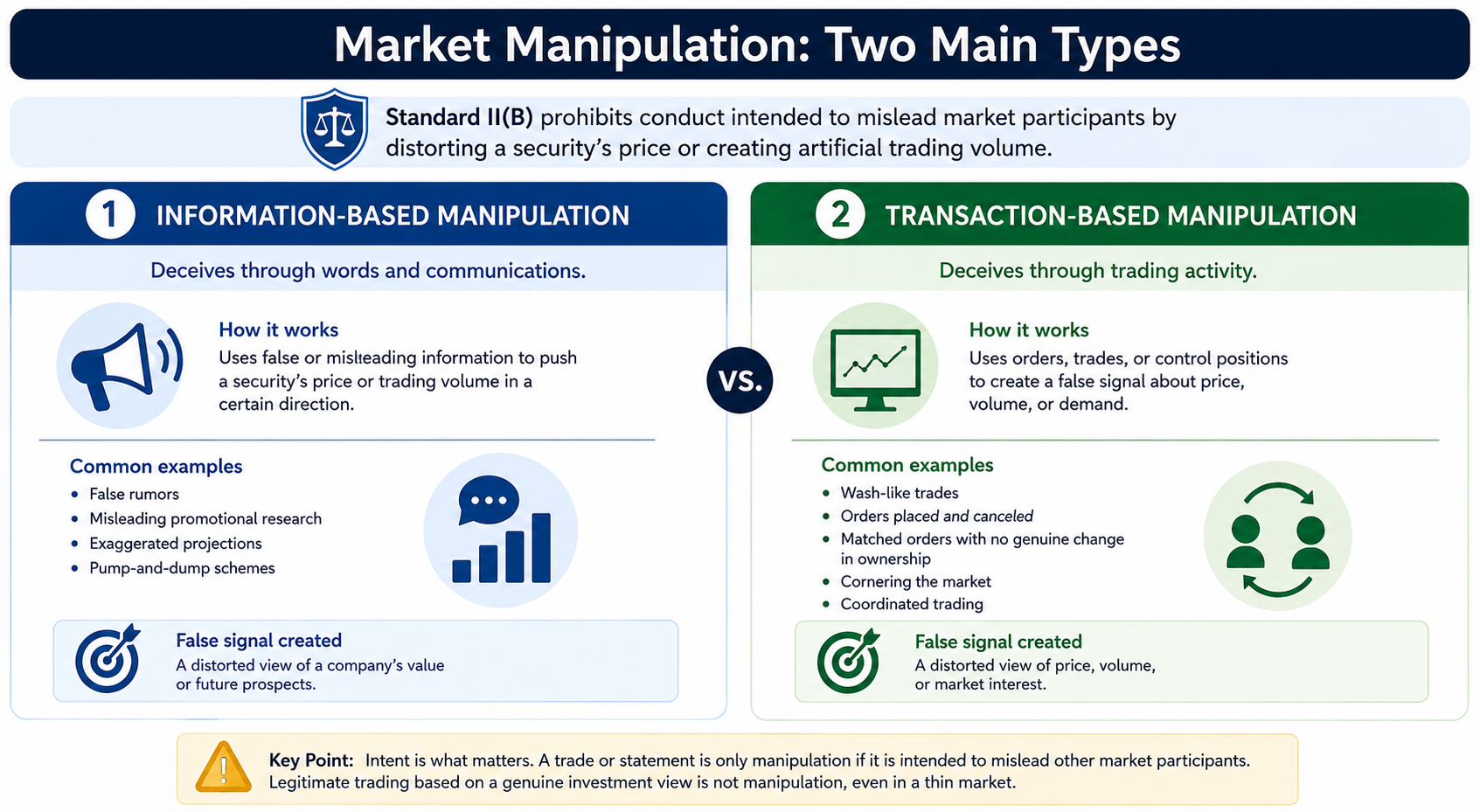
Feature | Information-based | Transaction-based |
|---|---|---|
Method | False or misleading communication | Orders, trades, or control positions |
False signal | A distorted view of value or prospects | A distorted view of price, volume, or demand |
Common conduct | False rumors, misleading promotion, pump-and-dump | Wash-like trades, orders placed and canceled, cornering |
Exam clue | A statement made to move the market | Activity designed to fake interest, not gain exposure |
These two categories cover the practices the exam tests most often, but treat them as teaching buckets rather than a complete legal taxonomy across every jurisdiction.
What Is Information-Based Manipulation?
Information-based manipulation spreads false rumors, misleading promotional research, or knowingly exaggerated projections to move a security. The classic version is a pump-and-dump, where someone talks up a stock they hold, then sells into the demand they created.
The line to watch is between an honest opinion and a manufactured claim. An analyst can hold and publish a genuinely optimistic view supported by real analysis, even if it later proves wrong. That is research, not manipulation. The violation comes when the statement is designed to create artificial demand rather than to share a sincere conclusion. When the issue is a misleading statement without a market-distortion purpose, that belongs under Standard I(C) Misrepresentation instead.
What Is Transaction-Based Manipulation?
Transaction-based manipulation uses trading itself to fake a market signal. It includes creating artificial volume, executing trades that produce no real change in beneficial ownership, placing orders meant to move the bid or offer and then canceling them, coordinating activity across accounts, and taking control of an underlying asset to influence a related instrument.
The trap here is that the trades can be real. An order that actually posts, or a trade that actually executes, can still be manipulative if its purpose was to mislead rather than to gain genuine exposure or execution. Newer trading technology is just context. The underlying question stays the same: was the activity meant to deceive other participants about supply, demand, price, or volume.
How Do You Distinguish Manipulation From Legitimate Trading?
Run three checks: intent, market signal, and economic purpose. Ask whether the trader meant to deceive, whether the activity created an artificial signal, and whether there was a real economic reason for the conduct.
Plenty of aggressive strategies are perfectly legitimate. Large trades, rapid order changes, arbitrage, short selling, liquidity provision, and strategies built on a perceived market inefficiency are not manipulation just because they affect price or happen in an illiquid name. The deciding question is whether the trader was seeking genuine execution or economic exposure, or instead trying to fool others about the state of supply, demand, price, or volume. Real purpose points to legitimate trading. A staged signal with no economic reason points to manipulation.
Recommended Procedures for Compliance
Firms control this risk with order-entry and cancellation controls and with real-time surveillance across the relevant venues and related instruments. They watch for wash-like activity, coordinated accounts, cross-product conduct, and algorithm behavior that looks designed to mislead.
Trade-exception reporting and prompt escalation to compliance round out the system. For unusual strategies, the practical safeguard is documentation: record the legitimate investment or execution rationale so that activity which looks aggressive can be shown to have a real economic purpose.
Compliant Scenario
Situation. Lena Vasquez manages a fund holding a large stake in a thinly traded industrial supplier. She needs to exit. Because the stock trades on light volume, she works the position out gradually over several weeks and accepts the normal price pressure her selling causes. She spreads no rumors and does not route trades between accounts she controls.
Relevant issue. Her selling pushes the price down. The question is whether a decline she caused makes this manipulation.
Correct action. She documents her execution objective, sells in a measured way to manage market impact, and lets the price find its level.
Why it complies. The price moved because of genuine selling for a real economic reason, not because she staged a false signal. A price decline from legitimate liquidation is not manipulation.
Violation Scenario
Situation. Theo Brandt holds a position in a small-cap equipment maker he wants to sell at a higher price. He places a series of large, visible buy orders above the prevailing bid to make demand look strong. As other investors react and the price ticks up, he cancels the buy orders before they execute and sells his existing position into the rising interest.
Violation. Theo created an artificial impression of demand through orders he never intended to fill, then traded against the reaction he engineered.
Required alternative. He should have sold his position based on its real market, without posting orders designed to mislead other participants about demand.
Why the original action fails. The deceptive intent and the artificial order signal support a violation even though the buy orders never executed. A completed trade and an actual profit are not required.
Common Exam Traps
Assuming any price move in a thin market is manipulation. Illiquid stocks move on normal trading. A legitimate trade with a real purpose is not a violation just because it shifts the price.
Looking only for false statements. Manipulation is not always verbal. Transaction-based conduct, like staged orders or wash-like trades, counts too.
Requiring a profit. The Standard reaches the attempt. The manipulator does not have to earn money or complete the scheme for it to be a violation.
Treating real trades as automatically clean. An executed trade can still be manipulative when its purpose was to fake volume or demand rather than to gain exposure.
Confusing II(A) and II(B). Trading on inside information is Standard II(A). Distorting market signals to mislead others is Standard II(B). Match the conduct to the right rule.
Practice Question
Over two trading sessions, an algorithmic trader repeatedly submits large buy orders for a mid-cap stock and cancels almost all of them within milliseconds, just before they would fill. Internal messages show the trader's stated goal was to make other participants believe demand was building so they would lift their own bids. The trader then sells a held position into the resulting price rise. The held position is sold at a small loss because the move faded faster than expected.
Which feature most strongly indicates a violation of Standard II(B)?
The trader's stated goal of making other participants believe demand was building.
The use of an automated system to submit and cancel orders quickly.
The fact that the held position was eventually sold.
Correct Answer: A
Standard II(B) turns on the intent to mislead. The internal messages show the orders were placed to create a false impression of demand and induce others to act, which is the core of transaction-based manipulation. The orders were a staged signal, not an attempt to gain real exposure.
Option B is wrong because automated order entry and rapid cancellation are common and lawful in normal trading. The technology is not the violation; the deceptive purpose is.
Option C is wrong because selling a held position is an ordinary act, and the loss is irrelevant. A violation does not require a profit or a successful move.
Continue Your CFA Level I Prep With KeyPoint
Use structured lessons, practice questions, mock exams, and progress tracking to focus on the time you have left
FAQs About Standard II(B): Market Manipulation
What is market manipulation under CFA Standard II(B)?
Market manipulation is conduct intended to mislead participants by distorting a security's price or creating artificial trading volume. It includes both false communications and trading activity designed to fake a market signal.
What are the two main types of market manipulation?
Information-based manipulation, which spreads false or misleading information, and transaction-based manipulation, which uses orders, trades, or control positions to create a false impression of price, volume, or demand.
Is a large trade that changes a stock price market manipulation?
Not by itself. A large trade made for a genuine economic reason can move the price, especially in a thin market, without violating the Standard. The violation requires an intent to mislead.
Does attempted manipulation violate the Standard if the trader makes no profit?
Yes. The Standard reaches conduct designed to mislead even if it fails. A profit, a completed scheme, or a successful price move is not required.