
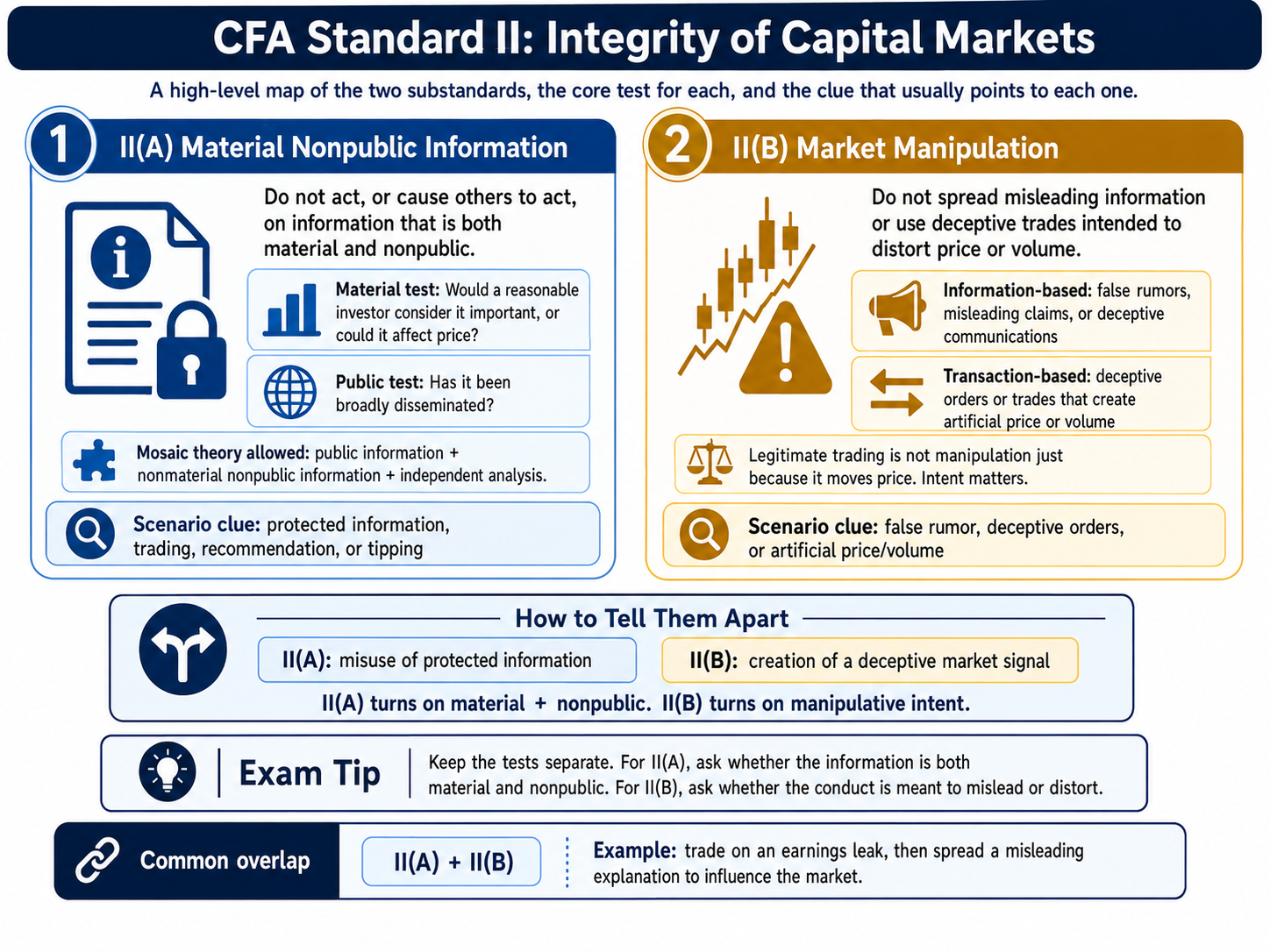
The integrity of capital markets depends on two things: fair use of information and honest price formation. CFA® Standard II protects both through two duties. Standard II(A) concerns material nonpublic information. Standard II(B) concerns conduct meant to mislead market participants or distort prices and volume. This note compares the two and links to the detailed notes for each.
Quick Answer
CFA Standard II has two parts. II(A) prohibits acting, or causing others to act, on information that is both material and nonpublic. II(B) prohibits information-based or transaction-based conduct intended to mislead the market or distort price or volume. The simplest way to tell them apart: II(A) is about misusing protected information, while II(B) is about creating a deceptive market signal.
Key Takeaways About Integrity of Capital Markets
For II(A) to apply, information must be both material and nonpublic, not just one of the two.
Causing another person to act on material nonpublic information can violate II(A), not only trading yourself.
Mosaic theory permits analysis built from public and nonmaterial nonpublic information.
II(B) covers both information-based and transaction-based manipulation.
Legitimate trading is not manipulation just because it moves a price.
One scenario can raise both II(A) and II(B) at once.
What You Need to Know for CFA Level I
Know the names and order of II(A) and II(B), and keep the two tests they rely on separate. For II(A), that means the material test and the nonpublic test. For II(B), it means intent.
You should also understand mosaic theory, the two broad manipulation categories, and the role intent plays in separating a legitimate strategy from a deceptive one. The exam often mixes these into one scenario, so being able to route between the two duties matters as much as defining them.
What Does CFA Standard II Cover?
Standard II(A): Material Nonpublic Information
Covered professionals must not act, or cause others to act, on information that could affect an investment's value when that information is both material and nonpublic. Two separate tests decide whether the duty applies.
Materiality turns on whether a reasonable investor would likely consider the information important, or whether it could affect the price of a security. Public status turns on broad dissemination. Sharing information with a limited group does not make it public. Tipping or encouraging someone else to trade can raise the same issue as trading directly. Information barriers and restricted-list controls are among the tools that help prevent misuse.
See the Standard II(A): Material Nonpublic Information note for detailed materiality tests, mosaic theory, and procedures.
Standard II(B): Market Manipulation
Conduct must not be intended to mislead market participants or distort price-setting or trading volume. Information-based manipulation involves false or misleading communications. Transaction-based manipulation involves deceptive orders or trades designed to create artificial price or volume signals.
Legitimate strategies are not prohibited just because they affect a thin or volatile market. Intent and context are what separate a deceptive act from an honest one.
See the Standard II(B): Market Manipulation note for detailed categories, controls, and scenarios.
Material Nonpublic Information vs Market Manipulation
Area | Standard II(A) | Standard II(B) |
|---|---|---|
Main issue | Misuse of protected information | Creation of a false or misleading market signal |
Key test | Is the information material and nonpublic? | Is the conduct intended to mislead or distort? |
Typical conduct | Trading, recommending, or tipping | False information, deceptive orders, artificial price or volume |
Information status | Central to the analysis | May involve public, false, or manipulated information |
Intent | Knowledge of and action on protected information | Manipulative intent is central |
Main controls | Information barriers, restricted lists, and monitoring | Communications review, trading surveillance, and escalation |
What Is Mosaic Theory?
Mosaic theory is the principle that an analyst may reach a material conclusion by combining public information, nonmaterial nonpublic information, and independent analysis. The conclusion can be material even though no single input was both material and nonpublic.
The key boundary is the source of the conclusion itself. An analyst may use the conclusion they built, but they may not act on a material conclusion that was handed to them as nonpublic information. In other words, mosaic theory does not permit using a material nonpublic fact, only the analyst's own work product assembled from permitted pieces. Research support should be retained, and the reliability and materiality of each input should be assessed carefully.
What Are the Types of Market Manipulation?
The two broad types of market manipulation differ by the tool used: words or trades.
Information-Based Manipulation
Information-based manipulation uses communication to mislead. It includes false rumors, misleading statements, artificially optimistic or negative claims, coordinated misinformation, and content designed to push others into trading.
For example, an analyst who runs a widely followed research channel might post an unverified claim that a small-cap company is about to win a major contract, knowing it is false, in order to lift the price before selling. The same logic applies to a social media account used to seed a misleading narrative about a stock.
Transaction-Based Manipulation
Transaction-based manipulation uses orders or trades to create a false picture of supply or demand. It includes orders or trades meant to create artificial price or volume, trades with no genuine change in beneficial ownership, and orders entered and then cancelled to fake demand or supply. It can also include using a dominant position to distort related instruments.
For example, a trader might enter a series of large buy orders to suggest strong demand, then cancel them once other participants react, having no intention of executing. This list shows common patterns rather than a complete legal taxonomy.
How to Identify the Relevant Standard II Subsection
Use this routing sequence:
Did the person receive or possess information that is not broadly available?
Is that information likely material?
Did the person trade, recommend, or cause another person to act? Consider II(A).
Did the person spread misleading information or place deceptive orders?
Was the purpose to mislead participants or distort price or volume? Consider II(B).
Could both Standards apply?
Market Manipulation Examples and Mixed Scenarios
These three short examples are original and illustrative.
Information-based. An analyst knowingly posts a false rumor that a midsize retailer is about to be acquired, hoping to push the share price up before selling a position. The likely Standard is II(B), and the decisive fact is the intent to mislead through a false communication.
Transaction-based. A trader repeatedly places large orders in a thinly traded security and cancels them before they execute, creating the appearance of demand to draw in other buyers. The likely Standard is II(B), and the decisive fact is the deceptive order activity designed to fake a price or volume signal.
Mixed. A person learns nonpublic earnings information before its release, trades ahead of it, and then posts a misleading public explanation for the resulting price move to cover the tracks. This raises II(A) because of the action on material nonpublic information, and II(B) because of the misleading communication. The decisive facts are the protected information for II(A) and the intent to mislead for II(B).
Common Exam Traps
Treating all nonpublic information as material, when both tests must be met.
Assuming any analyst conclusion that moves a stock is inside information.
Forgetting that causing another person to act can violate II(A).
Treating every large or price-moving trade as manipulation.
Ignoring intent under II(B), which is central to the analysis.
Confusing a false rumor with the receipt of material nonpublic information.
Practice Question
An analyst combines a company's public filings, conversations with several of its suppliers about industry demand, and her own modeling to conclude that the company will likely miss its earnings target. None of the individual pieces she gathered was both material and nonpublic. She trades on her conclusion. Does her conduct violate Standard II?
Yes, because her conclusion is material, so acting on it violates II(A).
No, because her conclusion was built through mosaic theory from public and nonmaterial nonpublic information and independent analysis.
Yes, because trading ahead of an earnings release is always market manipulation under II(B).
Correct Answer: B
Mosaic theory permits an analyst to reach and act on a material conclusion assembled from public information, nonmaterial nonpublic information, and her own analysis. The conclusion can be material even though no single input was both material and nonpublic.
Option A. Incorrect because II(A) applies to material nonpublic information she received, not to a material conclusion she built herself from permitted inputs.
Option C. Incorrect because trading on a well-supported conclusion is not manipulation. II(B) requires intent to mislead or distort, which is absent here.
Study Each Standard II Subsection
Continue Your CFA Level I Prep With KeyPoint
Use structured lessons, practice questions, mock exams, and progress tracking to focus on the time you have left
FAQs About Guidance For Standard II
What is CFA Standard II?
CFA Standard II protects the integrity of capital markets. It has two parts: II(A) Material Nonpublic Information and II(B) Market Manipulation. Together they protect fair information use and honest price formation.
What is material nonpublic information?
Material nonpublic information is information that a reasonable investor would likely consider important, or that could affect a security's price, and that has not been broadly disseminated. Both the material test and the nonpublic test must be met.
What is mosaic theory?
Mosaic theory is the principle that an analyst can reach a material conclusion by combining public information, nonmaterial nonpublic information, and independent analysis. The conclusion can be acted on as long as it was not handed to the analyst as material nonpublic information.
What are the two types of market manipulation?
The two types of market manipulation are information-based manipulation, which uses false or misleading communications, and transaction-based manipulation, which uses deceptive orders or trades to fake price or volume.
What is the difference between Standard II(A) and II(B)?
Standard II(A) is about misusing information that is material and nonpublic. Standard II(B) is about conduct intended to mislead participants or distort price or volume. One is about protected information, the other is about a deceptive signal.
Can legitimate trading move prices without violating Standard II(B)?
Yes. Trading on a sound, well-supported view can move a price without violating II(B). The Standard turns on intent to mislead or distort, not on price impact alone.