
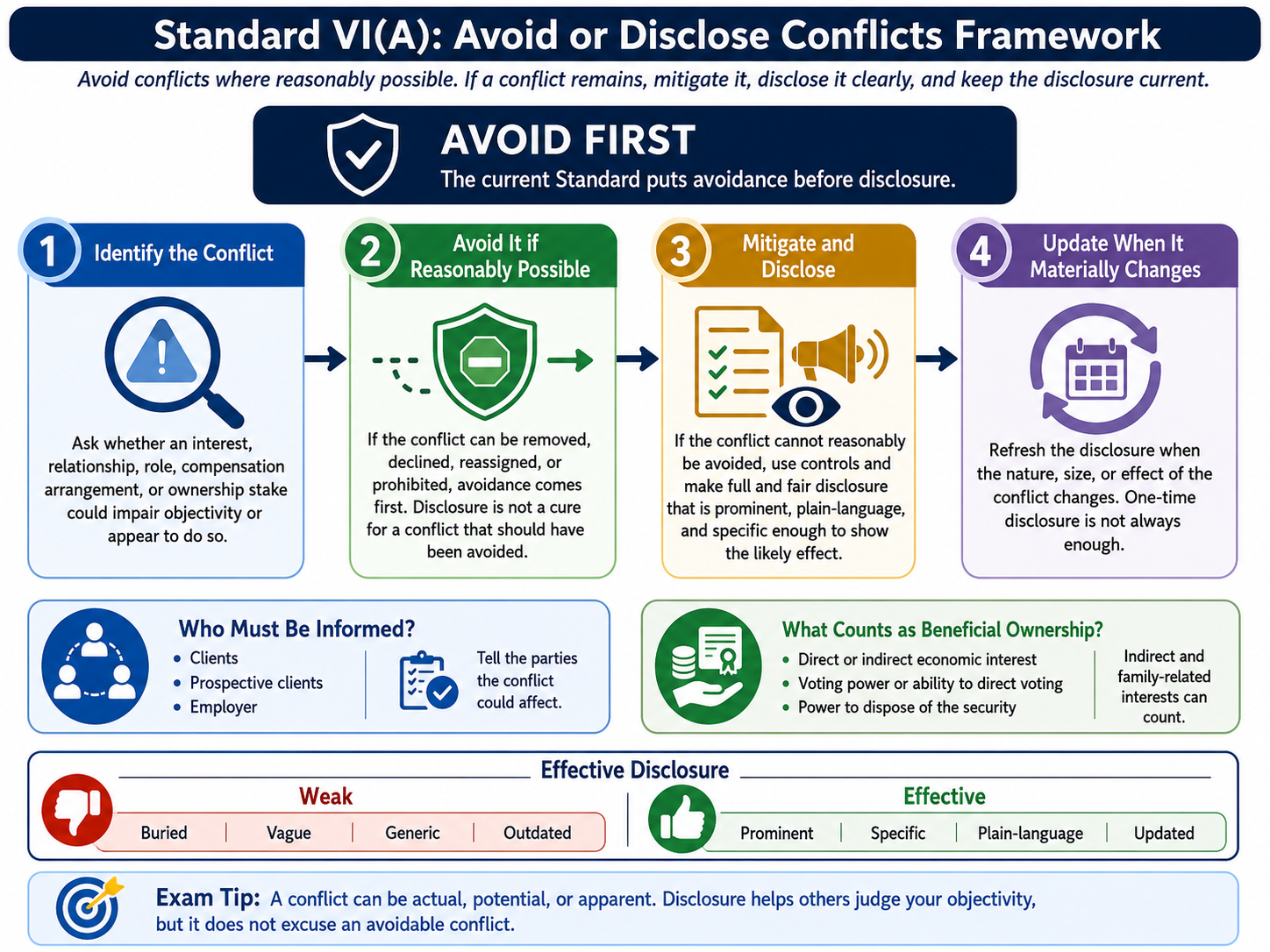
Standard VI(A): Avoid or Disclose Conflicts puts avoidance first. You must avoid conflicts that could reasonably be expected to impair your independence and objectivity or interfere with your duties to clients, prospective clients, and your employer. When a conflict cannot reasonably be avoided, you make full and fair disclosure, and that disclosure must be prominent, in plain language, and clear enough to do its job. Disclosure does not excuse a conflict you could and should have avoided.
Quick Answer
Standard VI(A) tells you to avoid conflicts where you reasonably can, and to disclose any that remain. Disclosure must be prominent, in plain language, and specific enough for the recipient to understand the conflict and its likely effect, and it must be updated when the conflict materially changes. Disclosure that is buried, vague, or one-time may not be enough, and it never cures a conflict you should have avoided.
Key Takeaways on Standard VI(A): Avoid or Disclose Conflicts
The current rule leads with avoidance. Disclosure is the response when a conflict cannot reasonably be avoided.
Conflicts can be actual, potential, or apparent. The appearance of a conflict can be enough to require action.
Effective disclosure is prominent, plain-language, specific, and updated when the conflict materially changes.
The duty runs to clients, prospective clients, and your employer.
Beneficial ownership is broad. It includes direct or indirect economic interest, voting power, or the power to dispose of a security.
Disclosure lets others judge your objectivity. It does not make otherwise improper conduct acceptable.
What You Need to Know
A conflict of interest is any matter that could reasonably be expected to impair your independence and objectivity, or raise a question about whether your judgment is free from bias. Conflicts are common in the investment profession, and a frequent source is compensation, especially incentive and bonus structures.
The current Standard sets a sequence. Identify the conflict. Avoid it where you reasonably can. Where you cannot, mitigate it as far as possible and disclose it fully and fairly. Then update the disclosure when the nature, size, or effect of the conflict changes materially. The earlier framing, which treated disclosure as the first or only response, is out of date.
Identify, Avoid, Mitigate and Disclose, Update
Stage | The question to ask |
|---|---|
Identify | Could this interest, relationship, compensation, role, or ownership impair my judgment or appear to? |
Avoid | Can the conflict reasonably be removed, declined, reassigned, or prohibited? |
Mitigate and disclose | If it is unavoidable, what controls reduce the risk, and what must affected parties understand? |
Update | Has the nature, size, or effect of the conflict materially changed? |
Best practice is to avoid both actual conflicts and the appearance of them. When avoidance is not reasonable, controls plus clear disclosure let your employer, clients, and prospects evaluate your objectivity for themselves.
What Makes Disclosure Effective
A disclosure that technically exists is not automatically a compliant disclosure. The Standard requires it to be prominent, in plain language, and able to communicate the information effectively.
Weak disclosure | Effective disclosure |
|---|---|
Generic, buried, technical, or incomplete | Prominent, specific, understandable, and timely |
Says only that "conflicts may exist" | Identifies the relevant interest or relationship and its possible effect |
Given once and never revisited | Updated when the conflict materially changes |
A vague statement on the last page of a long report, or a one-time disclosure that is never revisited, can fall short even though something was technically said.
Conflicts with Clients, Prospects, and Employers
The duty does not stop at clients. You disclose to clients and prospective clients when a conflict could reasonably affect a recommendation, analysis, or service. You also disclose to your employer when a conflict could impair unbiased advice, interfere with your duties, or cause you to act against the employer's interest. Disclosing to a compliance department can satisfy the employer-notification duty when that department is the firm's appropriate representative. A classic trap is disclosing a conflict to existing clients while forgetting prospective clients, or disclosing only to the employer when clients are also affected.
Beneficial Ownership, Including Indirect Interests
You beneficially own a security when you have a direct or indirect economic interest in it, the power to vote or direct its voting, or the power to dispose of it or direct its disposition. That definition reaches well beyond stock held in your own name. Holdings through a controlled family entity, immediate family holdings, and options or other instruments that may create future ownership can all count. Material beneficial ownership of a security you analyze, recommend, or discuss is disclosable. The point is not to ban ownership outright, but to let the audience judge possible bias.
Common Sources of Conflict
Conflicts often arise from compensation, bonuses, and incentives, ownership of recommended securities, stock options, family or business relationships, outside board service, issuer-paid compensation, cross-department pressure within a firm, proprietary products, underwriting or market-making relationships, and nonstandard fee arrangements. Board service deserves special care, because directors can receive material nonpublic information and owe duties to both the company and outside clients.
Recommended Procedures for Compliance
Firms reduce conflicts with information barriers, independent reporting lines, restricted lists, blackout periods, preclearance, and monitoring of personal trades. They may prohibit certain activities outright, such as some outside board service or personal trading, to avoid even the appearance of a conflict. You comply with those restrictions, report conflicts promptly when they cannot be avoided, and make sure remaining disclosures are prominent and kept current.
Scenarios
Violation: a buried, stale disclosure of indirect ownership
Situation. Anika covers semiconductor-equipment makers. She holds shares in one of them indirectly through a family investment LLC she controls. Her employer allows her to keep coverage if controls are in place.
Conduct. She places a single line, "the analyst or related parties may hold positions in companies covered," on page 40 of a long report. Months later she increases the position and does not update the disclosure.
Analysis. The indirect holding is beneficial ownership and is disclosable. The disclosure is neither prominent nor specific, and it was never updated after a material change in the position. Anika violates Standard VI(A) on prominence, specificity, and updating.
Takeaway. Indirect ownership counts, the disclosure has to be findable and specific, and it has to be refreshed when the conflict materially changes.
Compliant: controls plus a prominent, plain-language disclosure
Situation. Theo sits on the board of a small supplier his firm wants him to keep covering. The firm cannot easily reassign the coverage.
Conduct. The firm puts an information barrier in place, and Theo discloses the directorship prominently and in plain language at the start of each report, explaining how it could affect his objectivity. When his board compensation terms change, he updates the disclosure.
Analysis. The conflict could not reasonably be avoided, so the firm mitigates it with controls and Theo makes a prominent, specific disclosure before the recommendation reaches clients, then keeps it current. This meets Standard VI(A).
Takeaway. When avoidance is not reasonable, the compliant path is mitigation plus a prominent, plain-language, up-to-date disclosure made before clients act.
Common Exam Traps
Using the old title and treating disclosure as the first or only required response.
Assuming any disclosure cures an avoidable conflict.
Ignoring apparent conflicts because no actual bias is proven.
Treating indirect or family ownership as irrelevant.
Believing a disclosure is adequate just because it appears somewhere in a document.
Forgetting to update a disclosure after a material change.
Confusing general conflict disclosure under VI(A) with written consent for additional compensation under IV(B).
Confusing referral-fee disclosure under VI(C) with the broader conflict rule.
Practice Question
An analyst has a conflict of interest that cannot reasonably be avoided, and it could affect a recommendation that will reach the firm's clients. Which action most likely complies with Standard VI(A)?
The analyst applies the firm's controls and makes a prominent, plain-language disclosure of the conflict before the recommendation reaches clients.
The analyst adds a generic statement that "conflicts of interest may exist" to the firm's standard disclaimer.
The analyst discloses the conflict to the firm's compliance department but not to the clients the recommendation will reach.
Correct Answer: A
When a conflict cannot reasonably be avoided, mitigating it with controls and making a prominent, plain-language disclosure before clients act is what the Standard requires.
Option B is incorrect. A generic, buried disclaimer is not specific or prominent enough to let clients judge the conflict's effect.
Option C is incorrect. When clients are affected, disclosing only to the employer is not sufficient. The disclosure must also reach the affected clients.
Continue Your CFA Level I Prep With KeyPoint
Use structured lessons, practice questions, mock exams, and progress tracking to focus on the time you have left
FAQs About Standard VI(A): Avoid or Disclose Conflicts
What changed when the Standard was retitled in 2024?
The emphasis. The current title, "Avoid or Disclose Conflicts," reflects that avoidance comes first. Older "disclosure of conflicts" materials can give the impression that disclosing a conflict is always enough, but the current Standard expects you to avoid conflicts where you reasonably can and to disclose only those you cannot.
Does disclosing a conflict make it acceptable?
Not always. Disclosure lets clients, prospects, and your employer judge your objectivity, but it does not cure a conflict you could and should have avoided, and it does not legalize conduct that is independently improper.
What counts as beneficial ownership?
A direct or indirect economic interest in a security, the power to vote or direct its voting, or the power to dispose of it. That includes holdings through a controlled entity, immediate family holdings, and options or instruments that may create future ownership.
Who must receive the disclosure?
Clients, prospective clients, and your employer, depending on who the conflict could affect. A frequent error is disclosing to existing clients but not prospective ones, or disclosing only to the employer when clients are also affected.