
Bond prices move when interest rates move, and that price risk is one of the core ideas CFA® Level I tests in fixed income. Duration and convexity are the two measures candidates use to estimate how much a bond's price will change when its yield changes. Duration gives you the first estimate, and convexity refines it.
Quick Answer
Duration estimates how much a bond's price changes when its yield changes. Convexity refines that estimate by accounting for the curved relationship between bond prices and yields. For CFA Level I, the key idea is that duration gives the first price-change estimate, while convexity improves the estimate when the yield change is larger.
Key Takeaways: Bond Duration and Convexity for CFA Level I
Bond prices and yields move in opposite directions, so a yield rise lowers the price and a yield fall raises it.
Modified duration estimates the percentage price change for a small change in yield.
Convexity adjusts for the curve in the price-yield relationship that duration alone ignores.
A duration-only estimate gets less accurate as the yield change grows.
Positive convexity adds to the price estimate whether yields rise or fall.
Level I questions can test both the calculation and the interpretation, so know both.
What You Need to Know for CFA Level I
For this topic, focus on a short list of ideas that show up again and again in questions.
Bond prices fall when yields rise and rise when yields fall.
Modified duration estimates the percentage price change for a small change in yield.
Convexity is a second-order adjustment that accounts for the curve in the price-yield line.
A higher duration means the bond is more sensitive to interest rate changes.
Yield changes go into the formula as decimals, so 0.50% is 0.005, not 0.5.
Duration and convexity measure price risk. They do not promise a return.
What Are Duration and Convexity?
Duration and convexity are two measures of how a bond's price responds to a change in yield. Duration is the first-order measure, and convexity is the second-order measure that corrects for the curve duration misses.
Think of it as estimating the same thing in two passes. Duration draws a straight line through the price-yield relationship and reads the price change off that line. That straight-line estimate is close for small yield moves, but the real relationship between price and yield bends, so the line drifts away from the truth as the yield change grows. Convexity measures that bend and adds it back, which is why the two are taught together rather than apart.
For Level I, "risk and return" here means price sensitivity. You are estimating how a bond's value moves with rates, not attributing a full return across coupons and reinvestment.
How Duration Measures Bond Price Risk
Modified duration estimates the percentage change in a bond's price for a given change in yield. A bond with a modified duration of 6 will lose roughly 6% of its value if its yield rises by one full percentage point, and gain roughly 6% if its yield falls by the same amount.
The higher the modified duration, the more the price swings when rates move. That is the heart of interest rate risk, and it is why a long bond feels rates more sharply than a short one.
Duration carries a built-in sign. Because price and yield move in opposite directions, the duration effect is negative when yields rise and positive when yields fall. The estimate is also at its most accurate for small yield changes, which sets up the reason convexity exists.
How Convexity Improves the Price Change Estimate
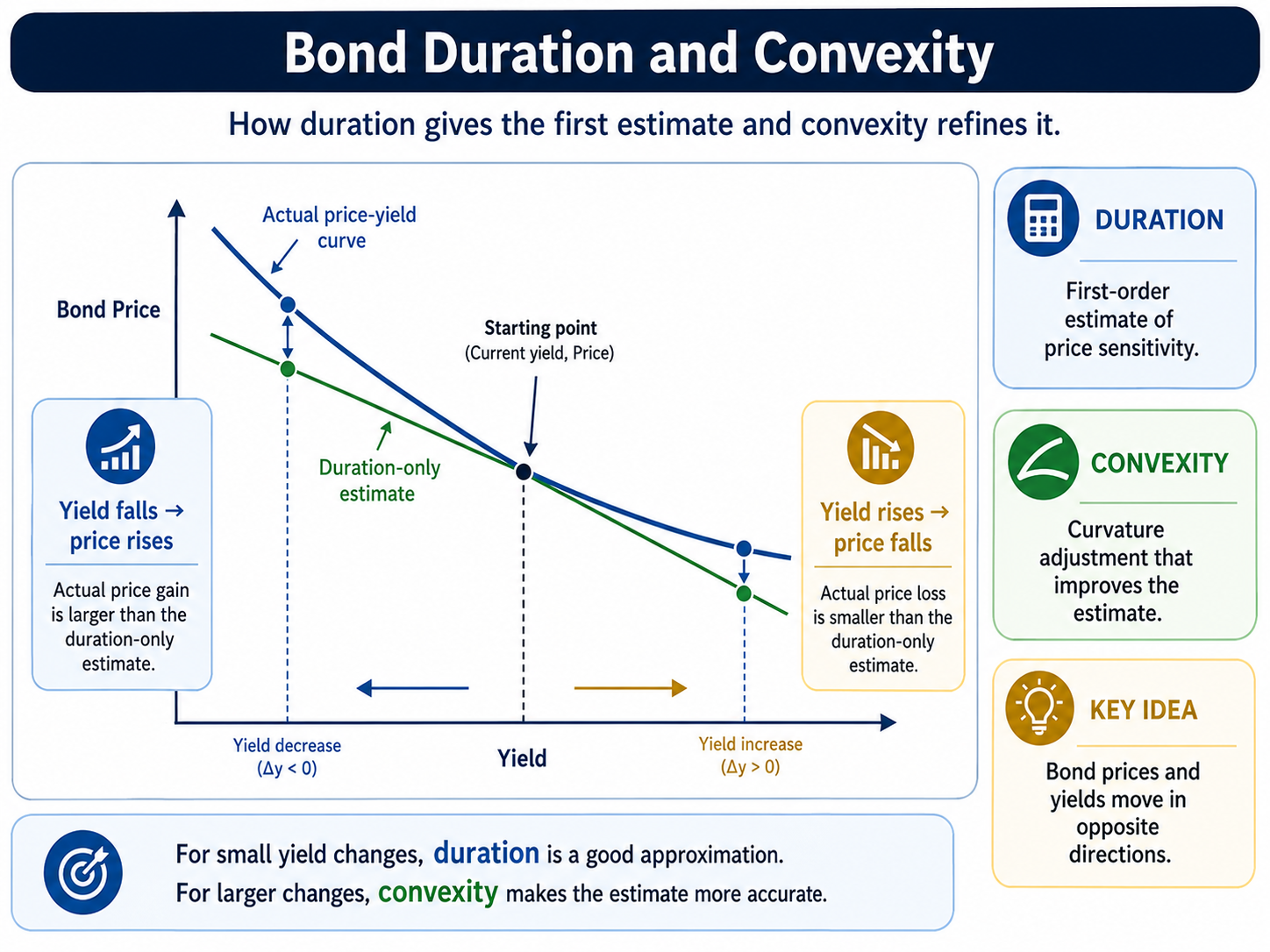
Convexity corrects the duration estimate for the curve in the price-yield relationship. Duration assumes a straight line, but the true relationship is curved, so duration alone misreads larger yield moves.
The correction always works in the bond holder's favor for a standard bond. When yields fall, convexity makes the price gain a little larger than duration predicts. When yields rise, it makes the price loss a little smaller. The reason is that the yield change is squared in the convexity term, so the adjustment is positive in both directions.
This is why a bond with more convexity is generally less exposed to interest rate risk than one with less. The further yields move, the more that curve matters, and the more a duration-only estimate understates the good news and overstates the bad.
Duration and Convexity Formula
The standard Level I formula estimates the approximate percentage change in a bond's price by combining the duration effect with the convexity adjustment.
Component | Meaning | CFA Level I interpretation |
|---|---|---|
Modified Duration | First-order price sensitivity to a yield change | A higher value means greater bond price risk |
ΔYield | Change in yield, entered as a decimal | 0.50% is entered as 0.005 |
Convexity | The curvature in the price-yield relationship | Improves the estimate for larger yield changes |
0.5 × Convexity × (ΔYield)² | The convexity adjustment | Adds the second-order effect on top of the duration estimate |
A positive result means an estimated price increase, and a negative result means an estimated decline. The formula gives a percentage change, so to find the new price you apply that percentage to the bond's current price.
Worked Example: Estimating a Bond's Price Change
Take a bond priced at 100 with a modified duration of 6.2 and a convexity of 48. Suppose its yield rises by 0.75%, entered as 0.0075. Here is how the estimate comes together.
Step 1: Duration effect. Multiply the modified duration by the yield change and apply the negative sign.
Step 2: Convexity adjustment. Apply the second-order term. The yield change is squared, so the result is positive.
Step 3: Approximate percentage price change. Add the two effects.
Step 4: Estimated new price. Apply the percentage change to the starting price.
Step 5: Read the result. A 0.75% rise in yield is estimated to cut the bond's price by about 4.5%, from 100 to roughly 95.49. Duration alone would have predicted a 4.65% drop. The convexity adjustment trims that loss by about 0.135%, which is the curve working in the holder's favor on the downside.
Common Exam Traps
A few mistakes cost candidates marks on this topic again and again.
Wrong sign. Forgetting that price and yield move in opposite directions, and reporting a price gain when yields rise.
Wrong units. Entering a 0.75% yield change as 0.75 instead of 0.0075, which throws the answer off by orders of magnitude.
Subtracting convexity. The convexity adjustment is added in both directions because the yield change is squared. Subtracting it on a yield increase is a common error.
Treating duration as exact. Duration is an approximation, and it drifts on larger yield moves. The question often rewards you for adding convexity, not ignoring it.
Mixing up single-bond and portfolio measures. A single bond's duration and convexity are not the same as a portfolio's weighted-average figures.
Practice Question
A bond is priced at 102. Its modified duration is 5.0 and its convexity is 60. If its yield falls by 1.00%, entered as 0.0100, what is the approximate percentage change in the bond's price?
+5.00%
+5.30%
+4.70%
Correct Answer: B
A yield fall is a negative yield change, so ΔYield is −0.0100. The duration effect is −5.0 × (−0.0100) = +0.05, or +5.00%. The convexity adjustment is 0.5 × 60 × (−0.0100)² = +0.003, or +0.30%. Adding the two gives +5.30%.
Option A leaves out the convexity adjustment and reports the duration effect alone.
Option C subtracts the convexity adjustment instead of adding it, which reverses the sign of a term that is always positive.
Continue Your CFA Level I Prep With KeyPoint
Use structured lessons, practice questions, mock exams, and progress tracking to focus on the time you have left
FAQs About Bond Duration and Convexity
What is duration in CFA Level I fixed income?
Duration measures a bond's approximate price sensitivity to a change in yield. Modified duration estimates the percentage price change for a small yield move, and a higher duration means a larger price swing when rates change.
What is convexity in CFA Level I fixed income?
Convexity is the adjustment that accounts for the curved relationship between bond prices and yields. Duration assumes a straight line, and convexity corrects for the bend that duration alone leaves out.
Why does convexity matter for bond price risk?
Convexity matters because a duration-only estimate gets less accurate as the yield change grows. For larger yield moves, convexity adds the second-order effect that duration misses, which makes the price-change estimate more reliable.
What is the formula for estimating bond price change using duration and convexity?
The approximate percentage price change equals (−Modified Duration × ΔYield) plus (0.5 × Convexity × (ΔYield)²). Enter the yield change as a decimal, so a 0.50% change goes in as 0.005.