
Bond prices and yields move in opposite directions, and you can estimate the size of that move with duration and convexity. Duration gives the first, straight-line estimate of the price change. Convexity adjusts that estimate for the curved shape of the price-yield relationship. This note is about applying the formula with values you are given, not about calculating duration or convexity from scratch.
Quick Answer
The approximate percentage price change of a bond combines a duration effect and a convexity effect. Duration gives the first estimate of how price changes when yield changes. Convexity improves that estimate because the price-yield relationship is curved, not straight. For CFA Level I, the main task is usually to apply the formula correctly and read the sign.
Key Takeaways: Percentage Price Change Using Bond Duration and Convexity
Approximate percentage price change is estimated using duration and a convexity adjustment.
The duration term is negative when the yield change is positive, because price and yield move in opposite directions.
The convexity adjustment is usually positive, because the yield change is squared.
Enter the yield change as a decimal, so 50 basis points becomes 0.005.
This formula applies duration and convexity values that the question provides.
The most common errors are sign mistakes and basis point conversion mistakes.
What You Need to Know for CFA Level I
Use the approximate percentage price change formula, and remember that price and yield move in opposite directions. Convexity exists in the formula because duration alone draws a straight line through a curved relationship, so it improves the estimate, especially for larger yield changes. Convert basis points carefully, since 50 basis points is 0.005, not 0.50 or 50. Use the duration measure the question gives you, which is modified duration or effective duration, and do not confuse this applied formula with the separate formulas used to calculate duration or convexity themselves.
How Duration and Convexity Estimate Bond Price Change
Duration is the slope-based, first-order estimate of how a bond's price responds to a yield change. On its own, it draws a straight line, which works well for small yield moves but drifts off for larger ones.
The actual relationship between price and yield is curved. Convexity measures that curvature and adjusts the duration estimate to fit it more closely. The larger the yield change, the more the convexity adjustment matters. For a typical option-free bond, positive convexity means the price gain from a yield decrease is a little larger than the price loss from an equal yield increase.
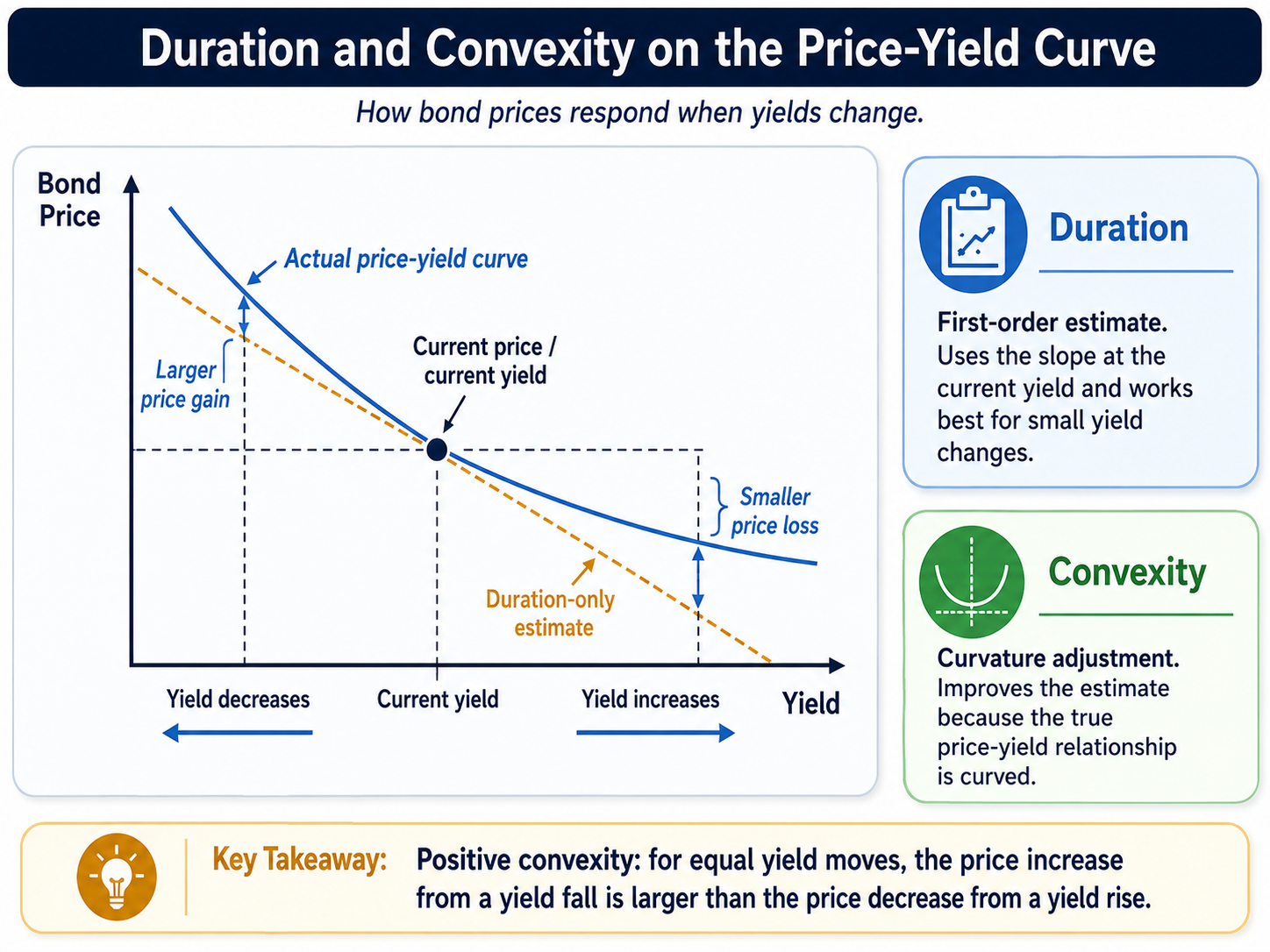
[Internal link opportunity: Link to /cfa/level-i/topics/fixed-income/study-notes/calculate-interpret-convexity/ using anchor text "calculate and interpret convexity".]
Percentage Price Change Formula
The formula you apply is:
Term | Meaning | CFA Level I Note |
|---|---|---|
Duration | Modified or effective duration | Use the duration measure the question provides |
ΔYield | Change in yield | Enter as a decimal, such as 0.005 for 50 basis points |
Convexity | Convexity measure | Used to adjust the duration-only estimate |
0.5 × Convexity × (ΔYield)^2 | Convexity adjustment | Usually positive, since the yield change is squared |
The first term carries the sign of the yield move. A yield increase makes the duration term negative, and a yield decrease makes it positive. The convexity term is added in both cases, so it lifts the estimate whether yields rise or fall.
Worked Example
A bond has a modified duration of 6.2 and a convexity of 80. Yields rise by 50 basis points. Estimate the percentage price change.
First, convert the yield change to a decimal: 50 basis points is 0.005. Then apply the formula:
Approximate % price change:
The estimated price decline is about 3.00%. Duration on its own would have suggested a 3.10% decline, and convexity trims that loss by 0.10%. If yields had instead fallen by 50 basis points, the duration term would flip to positive while the convexity term stayed positive, giving an estimate of about +3.20%. That small difference between the two outcomes is positive convexity at work.
Common Exam Traps
Entering 50 basis points as 50 or 0.50 instead of 0.005.
Dropping the negative sign on the duration term.
Treating the convexity adjustment as negative when yields rise. It is added either way.
Using Macaulay duration when the question provides or requires modified duration.
Trying to calculate duration or convexity when the question only asks you to apply values already given.
Practice Question
A bond has a modified duration of 7.5 and a convexity of 120. Its yield rises by 40 basis points. The approximate percentage price change is closest to:
−2.90%
−3.00%
+2.90%
Correct Answer: A
Convert 40 basis points to 0.004, then apply the formula:
Approximate % price change:
Option B is the duration-only estimate of −3.00%, which leaves out the convexity adjustment.
Option C has the right size but the wrong sign, since a yield increase lowers the price.
Continue Your CFA Level I Prep With KeyPoint
Use structured lessons, practice questions, mock exams, and progress tracking to focus on the time you have left
FAQs About Bond Percentage Price Change Using Duration and Convexity
What is the formula for percentage price change using duration and convexity?
The approximate percentage price change is (−Duration × ΔYield) + (0.5 × Convexity × (ΔYield)^2). The yield change goes in as a decimal.
Why is the duration term negative in the bond price change formula?
Because bond prices and yields move in opposite directions. When the yield change is positive, the duration term is negative, which signals a price decline.
Why is the convexity adjustment usually positive?
The yield change is squared in the convexity term, so it stays positive whether yields rise or fall. It is added to the duration estimate in both cases.
Should I use Macaulay duration or modified duration for percentage price change?
Use the duration measure the question gives you, which is modified duration or effective duration. Macaulay duration is a time measure and is not used directly in this price-change formula.