
Two bonds with the same maturity and the same benchmark rate can still offer different yields. The gap usually comes down to a handful of drivers: credit risk, liquidity, the overall yield level, and maturity. This note focuses on the factors that explain why bond spreads differ. For spread calculation methods, review yield and yield spread measures for fixed-rate bonds.
Quick Answer
Credit spread, liquidity, yield, and maturity are the factors that explain why one bond offers a higher yield than another. A wider credit spread usually reflects higher default risk. Lower liquidity tends to push the required yield up. Maturity changes how long an investor is exposed to credit and rate risk, while the overall yield level shapes how a spread should be read. For CFA® Level I, the skill being tested is interpretation, not calculation.
Key Takeaways About Credit Spread, Liquidity, Yield, and Maturity
Credit spread compensates investors for credit risk above a benchmark rate.
Less liquid bonds usually need a higher yield to attract buyers.
Longer maturity can raise exposure to both credit risk and interest rate changes.
The overall yield level affects how the size of a spread should be interpreted.
Level I questions often ask which factor explains a higher or lower spread, not how to compute it.
A common error is treating every spread difference as credit risk while ignoring liquidity.
What You Need to Know for CFA Level I
For the exam, hold on to these points:
Credit spread reflects compensation for credit risk.
Liquidity describes how easily a bond can be traded without moving its price much, and thinner liquidity usually means a higher yield.
Longer maturity can increase exposure to uncertainty and to rate changes.
Yield level matters because the same spread can mean different things in a high-rate environment versus a low-rate one.
Spread questions usually call for interpretation, so be ready to reason through the drivers rather than reach for a formula.
Why Do Bond Spreads Differ?
A bond's yield reflects far more than the risk-free or benchmark rate. On top of that base, investors demand extra return for the risks they take on, and that extra return is the spread.
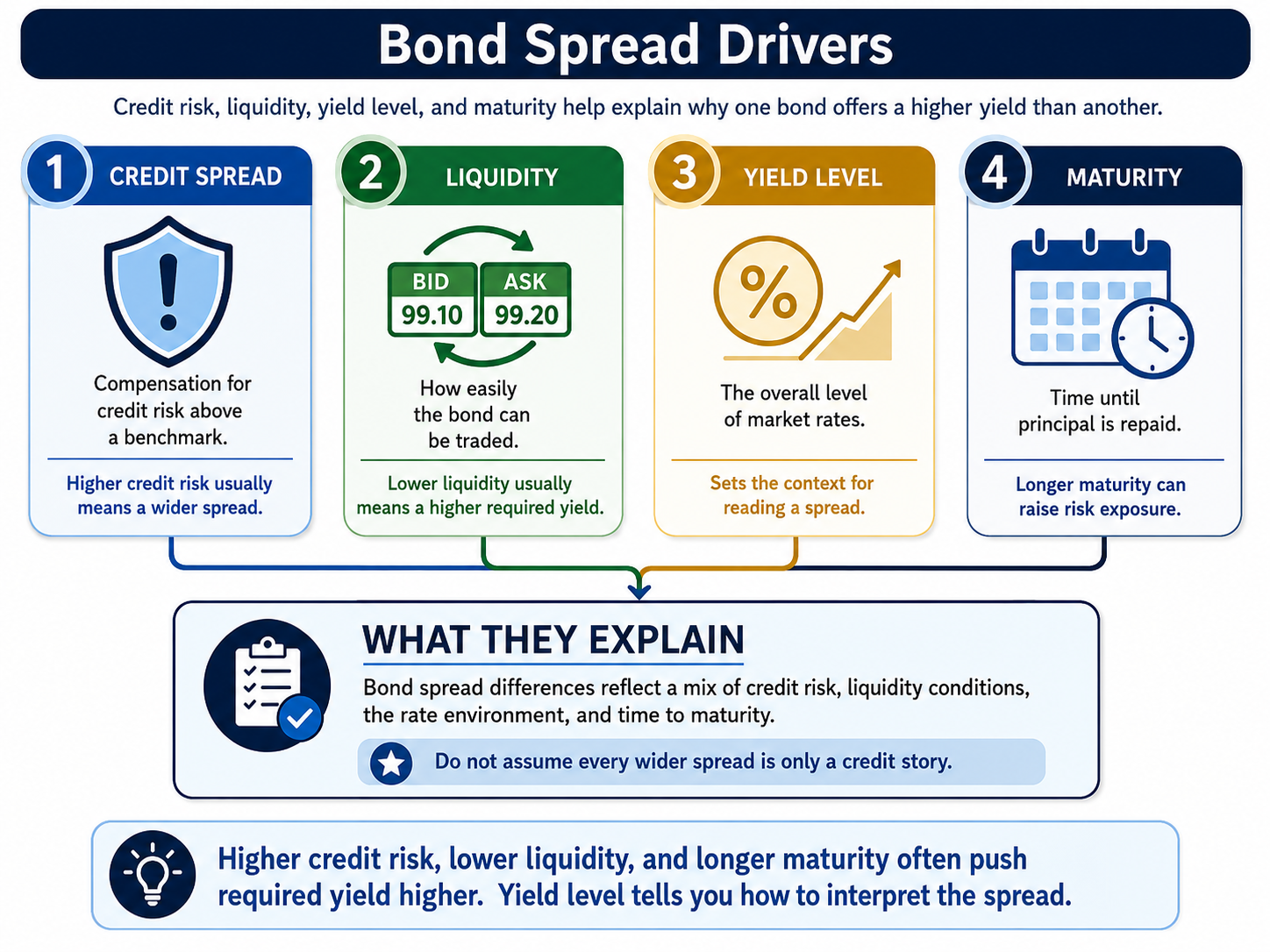
Four drivers do most of the explaining. Credit risk asks how likely the issuer is to miss a payment. Liquidity asks how hard the bond is to trade. Maturity sets how long the investor is exposed to all of it. Yield level sets the backdrop against which the spread is judged.
The catch is that the same spread is not always caused by the same thing. A 150 basis point spread on one bond might be mostly credit risk, while the same spread on another bond might be mostly a liquidity premium. Reading the spread well means asking which driver is doing the work.
Credit Spread, Liquidity, Yield, and Maturity Compared
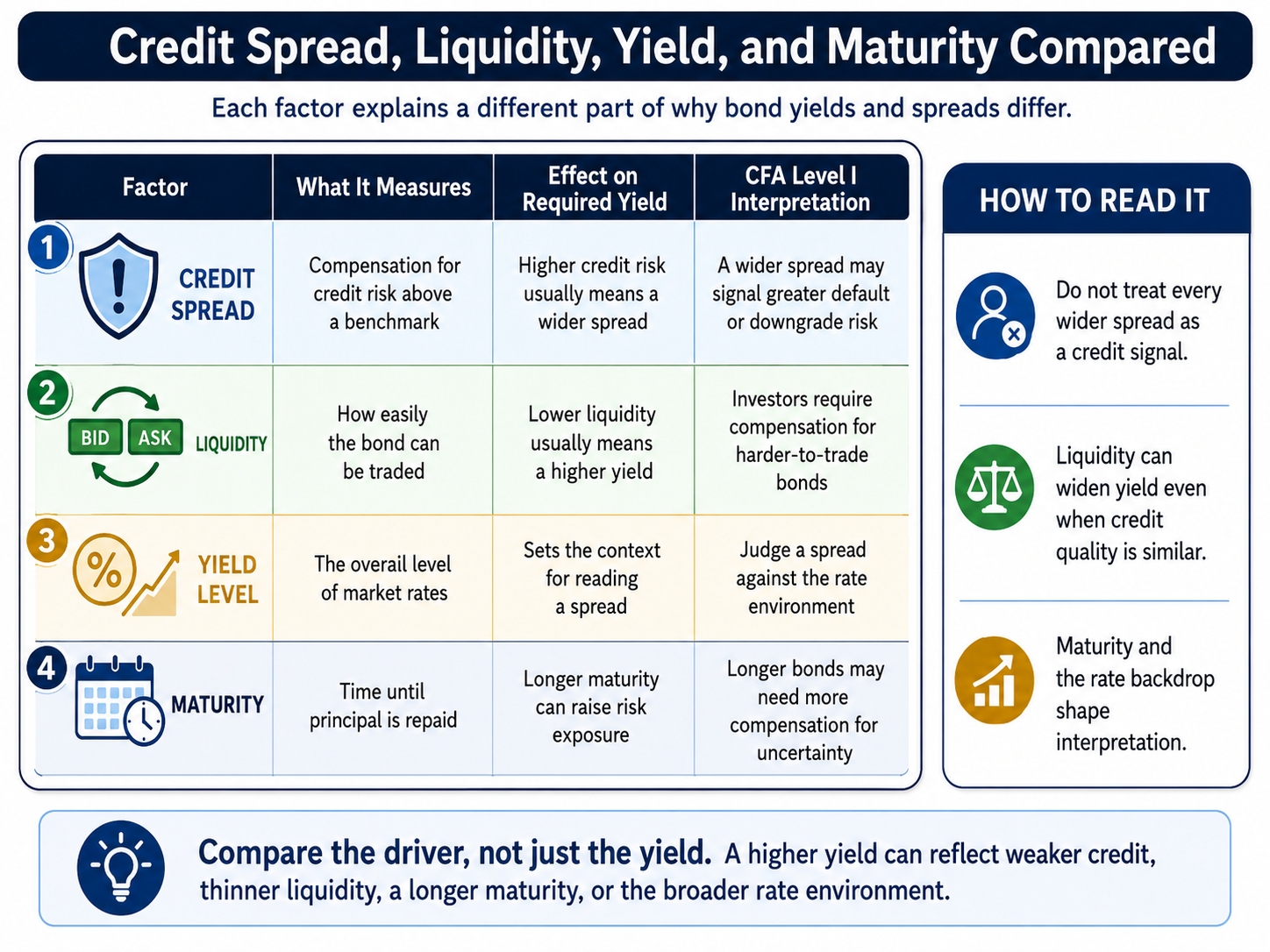
The table below separates the four drivers so you can see what each one measures and how it moves the required yield.
Factor | What It Measures | Effect on Required Yield | CFA Level I Interpretation |
|---|---|---|---|
Credit spread | Compensation for credit risk above a benchmark | Higher credit risk usually means a wider spread | A wider spread may signal greater default or downgrade risk |
Liquidity | How easily the bond can be traded | Lower liquidity usually means a higher yield | Investors require compensation for harder-to-trade bonds |
Yield level | The overall level of market rates | Sets the context for reading a spread | A spread should be judged against the rate environment |
Maturity | Time until principal is repaid | Longer maturity can raise risk exposure | Longer bonds may demand more compensation for uncertainty |
How Credit Spread Affects Bond Yield
Credit spread is the extra yield a bond pays over a benchmark bond or rate. It exists to compensate investors for the chance that the issuer fails to pay in full and on time.
When the market sees more default risk in an issuer, it demands a wider spread. The spread can also widen on downgrade risk or on general worry about the issuer's prospects, even before any actual default. In short, the spread is the market's price tag on the issuer's credit.
How Liquidity Affects Bond Yield
Liquidity refers to how easily a bond can be bought or sold without forcing a large price concession. A bond that trades rarely is harder to exit, and investors expect to be paid for that inconvenience.
That payment shows up as a higher yield. Two bonds can have very similar credit quality and still trade at different yields, with the less liquid one offering more. Liquidity can widen a spread on its own, which is exactly why you cannot assume every spread difference is about credit.
How Yield Level and Maturity Affect Spread Interpretation
Yield level is the backdrop. A 100 basis point spread reads very differently when benchmark rates are 2% than when they are 7%, because the spread is a smaller or larger share of the total return on offer. Judge a spread against the environment it sits in, not in isolation.
Maturity stretches the exposure. The longer a bond runs, the more time there is for credit quality to deteriorate and for rates to move against the holder. Longer maturity can magnify both credit and liquidity concerns, so a long bond often needs more compensation than a short one with otherwise similar features. When you read a spread, weigh the maturity and the rate environment together before drawing a conclusion.
Example: Comparing Bond Spread Drivers
Consider two corporate bonds with broadly similar coupon structures.
Feature | Bond M | Bond N |
|---|---|---|
Credit quality | Strong, investment grade | Weaker, below investment grade |
Trading activity | Trades actively | Trades thinly |
Maturity | 3 years | 9 years |
Bond N should generally offer the higher yield, and you can trace the reason through each driver. Its weaker credit quality means investors want more for default risk. Its thin trading means they want a liquidity premium on top. Its longer maturity stretches both of those concerns across more years.
None of these factors works alone. The higher spread on Bond N is the combined price of more credit risk, less liquidity, and a longer horizon. If you were handed only the yields and asked why they differ, the honest answer points to all three rather than to any single cause.
Common Exam Traps
Treating every wider spread as a credit signal. Liquidity and maturity can widen a spread even when credit quality is steady.
Ignoring liquidity when two bonds have similar credit quality. The thinner-trading bond can still yield more.
Forgetting that longer maturity stretches exposure to uncertainty, which can lift the required yield on its own.
Confusing yield level with credit spread. The total yield and the spread over the benchmark are two different numbers.
Assuming the highest-yielding bond is the best buy. A higher yield usually comes with more risk, less liquidity, or a longer maturity.
Practice Question
An analyst compares two corporate bonds issued in the same market with similar coupons. Bond P carries an investment-grade rating, trades frequently, and matures in five years. Bond Q carries a lower rating, trades infrequently, and matures in twelve years. Bond Q offers the wider yield spread.
Which explanation most likely accounts for Bond Q's wider spread?
Bond Q has stronger credit quality and deeper liquidity than Bond P.
Bond Q compensates investors for higher credit risk, lower liquidity, and a longer maturity.
Bond Q has a narrower spread because its longer maturity reduces risk.
Correct Answer: B
Bond Q layers three sources of extra risk: weaker credit, thinner trading, and a longer time to maturity. Each one raises the return investors require, so together they explain the wider spread.
Option A reverses the facts in the question, since Bond Q is described as lower-rated and less liquid, not stronger and deeper.
Option C contradicts the question outright, which states that Bond Q offers the wider spread, and it also misreads maturity by treating a longer horizon as risk-reducing.
Continue Your CFA Level I Prep With KeyPoint
Use structured lessons, practice questions, mock exams, and progress tracking to focus on the time you have left
FAQs About Credit Spread, Liquidity, Yield, and Maturity
What is a credit spread in CFA Level I?
A credit spread is the extra yield a bond pays over a benchmark rate or bond to compensate investors for credit risk. A wider spread generally signals that the market sees more default or downgrade risk in the issuer.
How does liquidity affect a bond's yield?
Less liquid bonds usually require a higher yield because investors need compensation for the difficulty of trading them. Even when two bonds have similar credit quality, the one that trades less often can offer more yield.
How does maturity affect credit spread?
A longer maturity stretches the time an investor is exposed to credit and interest rate changes. That added uncertainty can increase the spread investors require, so longer bonds often pay more than shorter ones with otherwise similar features.
Is a higher yield always better for a bond investor?
No. A higher yield usually reflects more risk, whether that is weaker credit quality, thinner liquidity, or a longer maturity. The extra yield is compensation for that risk rather than a free gain.