
This note uses curve-based duration and curve-based convexity to estimate how much a bond's value changes when the yield curve moves. Duration gives the first estimate, and convexity refines it. For the broader single-bond duration and convexity formula, review percentage price change using bond duration and convexity.
Quick Answer
Bond percentage price change using curve-based duration and convexity estimates the approximate change in a bond's value after a yield curve change. The duration term captures the main, first-order price effect, and the convexity term adjusts for the curved relationship between prices and yields. For CFA® Level I, focus on applying the formula, using the correct sign on the duration term, and reading the result as an approximate percentage.
Key Takeaways About Bond Price Change Using Duration and Convexity
The formula estimates a bond's approximate percentage price change, not an exact reprice.
The duration term and the yield change move in opposite directions, which is why the formula carries a negative sign.
Convexity adds an adjustment because the price-yield relationship is curved rather than straight.
The duration term is negative when yields rise and positive when yields fall.
For plain vanilla bonds, the convexity term is usually positive.
Frequent mistakes include entering the yield change as a whole percentage instead of a decimal, and dropping the sign on the duration term.
What You Need to Know for CFA Level I
For the exam, keep these points front of mind:
Curve-based duration estimates price sensitivity to a yield curve change.
Curve-based convexity adjusts for the curved relationship between bond prices and yields.
The formula combines a duration effect and a convexity effect into one estimate.
Yield changes go into the formula as decimals, so 50 basis points becomes 0.005.
The duration effect carries the opposite sign of the yield change.
The result is an approximation, not a full repricing of the bond.
What Does Bond Percentage Price Change Using Curve-Based Duration and Convexity Measure?
This measure estimates the percentage change in a bond's value when the yield curve shifts. It puts a number on price risk without forcing you to reprice the bond from scratch.
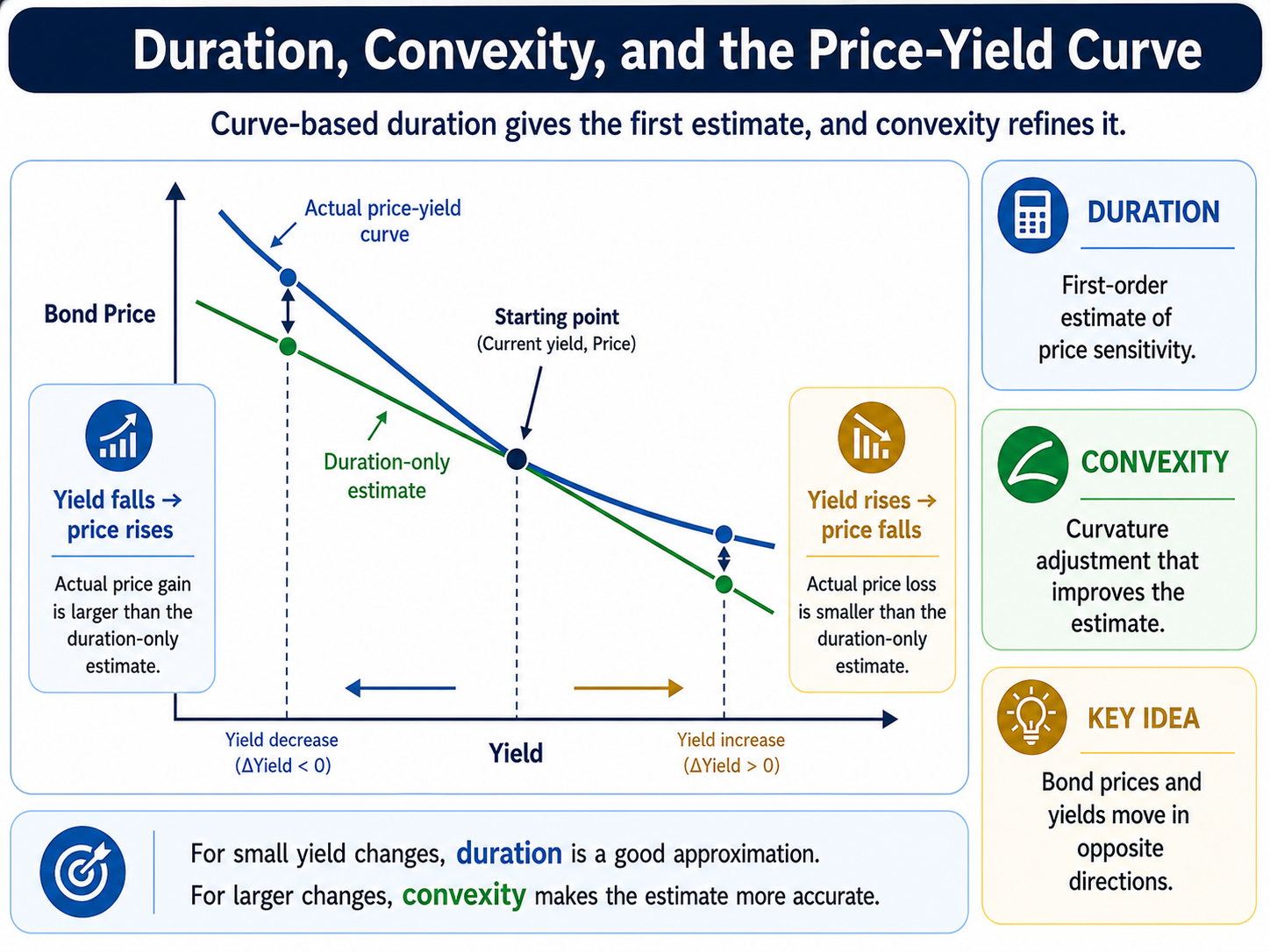
Duration handles the linear part of that estimate. It captures how the price moves in a straight-line approximation as yields change. The catch is that the real price-yield relationship is not a straight line, so duration alone drifts off as the yield change gets larger.
Convexity closes that gap. It captures the curve in the price-yield relationship, which is why the two measures are used together. The word "curve-based" matters here: both inputs are tied to a change in the yield curve rather than to a single assumed yield, which is what separates this note from the broader single-yield formula page.
Bond Percentage Price Change Formula
The approximate percentage price change combines the duration effect and the convexity adjustment:
A few rules keep the inputs clean:
Enter the yield change as a decimal. For example, 50 basis points is 0.005.
The duration term estimates the main price impact.
The convexity term refines that estimate.
When yields rise, the duration term is negative. When yields fall, it is positive.
Here is what each part of the formula is doing:
Formula Part | Meaning | CFA Level I Interpretation |
|---|---|---|
Curve-based duration | Price sensitivity to a yield curve change | Higher duration means more rate sensitivity |
ΔYield | The change in yield, entered as a decimal | 50 basis points should be entered as 0.005 |
Curve-based convexity | The curvature adjustment | Improves the estimate when rates move |
Negative sign before duration | The inverse price-yield relationship | Prices fall when yields rise |
0.5 × convexity × (ΔYield)² | The convexity adjustment | Usually adds back part of the duration-only estimate for plain vanilla bonds |
How to Interpret the Duration and Convexity Effects
Reading the two effects correctly is mostly about getting the sign right and knowing which term leads.
Rate Change | Duration Effect | Convexity Effect | Expected Price Direction |
|---|---|---|---|
Yields rise | Negative | Usually positive | Price usually falls |
Yields fall | Positive | Usually positive | Price usually rises |
Small yield change | Dominates the estimate | Smaller | Estimate is close to the duration-only result |
Large yield change | Less accurate on its own | Matters more | Convexity meaningfully improves the estimate |
The pattern to remember: duration sets the direction and most of the size, while convexity nudges the estimate toward the true price, especially when the yield move is large.
Worked Example
A bond has a curve-based duration of 7.4 and a curve-based convexity of 55. The relevant yield curve rate rises by 35 basis points. Estimate the bond's approximate percentage price change.
Start by converting the yield change to a decimal: 35 basis points is 0.0035.
Now apply the formula:
Approximate percentage price change:
The estimate is about a 2.56% decline. The duration term is negative because yields rose, which drives the price down. The convexity adjustment is positive but small, so it only slightly softens the duration-driven drop. The final figure is an approximation of the bond's percentage price change, not an exact new price.
Common Exam Traps
Entering basis points the wrong way. A 35 basis point move is 0.0035, not 35, and that single slip throws off the whole answer.
Dropping the negative sign on the duration term. Without it, the price direction comes out backward.
Treating convexity as a stand-in for duration. Convexity adjusts the estimate; it does not replace the duration term.
Forgetting that the output is a percentage price change, not a dollar price or a new yield.
Mixing this up with broader duration and convexity interpretation questions. This note is specifically about applying the curve-based formula.
Practice Question
A bond has a curve-based duration of 4.8 and a curve-based convexity of 28. The relevant yield curve rate decreases by 45 basis points. Using curve-based duration and convexity, the approximate percentage price change is closest to:
+2.16%
+2.19%
-2.13%
Correct Answer: B
Convert 45 basis points to a decimal, which gives 0.0045. Because the yield falls, the duration term is positive.
Approximate percentage price change:
That rounds to about +2.19%.
Option A. +2.16%, uses the duration term alone and forgets to add the convexity adjustment.
Option C. -2.13%, gets the sign backward by treating the yield change as an increase rather than a decrease, which sends the price the wrong way.
Continue Your CFA Level I Prep With KeyPoint
Use structured lessons, practice questions, mock exams, and progress tracking to focus on the time you have left
FAQs About Bond Percentage Price Change Using Curve-Based Duration and Convexity
What is the bond percentage price change formula using duration and convexity?
The approximate percentage price change equals the negative of curve-based duration times the yield change, plus 0.5 times curve-based convexity times the yield change squared. Duration captures the main price effect, and convexity adjusts for the curved price-yield relationship.
Why is the duration term negative in the price change formula?
Bond prices and yields move in opposite directions. When yields rise, the negative sign on the duration term turns the result into a price decline, which matches how bonds actually behave
How do you convert basis points in the bond price change formula?
One basis point equals 0.0001, so 50 basis points equals 0.005 and 35 basis points equals 0.0035. Always convert the yield change to a decimal before putting it into the formula.
What does convexity add to the duration estimate?
Convexity adjusts for the curve in the price-yield relationship. It matters most when the yield change is large, because duration alone becomes less accurate the further rates move.