
Duration is one of the most tested ideas in CFA® Level I fixed income, and the exam expects you to keep three versions straight. Macaulay, modified, and effective duration answer different questions, and the trap is using the wrong one for a given bond. This note shows what each measure means and when to reach for it.
Quick Answer
For macaulay duration vs modified duration, Macaulay duration measures the weighted average time to a bond's cash flows in years, while modified duration estimates the percentage price change for a change in the bond's own yield to maturity. Effective duration estimates price sensitivity to a shift in a benchmark yield curve and is the right choice when cash flows can change, such as bonds with embedded options.
Key Takeaways: Macaulay Duration vs Modified Duration and Effective Duration
Macaulay duration measures the timing of cash flows, expressed in years.
Modified duration estimates the percentage price change for a change in the bond's own YTM.
Effective duration estimates price sensitivity to a benchmark yield curve shift and suits bonds with uncertain cash flows.
Modified duration links directly to Macaulay duration for option-free bonds with known cash flows.
The main trap is using modified duration for a bond with embedded options when effective duration fits better.
What You Need to Know for CFA Level I
Define each of the three duration measures in one clear sentence.
Match the right measure to the bond type and the wording of the question.
Recall that modified duration comes from Macaulay duration for option-free bonds.
Recognize when uncertain cash flows or embedded options call for effective duration.
Read whether a question is about a change in the bond's YTM or a shift in the benchmark curve.
Macaulay vs Modified vs Effective Duration: Main Difference
The one-sentence distinction is this: Macaulay duration is about timing, modified duration is about price sensitivity to the bond's own yield, and effective duration is about price sensitivity to the benchmark curve when cash flows may change. Use the table below as your quick map.
Measure | What it answers | Best fit |
|---|---|---|
Macaulay duration | How long, on average, until I receive my cash flows? | Linking duration to an investment horizon |
Modified duration | How much does price move when the bond's YTM changes? | Option-free bonds with known cash flows |
Effective duration | How much does price move when the benchmark curve shifts? | Bonds with embedded options or uncertain cash flows |
What Is Macaulay Duration?
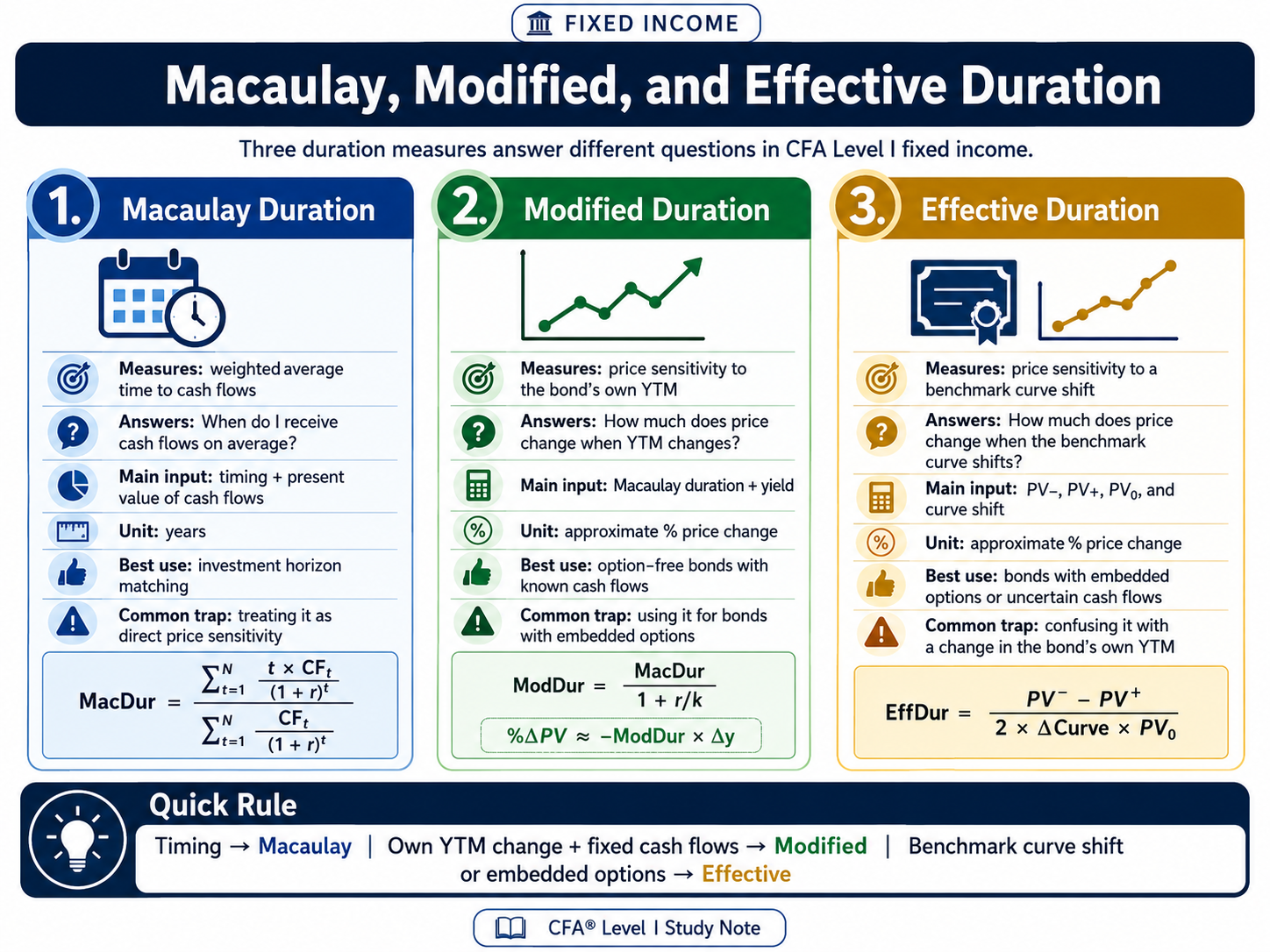
Macaulay duration is the weighted average time to a bond's cash flows, measured in years. Each cash flow is weighted by its present value as a share of the bond's price, so cash flows that arrive sooner and carry more value pull the number down, while later cash flows push it up.
Where:
= Macaulay duration
= time period when the cash flow is received
= total number of cash flow periods
= cash flow received at time t
= yield or discount rate per period
= discount factor for time t
Because it is a time measure, Macaulay duration connects naturally to an investment horizon. A candidate matching a bond to a future funding need cares about when the money actually arrives, and that is exactly what this measure captures.
What Is Modified Duration?
Modified duration estimates the percentage change in a bond's price for a change in its own yield to maturity. It is the first measure most candidates use for a standard option-free bond, and it comes straight from Macaulay duration.
Where:
= modified duration
= Macaulay duration
= annual yield to maturity
= number of compounding periods per year
= yield per compounding period
Here r is the yield per period and k is the number of periods per year. For a bond with annual Macaulay duration of 4.5 and an annual yield of 5 percent, modified duration is 4.5 divided by 1.05, which is about 4.29. The price impact of a small yield change then follows from a simple relationship.
The negative sign reflects the inverse link between yield and price. Modified duration is a linear approximation, so it works well for small yield changes and loses accuracy as the change grows.
What Is Effective Duration?
Effective duration estimates how much a bond's price moves when the benchmark yield curve shifts, rather than when the bond's own YTM changes. It is the right measure when future cash flows are not certain, which is the case for bonds with embedded options.
In this formula, is the bond price after a downward curve shift, is the bond price after an upward curve shift, and is the original bond price. is the size of the benchmark yield curve shift expressed in decimal form.
The key difference from modified duration is what changes. Effective duration measures the effect of a benchmark curve shift, not a change in the bond's own yield. This makes Deff useful for callable or putable bonds, where changing interest rates can alter expected cash flows and make a measure based on fixed cash flows less suitable.
Comparison Table
This table lines up the three measures on the points that decide exam questions.
Item | Macaulay | Modified | Effective |
|---|---|---|---|
Meaning | Weighted average time to cash flows | Price sensitivity to the bond's YTM | Price sensitivity to a benchmark curve shift |
Main input | Timing and present value of cash flows | Macaulay duration and yield | Prices after up and down curve shifts |
Unit | Years | Percentage price change | Percentage price change |
Best use | Investment horizon matching | Option-free bonds, known cash flows | Embedded options, uncertain cash flows |
Common trap | Used as a price sensitivity measure without adjustment | Used for bonds with embedded options | Confused with a change in the bond's own YTM |
How to Choose the Right Duration Measure in CFA Questions
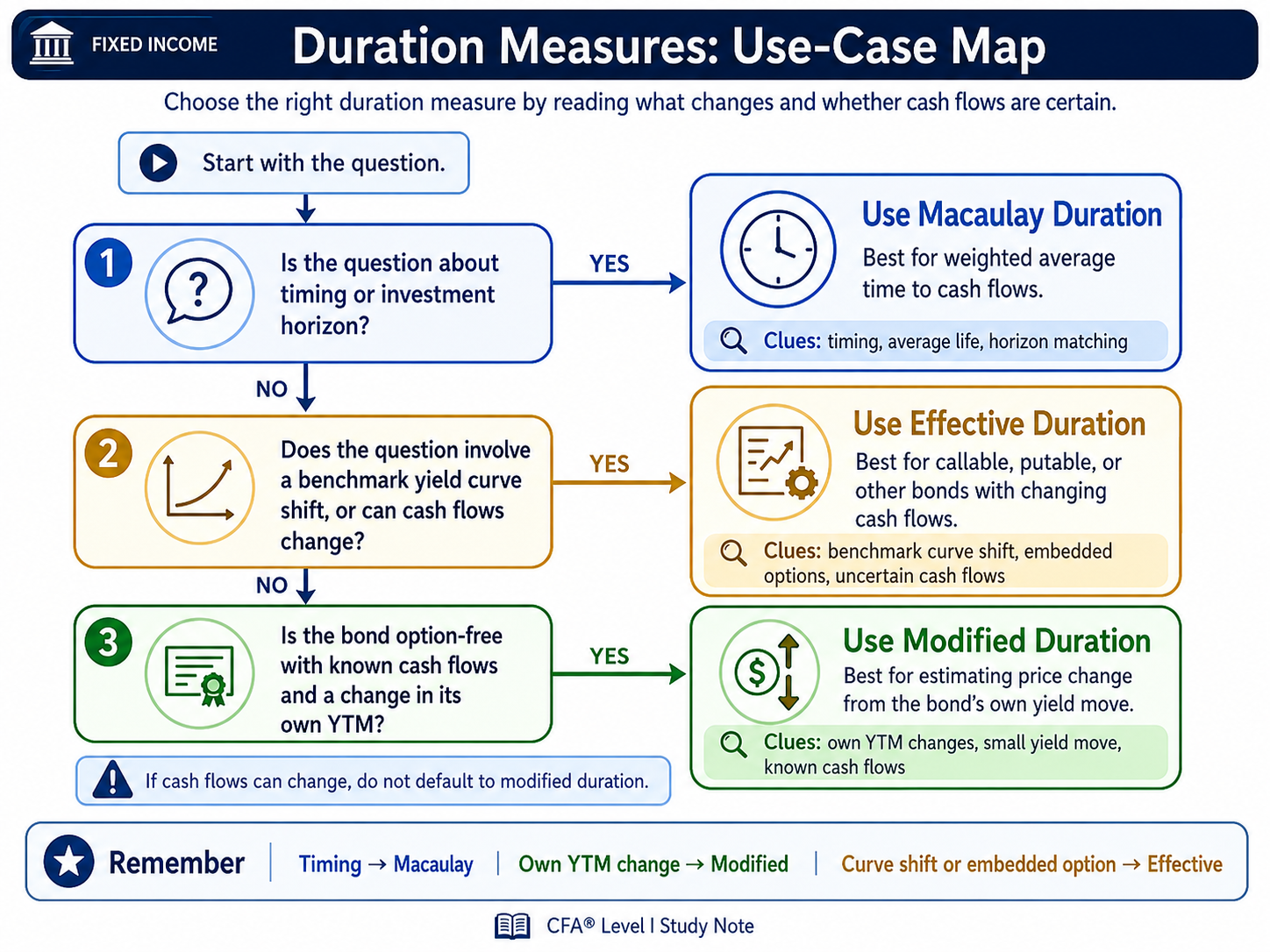
Read the question wording before you reach for a formula. The clues are usually in plain sight: what is changing, and are the cash flows certain?
If the question asks about timing or matching a horizon, think Macaulay duration.
If the bond is option-free and the question changes the bond's own YTM, use modified duration.
If the question shifts a benchmark yield curve, lean toward effective duration.
If the bond has an embedded option or uncertain cash flows, use effective duration.
Common Exam Traps
Using Macaulay duration as a price sensitivity measure without converting to modified duration first.
Using modified duration for a bond with embedded options, where effective duration is the better fit.
Confusing a change in the bond's YTM with a shift in the benchmark yield curve.
Forgetting that duration is an approximation and becomes less accurate for large yield changes.
Practice Question
A portfolio analyst is reviewing two bonds. Bond X is an option-free, fixed-rate corporate bond. Bond Y is a callable bond whose expected cash flows change when interest rates move. Which duration measure is most appropriate for estimating Bond Y's price sensitivity?
Macaulay duration, because it measures the timing of cash flows.
Modified duration, because it estimates price sensitivity to the bond's YTM.
Effective duration, because the bond's cash flows can change when rates move.
Correct Answer: C
Bond Y is callable, so its expected cash flows can change when interest rates move. Effective duration is appropriate because it measures price sensitivity when cash flows are affected by an embedded option.
Option A: Macaulay duration measures the weighted-average timing of a bond’s cash flows. It does not properly capture the changing cash flows of a callable bond when interest rates move.
Option B: Modified duration estimates price sensitivity to changes in YTM while assuming the bond’s cash flows remain fixed. That assumption is not appropriate for a callable bond because exercising the embedded option can change its expected cash flows.
Continue Your CFA Level I Prep With KeyPoint
Use structured lessons, practice questions, mock exams, and progress tracking to focus on the time you have left
FAQs About Macaulay, Modified, and Effective Duration
What is the difference between Macaulay duration and modified duration?
Macaulay duration measures the weighted average time to a bond's cash flows in years. Modified duration estimates the percentage price change for a change in the bond's own yield to maturity. One is about timing, the other about price sensitivity.
What is effective duration used for?
Effective duration is used for bonds with uncertain cash flows or embedded options, such as callable and putable bonds. It measures price sensitivity to a shift in the benchmark yield curve rather than a change in the bond's own yield.
Is modified duration the same as effective duration?
No. Modified duration is based on a change in the bond's own YTM and assumes fixed cash flows. Effective duration is based on a benchmark curve shift and allows for cash flows that can change.
Which duration measure should CFA Level I candidates use?
It depends on the question. Match the measure to the bond features and the wording: timing points to Macaulay, a change in the bond's YTM points to modified, and a benchmark curve shift or embedded option points to effective duration.