
Effective duration estimates how much a bond's price moves when the whole benchmark yield curve shifts. It is the duration measure you reach for when a bond's future cash flows are uncertain, such as a bond with an embedded option. For CFA Level I, you need the formula, the interpretation, and the difference between effective duration and modified duration.
Quick Answer
Effective duration measures a bond's price sensitivity to a small parallel shift in the benchmark yield curve. It suits bonds with uncertain cash flows, because it uses repriced values rather than fixed cash flows. The formula is divided by , with the curve shift in decimal form. A higher effective duration means greater interest rate risk.
Key Takeaways: Effective Duration
Effective duration measures price sensitivity to a parallel shift in the benchmark yield curve.
It is the right choice for bonds with uncertain cash flows, such as callable or putable bonds.
The formula is , with ΔCurve in decimal form.
is the price after a downward curve shift, and is the price after an upward shift.
A result of 5 means roughly a 5% price change for a 1% parallel shift in the curve.
What You Need to Know for CFA Level I
That effective duration uses a curve shift, while modified duration uses the bond's own yield.
Why effective duration suits bonds with embedded options or uncertain cash flows.
The effective duration formula and each input in it.
That the curve shift must be entered as a decimal, not in basis points.
How to read the result as approximate percentage price sensitivity.
What Effective Duration Measures
Effective duration estimates how a bond's price responds when the benchmark yield curve shifts up or down by a small amount. Instead of relying on the bond's own yield to maturity, it reprices the bond under two scenarios: the curve moves down, and the curve moves up. The size of the price gap between those scenarios tells you how sensitive the bond is.
This curve-based approach is the key difference from yield-based measures. Modified duration assumes the bond's cash flows are fixed and uses the bond's own yield. That assumption breaks down for bonds whose cash flows can change, such as callable bonds, where falling rates may trigger an early call. Effective duration handles that uncertainty by using full repricing.
The Effective Duration Formula
The formula compares the bond's price under a downward and an upward curve shift, scaled by the base price and the size of the shift.
Where:
- The bond's price if the benchmark curve shifts down.
- The bond's price if the benchmark curve shifts up.
- The size of the parallel shift, in decimal form.
- The bond's current, or base, price.
One detail decides many questions: comes first in the numerator. Because a downward rate shift raises the price, is the larger value, so the numerator stays positive. The other detail is the curve shift. A 25 basis point shift is 0.0025, not 25.
Effective Duration vs Modified Duration
Both measures estimate interest rate risk, but they make different assumptions. The comparison is a frequent exam target.
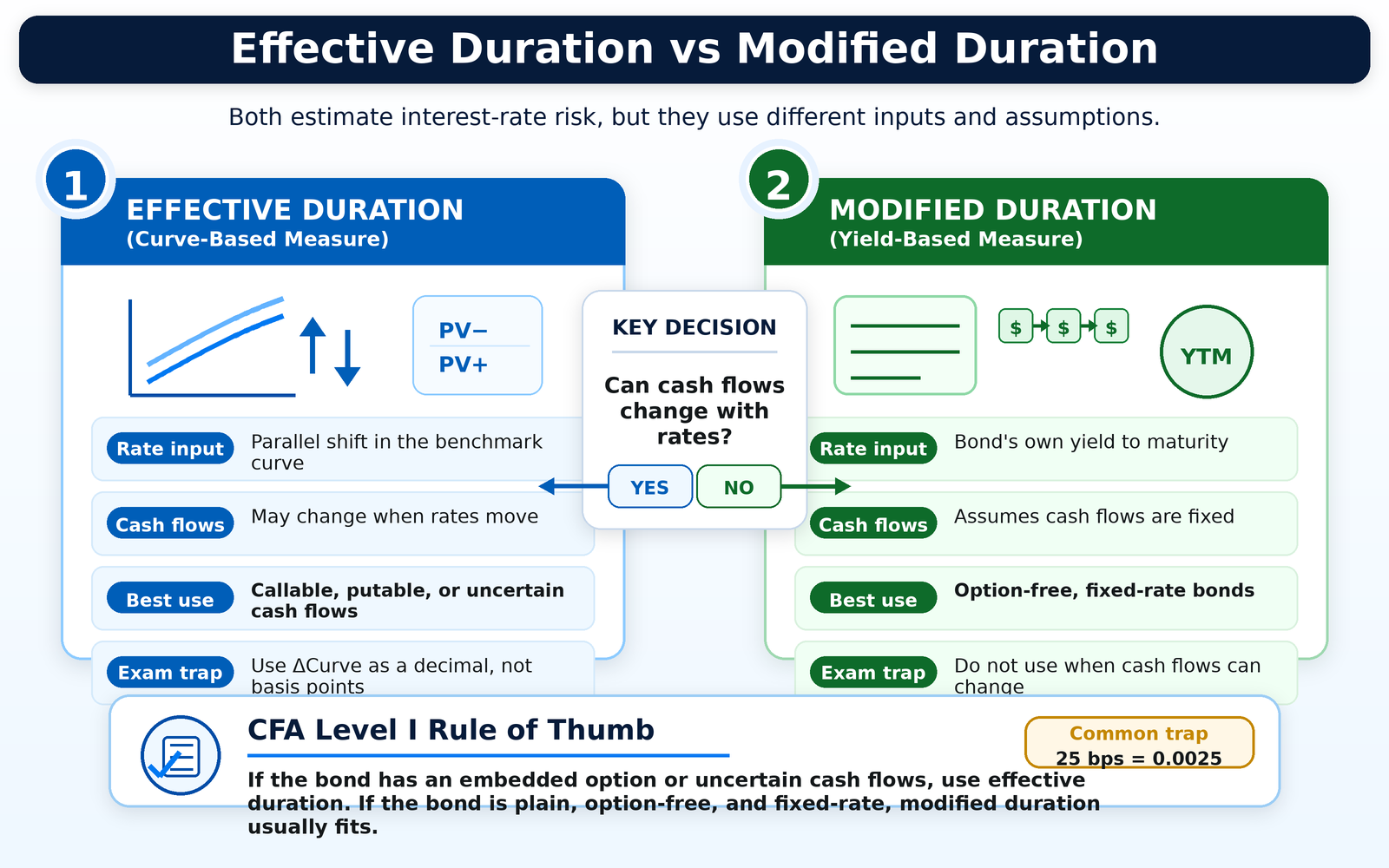
Feature | Effective duration | Modified duration |
|---|---|---|
Rate input | Parallel shift in the benchmark curve | The bond's own yield to maturity |
Cash flow assumption | Cash flows may change with rates | Cash flows are fixed |
Typical use case | Bonds with embedded options or uncertain cash flows | Option-free, fixed-rate bonds |
Common trap | Entering the curve shift in basis points | Applying it to a bond whose cash flows can change |
When a question describes a callable or putable bond, effective duration is usually the correct measure. When the bond is plain and option-free, modified duration fits.
Worked Example
A bond is priced at 101.20. When the benchmark curve shifts down by 20 basis points, its price rises to 102.05. When the curve shifts up by 20 basis points, its price falls to 100.30. Find the effective duration.
First, convert the curve shift to decimal:
Convert 20 basis points:
Effective duration calculation:
Simplify:
Final answer:
The result of about 4.32 means the bond's price changes by roughly 4.32% for a 1% parallel shift in the curve. A larger figure would signal greater interest rate risk.
Common Exam Traps
Entering the curve shift in basis points instead of decimal form.
Reversing and , which flips the sign of the answer.
Treating effective duration as the bond's maturity. It measures price sensitivity, not time.
Using modified duration for a bond with uncertain cash flows without thinking about the option.
Forgetting that in the denominator is the base price, not an average of and .
Practice Question
A bond is priced at 96.40. After a 25 basis point downward shift in the benchmark curve, its price is 97.55. After a 25 basis point upward shift, its price is 95.20. The effective duration is closest to:
0.49
2.44
4.88
9.75
Correct Answer: C
Effective duration = (97.55 − 95.20) / (2 × 0.0025 × 96.40) = 2.35 / 0.4820 = 4.88.
Option A reflects entering the shift as 25 basis points rather than 0.0025 in a misapplied way.
Options B and D come from dropping or doubling the factor of 2 in the denominator.
Continue Your CFA Level I Prep With KeyPoint
Use structured lessons, practice questions, mock exams, and progress tracking to focus on the time you have left
FAQs About Effective Duration and Interest Rate Risk
What is effective duration?
Effective duration measures how much a bond's price changes when the benchmark yield curve shifts by a small parallel amount. It is well suited to bonds with uncertain cash flows.
What is the effective duration formula?
The formula for the effective duration is:
.
and are the prices after a downward and upward curve shift, is the shift in decimal form, and is the base price.
How is effective duration different from modified duration?
Effective duration uses a shift in the benchmark curve and allows cash flows to change. Modified duration uses the bond's own yield and assumes fixed cash flows, so it fits option-free bonds.
Why is effective duration useful for bonds with embedded options?
For bonds with embedded options, cash flows can change as rates move, so a fixed-yield measure is unreliable. Effective duration reprices the bond under curve shifts, which captures that behavior.