
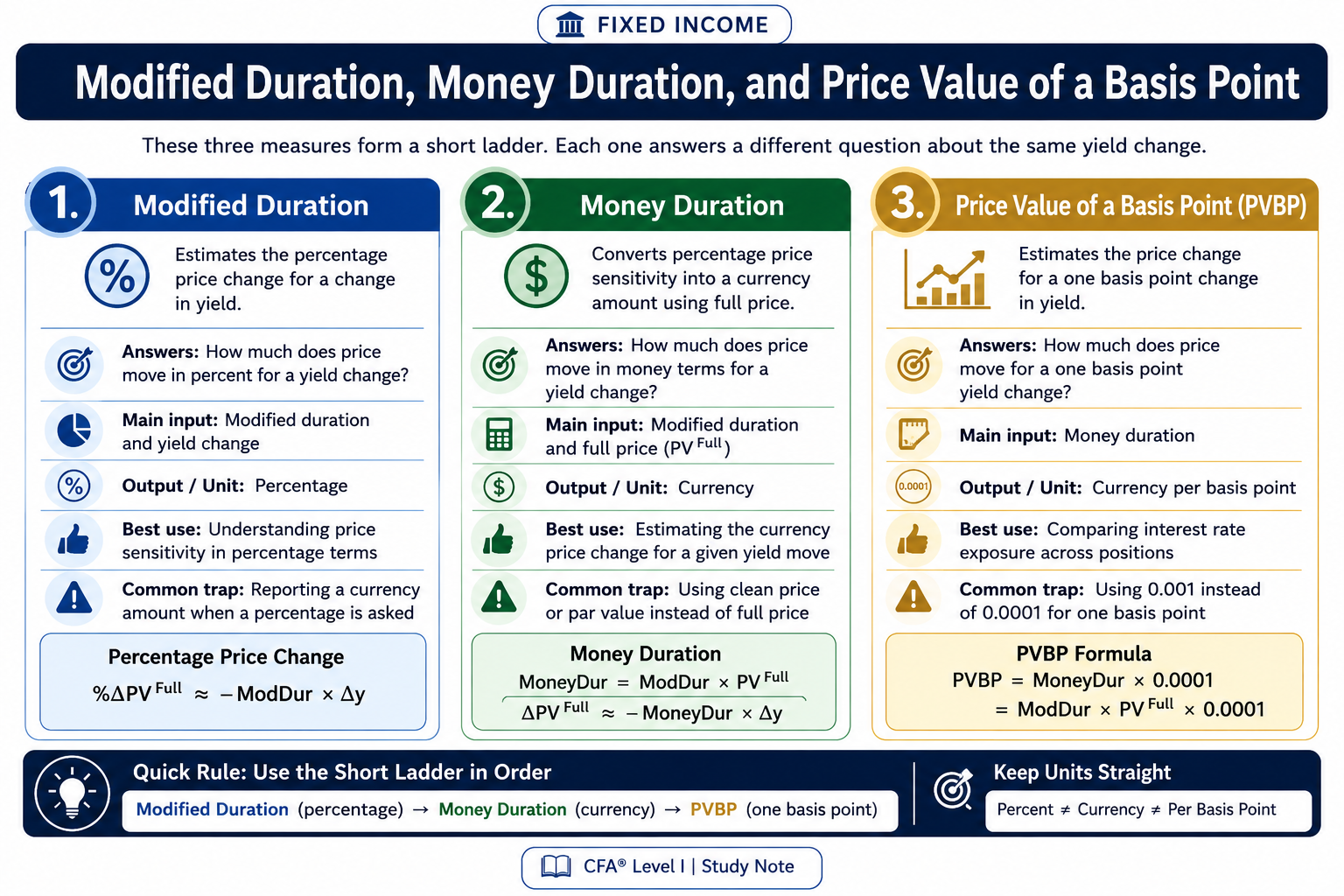
These three measures form a short ladder. Modified duration gives you a percentage price change, money duration turns that into a currency amount, and the price value of a basis point narrows it down to a one basis point move. For CFA® Level I, the points come from keeping the units straight and running the conversion cleanly.
Quick Answer
The price value of a basis point (PVBP) is the approximate change in a bond's full price for a one basis point change in yield. It sits at the end of a conversion ladder: modified duration estimates the percentage price change, money duration converts that to a currency amount using full price, and PVBP scales the money duration down to a single basis point.
Key Takeaways: Price Value of a Basis Point
Modified duration estimates the percentage price change for a change in yield.
Money duration converts that percentage sensitivity into a currency amount using full price or market value.
PVBP estimates the price change for a one basis point change in yield.
PVBP equals money duration multiplied by 0.0001.
The main trap is mixing percentage price change, currency price change, and basis-point price change.
What You Need to Know for CFA Level I
Move from modified duration to money duration to PVBP in the right order.
Use full price, not clean price, when the question calls for it.
Apply the correct decimal for a basis point, which is 0.0001.
Keep the sign right: a yield increase lowers price.
Tell apart a percentage answer, a currency answer, and a one basis point answer.
Modified Duration, Money Duration, and PVBP: Main Difference
Each measure answers a slightly different question about the same yield move. Modified duration says how much the price moves in percentage terms. Money duration says how much it moves in currency terms. PVBP says how much it moves for the smallest standard step, one basis point.
Measure | Output | Question it answers |
|---|---|---|
Modified duration | Percentage | How much does price move in percent for a yield change? |
Money duration | Currency | How much does price move in money terms for a yield change? |
PVBP | Currency | How much does price move for a one basis point yield change? |
What Is Modified Duration?
Modified duration estimates the percentage change in a bond's price for a change in its yield to maturity. It is derived from Macaulay duration and is commonly used to estimate the price impact of relatively small yield changes.
Where:
= Percentage change in the bond's full price
= Modified duration of the bond
= Change in yield, expressed as a decimal, such as 0.0025 for 25 basis points
= Reflects the inverse relationship between yield and price
The negative sign shows that bond prices and yields generally move in opposite directions. The result is an estimated percentage price change, not a dollar amount.
Modified duration provides a linear approximation, so it is most useful for relatively small yield changes. For larger changes, convexity can improve the estimate.
What Is Money Duration?
Money duration converts a bond's percentage price sensitivity into a currency amount. For a bond, multiply modified duration by the bond's full price.
Where:
= Money duration, or currency price sensitivity
= Modified duration of the bond
= Full price of the bond, including accrued interest where applicable
Once you know money duration, you can estimate the currency change in the bond's full price for a given change in yield:
Where:
= Estimated currency change in the bond's full price
= Money duration of the bond
= Change in yield, expressed as a decimal
= Reflects the inverse relationship between bond prices and yields
The key detail is that money duration uses the bond's full price. Using the clean price instead would leave out accrued interest and produce a different result.
What Is Price Value of a Basis Point?
The price value of a basis point is the approximate change in a bond's full price for a one basis point change in yield. A basis point is 0.0001 in decimal yield terms, so PVBP is money duration scaled down to that single step.
PVBP is well suited to bonds where you want a precise, small-move figure. Because it isolates a one basis point change, it gives a clean unit for comparing interest rate exposure across positions.
PVBP Formula and Formula Breakdown
Price value of a basis point (PVBP) measures the estimated currency change in a bond's full price for a 1 basis point change in yield. It can be calculated from money duration or directly from modified duration and full price.
Because money duration equals modified duration multiplied by full price, PVBP can also be written as:
Where:
= Price value of a basis point, or the estimated currency price change for a 1 bp change in yield
= Money duration of the bond
= Modified duration of the bond
= Full price of the bond, including accrued interest where applicable
= Decimal representation of one basis point, or 0.01%
PVBP is generally reported as a positive sensitivity measure. The direction of the actual price change depends on whether yields rise or fall.
Worked Example
A bond has a full price of 102.50 per 100 of par value and a modified duration of 4.80. Find the money duration and PVBP, then estimate the price change for a 25 basis point increase in yield.
Step 1: Calculate money duration.
Step 2: Calculate PVBP.
This means the bond's price changes by approximately 0.0492 per 100 of par value for a 1 basis point change in yield.
Step 3: Estimate the price change for a 25 bp increase in yield.
A 25 basis point increase equals 0.0025. Because bond prices and yields generally move in opposite directions:
The bond's price falls by approximately 1.23 per 100 of par value, from 102.50 to about 101.27.
You can confirm the result using PVBP:
Both methods produce the same approximate price change.
Common Exam Traps
Forgetting that one basis point equals 0.0001 in decimal yield terms.
Using clean price when the question gives or requires full price.
Reporting a percentage change when the question asks for a currency price change.
Dropping the negative sign when a yield increase lowers the price.
Practice Question
A bond has a full price of 98.75 per 100 of par value and a modified duration of 6.25. What is the price value of a basis point?
0.0617
0.0625
0.6172
Correct Answer: A
PVBP equals modified duration times full price times 0.0001, which is 6.25 times 98.75 times 0.0001, or about 0.0617.
Option B uses 100 of par instead of the 98.75 full price, a common mix-up.
Option C uses 0.001 instead of 0.0001, so the answer is off by a factor of ten.
Continue Your CFA Level I Prep With KeyPoint
Use structured lessons, practice questions, mock exams, and progress tracking to focus on the time you have left
FAQs About Modified Duration, Money Duration, and Price Value of a Basis Point (PVBP)
What is price value of a basis point?
PVBP is the approximate change in a bond's full price for a one basis point change in yield. It isolates the smallest standard yield step, which makes it a clean way to measure interest rate exposure.
What is the PVBP formula?
PVBP equals money duration times 0.0001, which is the same as modified duration times full price times 0.0001. The inputs are modified duration, the bond's full price, and the decimal value of one basis point.
Is PVBP the same as PV01 or DV01?
They are closely related terms used in practice, and they all describe the price impact of a one basis point yield change. For CFA Level I, use the curriculum wording, price value of a basis point, as your reference point.
What is the difference between modified duration and money duration?
Modified duration gives a percentage price change for a yield move. Money duration converts that into a currency amount by multiplying modified duration by the bond's full price.