
Fixed-rate bonds can be evaluated with two related but separate tools: yield measures and yield spread measures. A yield measure describes the bond's return or quoted yield under a stated assumption. A spread measure compares that bond's yield to a benchmark rate or curve. For CFA Level I, the task is to know what each measure means, when it is used, and how to read the result.
Quick Answer
Yield measures describe the return or quoted yield on a fixed-rate bond, while yield spread measures compare that bond's yield with a benchmark rate or curve. For CFA Level I, focus on what each measure assumes, which benchmark it uses, and how to read a spread in basis points. A wider spread usually signals higher required compensation for risk, liquidity, or other bond-specific factors.
Key Takeaways: Yield and Yield Spread Measures for Fixed-Rate Bonds
Yield measures and spread measures answer different questions.
Current yield is the annual coupon divided by price, and it ignores maturity value and reinvestment.
Yield to maturity is the return if the bond is held to maturity and cash flows arrive as promised.
Yield to call, yield to put, and yield to worst matter when a bond has embedded options.
Yield spreads compare a bond's yield with a benchmark rate or curve.
Spreads are usually quoted in basis points, where 100 basis points equals 1.00%.
What You Need to Know for CFA Level I
Separate yield measures from spread measures before you start solving. Know current yield, yield to maturity, yield to call, yield to put, and yield to worst at a conceptual level, and know that spread measures sit a bond's yield against a benchmark. A wider spread generally means the market wants more compensation above that benchmark. Convert between percentage points and basis points cleanly, and do not reach for money market yield-spread measures unless the question is actually about money market instruments.
Yield Measures for Fixed-Rate Bonds
A fixed-rate bond pays a stated coupon, but its quoted yield depends on price, maturity, any call or put features, and the measure being used. That is why one bond can be described by several different yield figures.
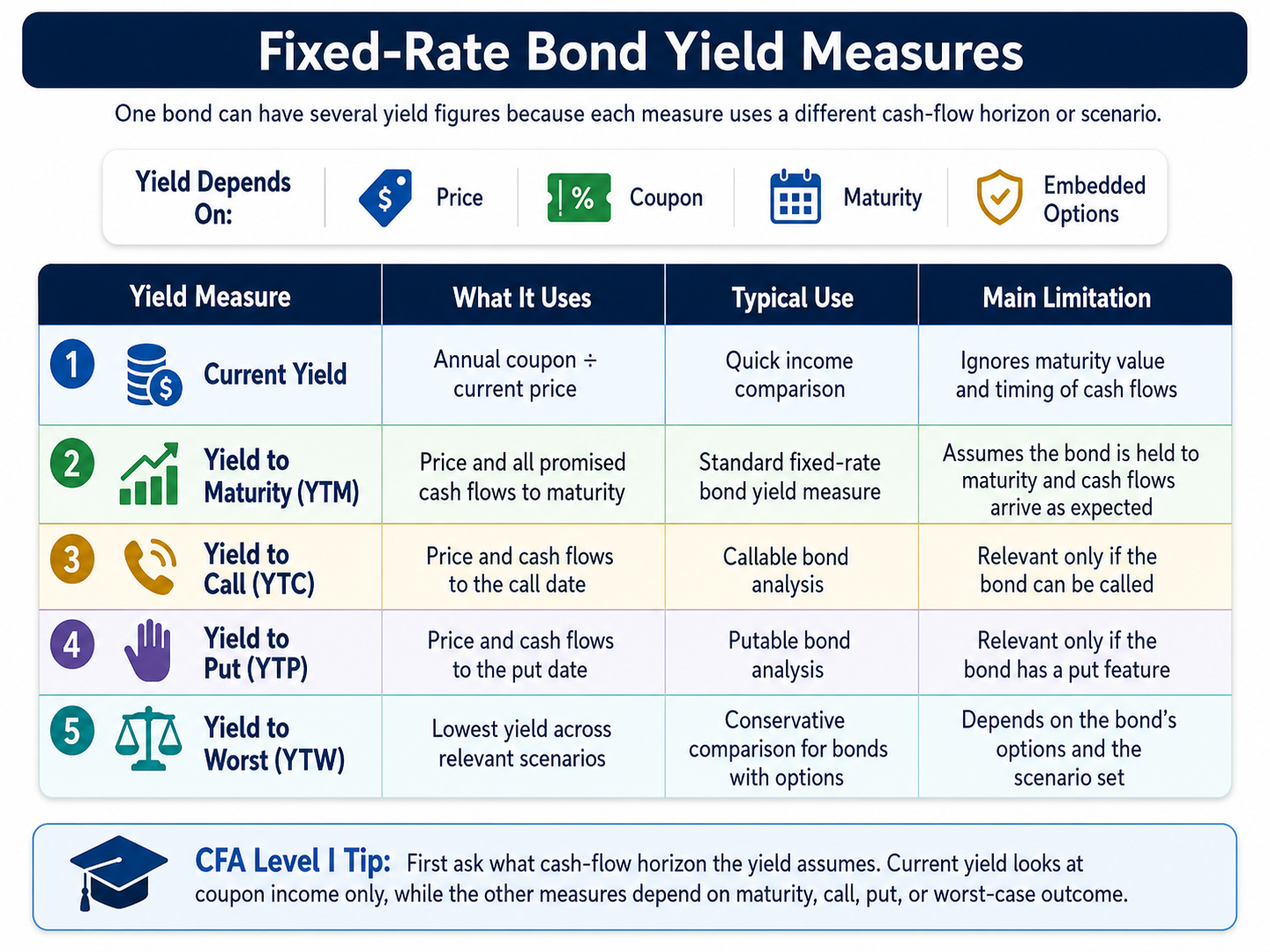
Current yield is the simplest. It relates annual coupon income to the current price, but it ignores the maturity value and the timing of cash flows. Yield to maturity is the standard measure, and it assumes the bond is held to maturity with all promised cash flows received. Yield to call and yield to put apply when a bond can be redeemed early by the issuer or sold back by the investor. Yield to worst is the lowest yield across the relevant call, put, and maturity scenarios.
Yield Measure | What It Uses | Typical Use | Main Limitation |
|---|---|---|---|
Current Yield | Annual coupon divided by current price | Quick income comparison | Ignores maturity value and the timing of cash flows |
Yield to Maturity | Price and all promised cash flows to maturity | Standard fixed-rate bond yield measure | Assumes the bond is held to maturity and cash flows arrive as expected |
Yield to Call | Price and cash flows to the call date | Callable bond analysis | Relevant only if the bond can be called |
Yield to Put | Price and cash flows to the put date | Putable bond analysis | Relevant only if the bond has a put feature |
Yield to Worst | Lowest yield across relevant scenarios | Conservative comparison for bonds with options | Depends on the bond's options and the scenario set |
Yield Spread Measures for Fixed-Rate Bonds
A yield spread compares a bond's yield with a benchmark rate or curve. The benchmark can be a government bond yield, a swap rate, or the spot curve, depending on the measure, so the benchmark itself is part of the answer.
Spreads show how much extra yield the market requires for a bond's specific features, such as credit risk, liquidity, or an embedded option. Because the benchmark varies, naming the right benchmark is half the work.
Spread Measure | Benchmark or Reference | What It Shows | CFA Level I Exam Clue |
|---|---|---|---|
Benchmark spread (G-spread) | Government bond yield of similar maturity | Yield over a government benchmark, sometimes called the nominal spread | The question compares a bond yield with a government benchmark yield |
I-spread | Swap rate of similar maturity | Yield over the swap curve | The question mentions swap rates or the swap curve |
Zero-volatility spread (Z-spread) | The benchmark spot curve | A constant spread added to each spot rate so the present value of cash flows equals the price | The question adds a spread to spot rates to match a price |
Option-adjusted spread (OAS) | Benchmark curve after removing the embedded option value | The spread once the option effect is separated out | The question involves a callable or putable bond and option-adjusted analysis |
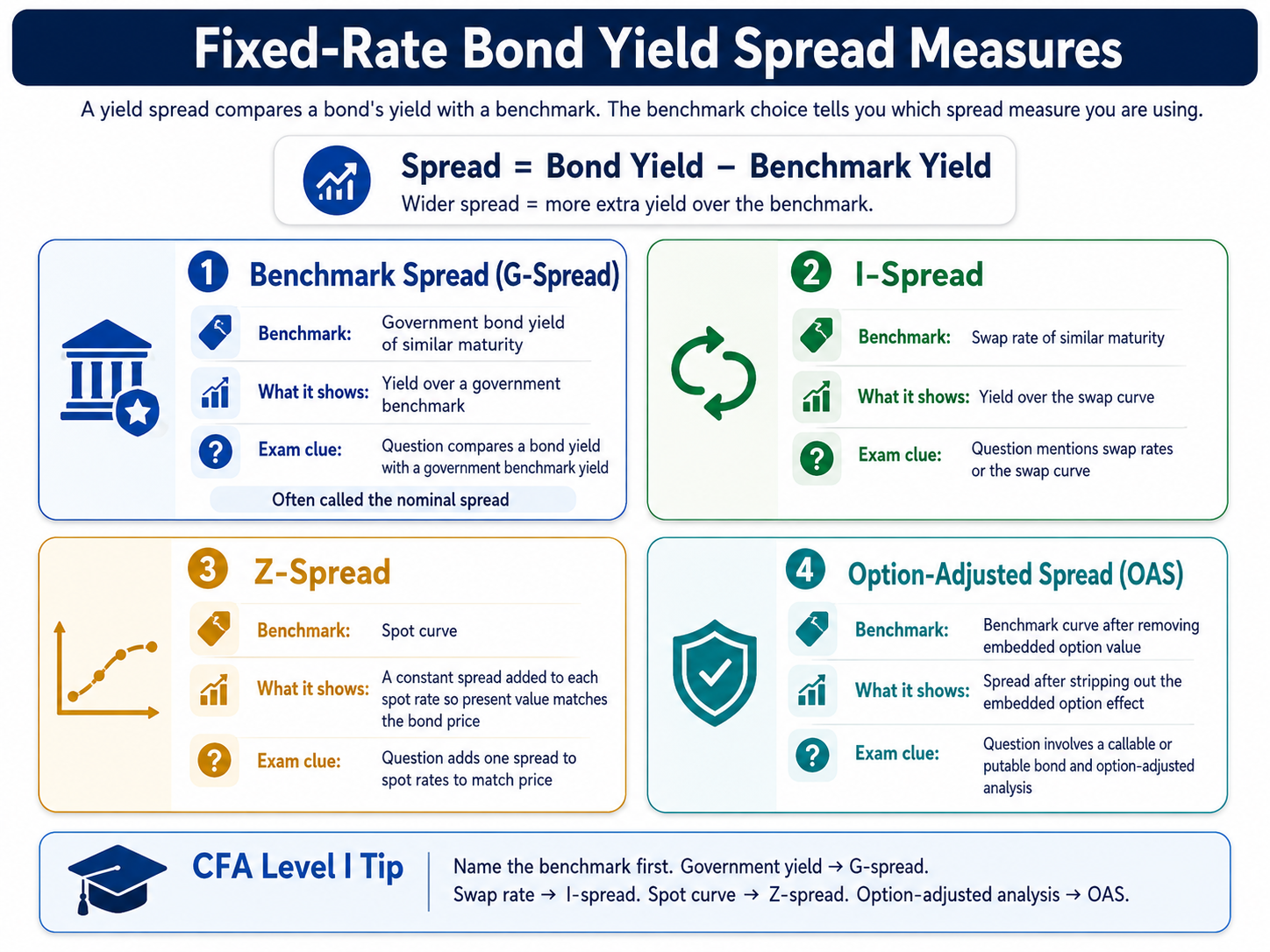
A quick note on naming. The simple spread of a bond's yield over a comparable government benchmark is often called the nominal spread, the benchmark spread, or the G-spread, and these refer to the same idea. The I-spread swaps the benchmark to the swap rate. The Z-spread uses the whole spot curve rather than a single yield. The OAS starts from the Z-spread and strips out the value of an embedded option, which is why it is the measure used for callable and putable bonds. For reference, see: Spot Curve, Yield Curve, Coupon Bonds, Par Curve, and Forward Curve
How to Interpret Yield Spreads
A yield spread is the difference between a bond's yield and the yield on a relevant benchmark. For a fixed-rate bond, the basic calculation is:
Yield Spread = Bond Yield – Benchmark Yield
To interpret a yield spread:
Identify the bond's yield.
Select the appropriate benchmark yield.
Subtract the benchmark yield from the bond yield.
Convert the result to basis points if needed.
Interpret the spread in the context of the bond's risks and market conditions.
For example, if a corporate bond yields 6.20% and a comparable government bond yields 4.80%, the spread is 1.40%, or 140 basis points.
A wider spread generally indicates that investors require more yield above the benchmark to hold the bond. A narrower spread indicates a smaller yield premium. However, the spread alone does not identify the source of that premium. Credit risk, liquidity, embedded options, tax treatment, maturity, and broader market conditions can all affect yield spreads.
Worked Example
A 7-year fixed-rate corporate bond has a yield to maturity of 6.25%. A comparable 7-year government bond yields 4.90%. Calculate the benchmark spread, or G-spread, and interpret the result.
Because 1% equals 100 basis points:
The corporate bond therefore offers 135 basis points of additional yield over the comparable government benchmark.
This spread represents the extra yield investors require relative to the benchmark, but it does not by itself explain why the difference exists. If the spread later widens from 135 to 170 basis points, investors are demanding more compensation, which may reflect changes in perceived credit risk, liquidity, or broader market conditions.
Common Exam Traps
Confusing yield measures with yield spread measures.
Forgetting that spreads are usually quoted in basis points.
Using the wrong benchmark for the spread measure.
Treating yield to maturity as a guaranteed realized return.
Assuming a wider spread has only one cause, such as credit risk, when liquidity, optionality, maturity, and market conditions can all contribute.
Drifting into money market spread measures when the question is about fixed-rate bonds.
Practice Question
A fixed-rate corporate bond has a yield to maturity of 5.80%. A government benchmark bond with a similar maturity yields 4.45%. The bond's benchmark spread is closest to:
135 basis points
145 basis points
1,035 basis points
Correct Answer: A
The benchmark spread is 5.80% − 4.45% = 1.35%, or 135 basis points.
Option B overstates the spread by 10 basis points.
Option C comes from converting the percentage difference to basis points incorrectly, since 1.35% is 135 basis points, not 1,035.
Continue Your CFA Level I Prep With KeyPoint
Use structured lessons, practice questions, mock exams, and progress tracking to focus on the time you have left
FAQs About Yield and Yield Spread Measures for Fixed-Rate Bonds
What is the difference between a yield measure and a yield spread measure?
A yield measure describes a bond's return or quoted yield under a stated assumption, such as yield to maturity. A yield spread measure compares that yield with a benchmark rate or curve to show the extra yield the bond offers.
What is the benchmark spread (G-spread) on a fixed-rate bond?
It is the bond's yield minus the yield on a government benchmark bond of similar maturity, usually quoted in basis points. It is sometimes called the nominal spread or benchmark spread.
How do you convert a yield spread to basis points?
Multiply the percentage spread by 100. A spread of 1.35% is 135 basis points, since 100 basis points equals 1.00%.
What is the difference between the G-spread, I-spread, Z-spread, and OAS?
The G-spread is over a government yield, the I-spread is over the swap rate, and the Z-spread is a constant spread over the whole spot curve. The OAS starts from the Z-spread and removes the value of an embedded option, which makes it the measure for callable and putable bonds.