
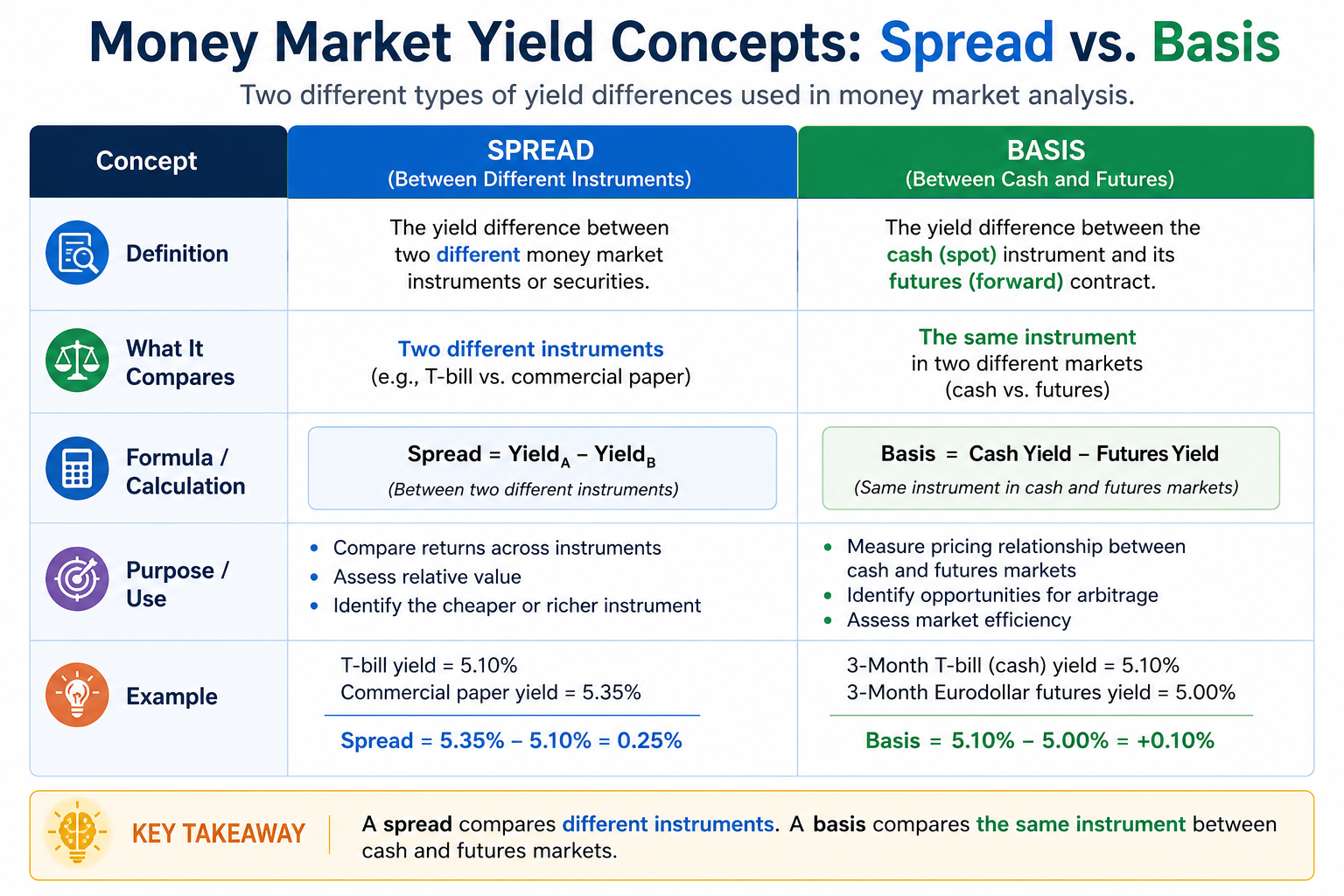
A yield spread for a money market instrument is the difference between its yield and the yield on a benchmark or comparable instrument. The catch is that money market yields are quoted in different ways, so subtracting two quoted numbers can be misleading. For CFA Level I, the skill being tested is putting both yields on the same basis before you read the spread.
Quick Answer
A yield spread measure compares one money market instrument's yield with a benchmark or another instrument. It is meaningful only when both yields are stated on the same basis, because money market instruments use different quote conventions. For CFA Level I, convert discount basis yield, add-on yield, and bond equivalent yield to a common basis first, then interpret the spread.
Key Takeaways: Yield Spread Measures for Money Market Instruments
A yield spread is the difference between two yields.
Money market yields can use different quote conventions.
Converting to a comparable basis comes before interpreting the spread.
A wider spread may reflect credit risk, liquidity, maturity, or market conditions.
Do not compare a discount basis yield directly against an add-on basis yield.
What You Need to Know for CFA Level I
You should be able to recognize money market instruments as short-term debt, see that their quoted yields may not share a denominator or time basis, compare discount basis yield, add-on yield, and bond equivalent yield at a high level, and explain that a spread only means something once both yields use the same convention.
What Are Yield Spread Measures for Money Market Instruments?
Yield spread measures compare the return on one short-term instrument with the return on another. Money market instruments include Treasury bills, commercial paper, certificates of deposit, and similar short-dated debt. The spread is meant to show how much extra yield one instrument offers over another, which can reflect differences in credit, liquidity, maturity, or structure.
The formula itself is simple.
Use this spread only after both yields are stated on the same basis.
Why Money Market Yield Spreads Can Be Misleading
Money market yield spreads can mislead because the two yields may not be measured the same way. Some instruments quote on a discount basis tied to face value, while others quote on an add-on basis tied to the price paid, and day-count conventions can differ as well. Subtract two yields built on different conventions and the spread is not a like-for-like difference. The numbers look comparable, but they are not.
Common Money Market Yield Bases
Money market instruments commonly use three bases you should be able to tell apart. The full mechanics of each belong on the dedicated money market yields note, so this is the comparison-level view.
Yield Basis | How It Is Quoted | Main Issue for Spread Comparison | CFA Exam Trap |
|---|---|---|---|
Discount basis yield | Based on face value and the discount from par | Can understate the return versus a price-based yield | Comparing it directly with an add-on yield |
Add-on yield | Based on the initial price or amount invested | More directly tied to the investor's return | Forgetting the day-count convention |
Bond equivalent yield | Annualized on a 365-day add-on basis | Often used to compare with bonds | Mixing it with a bank discount basis |
A discount basis yield divides the gain by face value and annualizes on a 360-day year, which tends to understate the true return. An add-on yield divides the gain by the price actually paid, which lines up better with what the investor earns. A bond equivalent yield restates an add-on yield on a 365-day basis so it can sit beside bond yields.
How to Compare Yield Spreads on the Same Basis
To compare spreads fairly, convert both instruments to one basis first, then subtract. A practical choice is the bond equivalent yield, because it places short-term instruments on a footing you can compare with bonds. Convert each instrument's quoted yield to that common basis, find the spread, and only then interpret it.
Worked Example: Two Quotes That Are Not What They Seem
Two 90-day instruments are each quoted at 6.00%. Instrument A is quoted on a bank discount basis, and Instrument B is quoted on an add-on basis. At a glance, the spread looks like zero. It is not.
Start with Instrument A. On a face value of 100, a 6.00% bank discount rate over 90 days implies a price of 98.50, so the gain of 1.50 on a price of 98.50 is a holding-period yield of about 1.5228%. Annualized on a 365-day add-on basis, that is a bond equivalent yield of about 6.176%.
Now Instrument B. A 6.00% add-on rate over 90 days on a 360-day basis is a holding-period yield of 1.50%. Annualized on a 365-day basis, that is a bond equivalent yield of about 6.083%.
Once both are on the same basis, Instrument A yields about 6.176% and Instrument B about 6.083%, a spread of roughly 9 basis points in A's favor. The naive comparison of the two quoted 6.00% figures hides that gap entirely. The lesson is the heart of the topic: convert first, then compare.
How to Interpret Money Market Yield Spreads
Once both yields share a basis, the spread becomes a genuine signal, but not a single-cause one. A wider spread can reflect higher credit risk, lower liquidity, a different maturity, or broader market conditions. Reading every spread as pure credit risk is a mistake. The right interpretation considers what differs between the two instruments, not just the size of the gap.
Common Exam Traps
Comparing yields before putting them on the same basis.
Treating a discount basis yield as the investor's actual holding-period return.
Ignoring the day-count convention, such as 360 versus 365 days.
Assuming the highest quoted yield always means the highest comparable return.
Reading a spread as credit risk only, when liquidity and maturity may also matter.
Practice Question
An analyst is given two 90-day instruments. One is quoted on a bank discount basis and the other on an add-on basis. What must the analyst do before interpreting the spread between them?
Nothing, because both yields are annual percentages and can be subtracted directly.
Convert both yields to the same basis, then calculate and interpret the spread.
Choose the instrument with the higher quoted yield, since it always has the higher return.
Assume the spread reflects credit risk and ignore the quote conventions.
Correct Answer: B
Discount basis and add-on basis yields are not directly comparable, so the analyst must restate both on a common basis, such as a bond equivalent yield, before computing the spread.
Option A ignores the convention difference
Option C wrongly assumes the higher quote wins
Option D skips the conversion and over-attributes the spread to credit risk
Continue Your CFA Level I Prep With KeyPoint
Use structured lessons, practice questions, mock exams, and progress tracking to focus on the time you have left
FAQs About Yield Spread Measures for Money Market Instruments
What is a yield spread for a money market instrument?
It is the difference between the instrument's yield and the yield on a benchmark or comparable instrument. It is only meaningful when both yields use the same basis.
Why should money market yields be converted before comparing spreads?
Because money market instruments quote yields differently, on a discount basis, an add-on basis, or a bond equivalent basis, and with different day counts. Without conversion, the spread compares two things that are not measured the same way.
What is the difference between discount basis yield and add-on yield?
A discount basis yield is figured on face value and tends to understate the return. An add-on yield is figured on the price actually paid, so it lines up better with what the investor earns.
What can cause a money market yield spread to widen?
Higher credit risk, lower liquidity, a longer maturity, or broader market stress can all widen a spread. A wider spread is a signal to investigate, not proof of a single cause.