
The challenges to ethical behavior are the forces that weaken sound judgment even when a person knows the relevant rule. Ethical failure rarely comes from not knowing right from wrong. It usually comes from pressure, incentives, overconfidence, and the quiet habit of explaining bad choices to ourselves until they feel acceptable.
Quick Answer
The main challenges to ethical behavior include overconfidence in your own morality, situational pressure, incentives, loyalty conflicts, short-term thinking, and rationalization. These forces narrow your attention and make improper conduct seem reasonable in the moment. Most people who act unethically still believe they are good people, which is exactly why the pressures, not the knowledge, are the real problem.
Key Takeaways
Personal blind spots, such as overconfidence, can stop careful ethical analysis before it starts.
Situational pressures, such as deadlines and authority, push otherwise honest people toward poor choices.
Incentives and loyalty can distort judgment without a person noticing.
Rationalization makes a wrong choice feel normal, often using phrases like "everyone does it."
The strongest safeguard is to pause and analyze before acting, not after.
What You Need to Know for CFA Level I
These five points show up again and again in CFA ethics questions.
Knowing the rule does not remove the pressure to break it.
Overconfidence can prevent the careful analysis a hard case needs.
Incentives and loyalty can quietly distort judgment.
Short-term benefits can hide long-term harm to clients, markets, and the firm.
Questions usually test the pressure, the duty, and the action, not just the final outcome.
What Are the Main Challenges to Ethical Behavior?
The barriers to ethical behavior fall into two groups: personal influences and situational influences. Personal influences come from inside you, such as bias and overconfidence. Situational influences come from outside, such as incentives, authority, and time pressure.
The two groups rarely act alone. A strong incentive is more dangerous when you are also overconfident, and a tight deadline is harder to resist when a manager is pushing. The interaction is where most real failures happen.
Overconfidence in Personal Morality
Many people hold a quiet belief that goes "I am a good person, so my choice must be fine." That belief feels reassuring, and it is risky. It lets you skip the careful analysis a hard case needs, because you assume your instinct is already ethical. The more certain you are of your own character, the less likely you are to check your reasoning.
Incentives and Self-Interest
Compensation, career pressure, sales targets, prestige, and the wish to avoid embarrassment all pull at judgment. An incentive does not have to be huge to matter. A bonus tied to one number, or the fear of looking bad in front of a manager, can be enough to bend a decision without the person admitting why.
Loyalty and Authority Pressure
Pressure from a manager, a colleague, a client, or the culture of a firm can be intense. Loyalty is a good trait in most settings, which is what makes it tricky here. Wanting to be a team player, or not wanting to challenge a senior person, can push someone toward conduct they would reject on their own. Loyalty never excuses misconduct, even when the request comes from above.
Short-Term Focus
Immediate rewards and looming deadlines crowd out the longer view. A choice that solves today's problem can create a larger one for the client, the firm, or the market later. The harm is easy to miss because it arrives after the decision is made.
Rationalization and Normalization
Rationalization is the story we tell to make a wrong choice feel acceptable. Common versions include "everyone does it," "the client will never know," and "it worked out, so it was fine." Normalization is what happens when a small compromise becomes routine and the next one feels easier. Watch for the explanation that arrives a little too quickly.
Ethical Dilemmas vs Clear Violations
Not every hard choice is an ethical dilemma. Knowing the difference changes how you answer a question.
Issue | Ethical Dilemma | Clear Violation |
|---|---|---|
Nature | Competing duties or choices | Conduct conflicts with a known requirement |
Main task | Weigh facts, duties, stakeholders, consequences | Identify the rule and the required action |
Common risk | Treating one duty as automatically dominant | Rationalizing prohibited conduct |
An ethical dilemma involves genuine competition between duties, where reasonable people might weigh the facts differently. A clear violation is simpler: the conduct breaks a known requirement, and the task is to name it and act. A choice with difficult consequences is not automatically a dilemma.
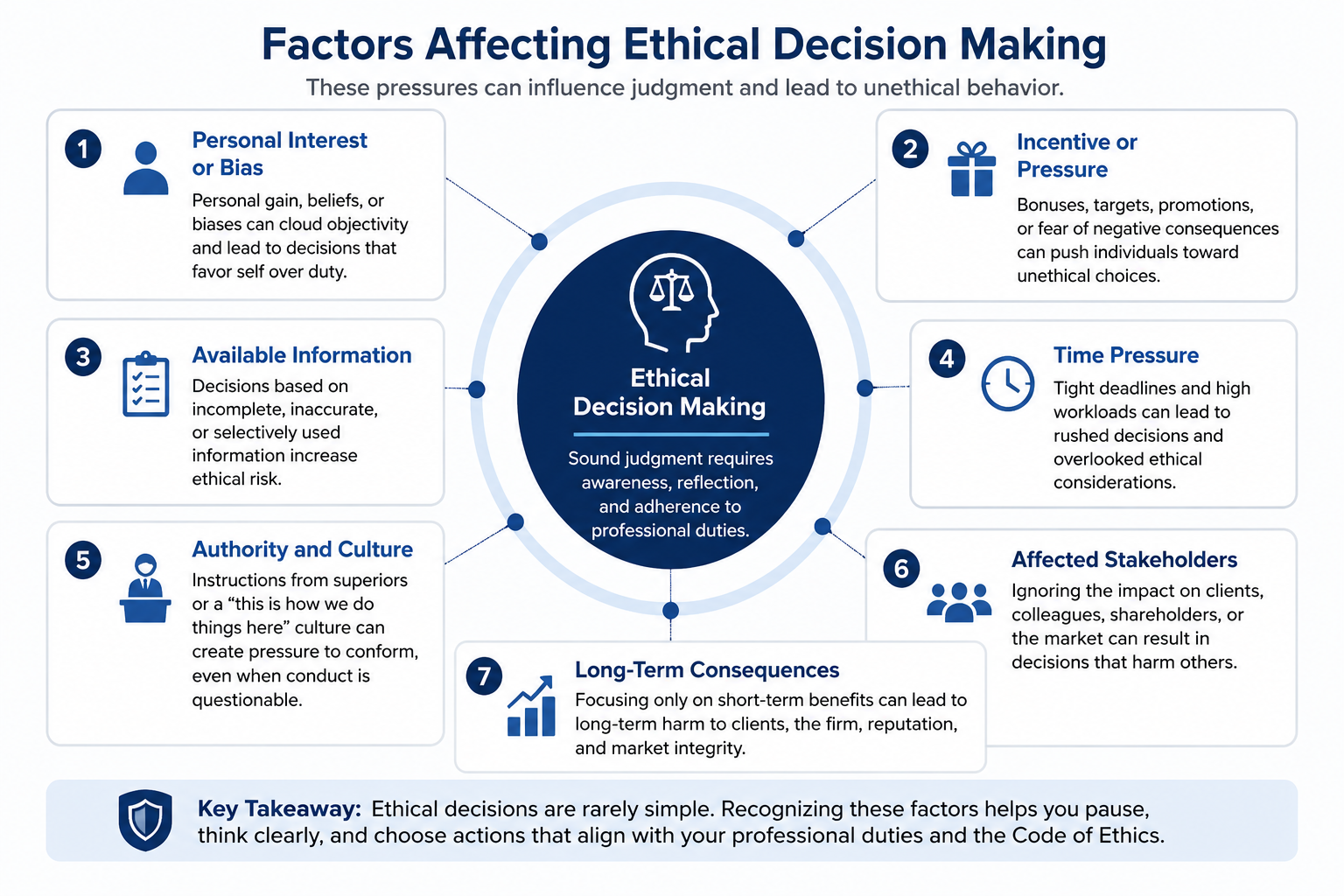
Factors Affecting Ethical Decision Making
When you read a scenario, scan for these factors affecting ethical decision making. Each one is a pressure point that can bend a choice.
Personal interest or bias.
Incentive or pressure.
Available information, including what is missing.
Time pressure.
Authority and culture.
Affected stakeholders.
Long-term consequences.
How Can Professionals Reduce These Barriers?
The fix is a habit, not a personality. A simple routine protects judgment when pressure is high.
Pause before acting, especially when a decision feels urgent.
Gather the facts that are missing.
Identify who is affected and what duties you owe them.
Consult the Code, the Standards, firm policy, or compliance.
Seek an independent review when the case is close.
Document the issue and how you decided.
Check the long-term consequences, not just the immediate ones.
This is a quick safeguard, not the full process. For the complete step-by-step method, use the ethical decision-making framework.
Example Scenario
Tom is a junior analyst preparing slides for a client meeting on a fund his team manages. His draft includes a clear note about the fund's exposure to a single volatile sector. An hour before the meeting, his team lead asks him to remove the note, saying it will "raise questions we do not have time for today" and can be covered later.
Tom faces authority pressure from a senior colleague and time pressure from the deadline. The rationalization is already supplied: cover it later. The affected stakeholders include the client, who has a right to know the risk before deciding, and the firm, whose reputation depends on honest communication.
Removing a material risk warning to smooth a meeting is not a minor edit. The safer response is to keep the disclosure, raise the concern with the team lead, and escalate to compliance if needed rather than quietly comply. Whether this also breaches a specific Standard can be checked later, but Tom does not need that cross-reference to see the request is wrong.
Common Exam Traps
Assuming an ethical person cannot be swayed by incentives. Good people respond to incentives too. That is the whole point.
Treating every difficult choice as a dilemma. Some hard choices are clear violations with an obvious right answer.
Focusing only on intention and ignoring process. A good intention does not save a careless or undocumented decision.
Judging conduct only by whether harm occurred. Conduct can be wrong even when nothing bad happens to result.
Missing authority or group pressure in CFA ethics questions. Scan for who is applying pressure, not just what the rule says.
Practice Question
An analyst is told by her supervisor to delay reporting an error that would lower a client's quarterly return, because the supervisor wants to "wait for the numbers to recover." The analyst dislikes the idea but does not want to seem difficult so early in her career. Which factor is most clearly impairing the ethical decision here?
Lack of technical knowledge about how to report the error
Authority and loyalty pressure combined with concern for her own career
The absence of any affected stakeholder in the situation
Correct Answer: B
The analyst knows what should happen. What is bending her judgment is pressure from a senior person plus a personal interest in not appearing difficult. Naming that pressure is the first step to resisting it.
Option A. Option A is wrong because the problem is not a knowledge gap. She understands the error and the duty to report it.
Option C. Option C is wrong because the client is a clearly affected stakeholder, and protecting that client is exactly what the pressure is working against.
Continue Your CFA Level I Prep With KeyPoint
Use structured lessons, practice questions, mock exams, and progress tracking to focus on the time you have left