
An ethical decision-making framework is a repeatable process for working through a professional choice when the right action is not obvious. Real decisions often come with incomplete facts, competing duties, financial incentives, and outcomes you cannot predict. CFA® Level I tests whether you can move through that uncertainty in a structured way instead of guessing, which is why scenario questions reward process over instinct.
Quick Answer
The ethical decision-making framework has four broad stages. First, identify the facts, the people affected, the duties owed, and the conflicts in play. Second, consider the pressures acting on you, the guidance that applies, and the reasonable alternatives. Third, decide and act on the choice that best meets your duties. Fourth, reflect on both the outcome and the reasoning that led there.
Key Takeaways About the Ethical Decision-Making Framework
An ethical issue has to be recognized before anyone can resolve it, so the process starts with spotting the problem.
Verified facts and untested assumptions are not the same thing, and separating them changes the analysis.
Every decision affects someone, so naming stakeholders and the duties owed to them comes before choosing an action.
Incentives, authority, loyalty, and time pressure can quietly bend judgment, and the framework forces you to name them.
Reasonable alternatives should be tested against your duties before you act, not after.
Reflection turns one decision into a better process for the next one, even when the result looked fine.
What You Need to Know for CFA Level I
The framework matters most when the rules alone do not settle the question. Many scenario items describe a Standard pointing one way and a manager or client pushing another, leaving the candidate to find the defensible path.
The process starts with facts and duties, not personal preference or the answer you would like to reach. Incentives and pressure are part of the analysis, not background noise. The final action should hold up under the law, the Code and Standards, and firm policy. Reflection then checks two things: the result and the quality of the reasoning. Exam questions often probe which step a person skipped or which next action best fits the framework.
What Is an Ethical Decision-Making Framework?
An ethical decision-making framework organizes how you analyze a professional dilemma. It slows down the moment between recognizing a problem and reacting to it, which is usually where self-serving or impulsive choices happen.
A good framework does three things. It structures the analysis so you do not miss a duty or a stakeholder, reduces snap decisions driven by pressure or convenience, and surfaces consequences you might otherwise miss, including effects on people who are not in the room.
It is also worth being clear about what the framework does not do. It does not replace the law, the Code and Standards, firm policy, or advice from compliance and legal experts. It is a method for reaching sound judgment within those rules, not a substitute for them, and it does not promise that every case becomes easy. The job is to make your reasoning defensible, not painless.
Why Does Ethical Decision Making Matter in Investment Management?
Ethical decision making matters because one professional's choice can reach far beyond that professional. The investment industry runs on trust, and decisions made under pressure are where that trust is tested.
A single decision can affect clients who rely on honest advice, employers and colleagues whose reputations are tied to the work, and other market participants who trade on the assumption that information is fair. Over time, repeated choices shape capital-market integrity, public confidence in the profession, and the reputation of the individual and firm, which is hard to rebuild once lost.
This is the same trust theme covered in Ethics and Trust in the Investment Profession, and the pressures that make ethical choices difficult are explored in Challenges to Ethical Behavior.
The Four Steps in the Ethical Decision-Making Framework
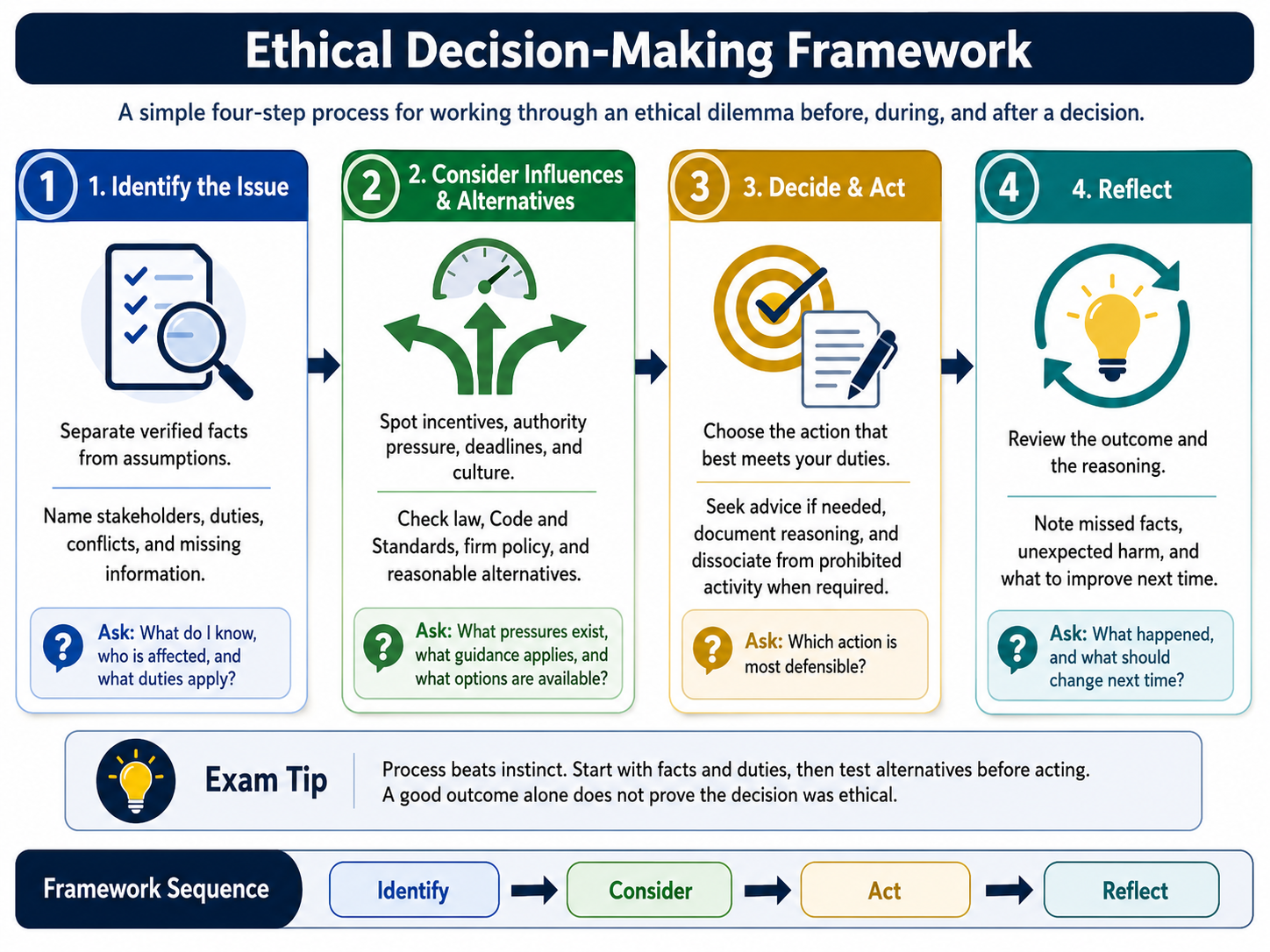
Step 1: Identify the Ethical Issue
Start by sorting what you actually know from what you only assume. Pull the relevant and reliable facts to one side and label the gaps, because a decision built on an unverified assumption is fragile.
Then map the rest of the picture. Who are the stakeholders, meaning the people who could benefit or be harmed? What duties do you owe, and to whom? Which ethical principles and professional requirements are in play? Is there a conflict of interest, whether your own or someone else's, that could distort the choice?
ASK YOURSELF: What do I know, what do I not know, who is affected, and what duties may apply?
Step 2: Consider Influences, Guidance, and Alternatives
Next, name the forces acting on the decision. Incentives, pressure from a senior colleague, loyalty to a team, a tight deadline, and the surrounding firm culture can all pull judgment off course. Naming them is what keeps them from working in the background.
Then bring in the guidance that applies: the law, the Code and Standards, firm policy, and compliance input. With that in view, lay out the reasonable alternatives rather than fixing on the first option. Think through the direct and indirect consequences of each, and weigh short-term effects against long-term ones. This step is about widening the set of choices before you narrow it.
Step 3: Decide and Act
Choose the action that best satisfies the duties you identified. Where a conflict exists, the goal is to avoid it when you can and manage it openly when you cannot.
If the facts or requirements are still unclear, seek advice before acting. Document your reasoning where that is appropriate, since a clear record protects both you and the people affected. When an applicable Standard requires it, dissociate from prohibited activity. Acting well does not always mean escalating to the most dramatic option, and it does not mean every issue calls for public reporting.
Step 4: Reflect on the Outcome and Process
After acting, look back at two things separately. Was the result what you expected, and did any affected party experience harm you did not foresee?
Then turn to the reasoning itself. Did you miss an important fact or underweight a pressure? Should the process change next time? The key idea here is that a favorable result does not prove the decision was sound. A choice made for weak reasons can still turn out well by luck, and a careful choice can still produce a poor outcome. Judging only by the result teaches the wrong lesson.
Ethical Decision-Making Worksheet for CFA Questions
Use this compact worksheet to move through a scenario quickly under exam time pressure.
Prompt | Candidate Check |
|---|---|
Facts | Which facts are verified, missing, or assumed? |
Stakeholders | Who may benefit or be harmed? |
Duties | To whom is a duty owed? |
Requirements | Which law, Standard, policy, or principle applies? |
Pressures | What incentive or situational influence may distort judgment? |
Alternatives | What reasonable actions are available? |
Action | Which action is most defensible? |
Reflection | What should be reviewed after acting? |
Worked Ethical Decision Scenario
Priya is an analyst whose firm advises a pension client on a proposed allocation to a private credit fund. The evening before the meeting, she notices that the client deck describes the fund's liquidity terms but leaves out a redemption gate that can lock investors in during stressed markets. The gate is material to a pension that may need access to capital. When she flags it, her managing director says the meeting is set, the relationship is sensitive, and they can cover the detail verbally if it comes up.
Identify
The verified facts are that the deck omits a material liquidity term and the meeting is scheduled. The assumption to avoid is that a verbal mention later equals disclosing it now. Stakeholders include the pension client and its beneficiaries, the firm, and the managing director. Priya owes the client honest, complete information and owes her employer sound work. The conflict is between informing the client and the pressure to protect a sensitive relationship.
Consider
The pressure is clear: a senior manager's authority, a fixed meeting time, and relationship sensitivity. The guidance includes the duty to communicate fairly and the firm's disclosure policy. The alternatives are not limited to send as is or cancel the meeting. She can correct the slide, add the gate to the written materials, raise it with compliance, or propose a short delay.
Decide and act
The defensible action is to make sure the material term reaches the client in writing before any decision, rather than relying on it surfacing in conversation. Correcting the deck and noting the concern to compliance meets the duty to the client. Leaving a known material omission in place to keep a manager comfortable would not hold up.
Reflect
Afterward, Priya should ask whether the near miss points to a weak review step that a disclosure checklist could catch earlier. A meeting that goes smoothly does not justify shipping an incomplete deck. The lesson is in the process, not the outcome.
Common Exam Traps
Starting from the answer you want and working backward, instead of starting from the facts.
Treating "it is legal" as the whole ethical test, when the Code and Standards or firm policy may demand more.
Ignoring incentives or pressure from authority because they feel like context rather than part of the decision.
Assuming a good outcome proves the original decision was ethical.
Jumping to an extreme action before weighing proportionate alternatives or seeking guidance.
Practice Question
An analyst learns that a recommendation report she is about to release relies on a data feed she now suspects is outdated. Her supervisor says the report has already been promised to clients for that afternoon and tells her to send it. Using the ethical decision-making framework, which step is the analyst most clearly at risk of skipping if she sends the report as instructed?
Reflecting on the outcome after the report is delivered.
Considering reasonable alternatives before acting.
Identifying the stakeholders affected by the report.
Correct Answer: B
The analyst has already recognized a factual problem (the suspect data) and knows who relies on the report, so the issue is not identification. The framework calls for considering alternatives before acting, such as verifying the feed, delaying release, or flagging the concern to compliance, rather than defaulting to the supervisor's instruction. Sending the report immediately skips that step.
Option A is incorrect because reflection comes after the action and is not the step being bypassed at the decision point.
Option C is incorrect because the affected stakeholders, the clients, are already evident from the facts, so identification is not where the process breaks down here.
Key Takeaways
Treat the framework as a sequence: identify, consider, act, reflect.
Separate verified facts from assumptions before anything else.
Name the pressures in the room, because unnamed incentives are the ones that distort a decision.
Compare real alternatives instead of accepting the first or most convenient option.
Judge a decision by its reasoning, not only by how it turned out.
Continue Your CFA Level I Prep With KeyPoint
Use structured lessons, practice questions, mock exams, and progress tracking to focus on the time you have left
FAQs About Ethical Decision-Making Framework
What are the four steps in the ethical decision-making framework?
Identify the issue, consider influences and alternatives, decide and act, then reflect on the outcome and the reasoning. Working through them in order keeps a decision grounded in facts and duties rather than pressure.
Why is reflection included in ethical decision making?
Reflection checks whether the reasoning was sound, not just whether the result was acceptable. A decision can turn out well for the wrong reasons, so reviewing the process is how you improve future choices.
How is the framework used in CFA ethics questions?
Many CFA ethics questions describe a pressured scenario and ask which step was missed or which action best fits the process. The framework helps you spot the gap quickly and choose the most defensible answer.