
The difference between legal and ethical standards is the difference between a floor and a fuller duty. Legal standards are enforceable rules set by governing authorities. Ethical standards guide conduct according to professional principles, and they can ask for more than the law spells out. Conduct that is legal is not always ethical, and that gap is where many CFA exam questions live.
Quick Answer
The difference between legal and ethical standards comes down to source, enforcement, and scope. Law is created and enforced by governing authorities and usually sets a minimum. Ethics is guided by principles and professional duties and can demand more than the legal minimum. Conduct can be fully legal yet still unethical, so a professional must weigh both, even when the law is silent.
Key Takeaways
Law is created and enforced by governing authorities.
Ethics is guided by principles, duties, and professional expectations.
Legal compliance does not always equal ethical conduct.
Professional standards may be more demanding than local law.
Scenario questions require finding both the legal rule and the ethical duty.
What You Need to Know for CFA Level I
Five points cover most of what the exam asks here.
The conceptual difference between law and ethics.
How the two can overlap, diverge, or leave a gap.
Why professional ethical standards matter when rules are silent.
How to spot conduct that is legal but unethical.
When to connect the issue to Standard I(A): Knowledge of the Law.
What Is the Difference Between Legal and Ethical Standards?
Legal standards are enforceable rules backed by government authority, while ethical standards are duties grounded in professional principles. That is the core distinction. The law tells you what you must not do. Ethics asks what a responsible professional should do.
Legal standards focus on enforceable compliance. They are written down, tied to a jurisdiction, and backed by sanctions. Ethical standards consider duties, fairness, trust, consequences, and the purpose behind the conduct. They can apply even where no written rule reaches.
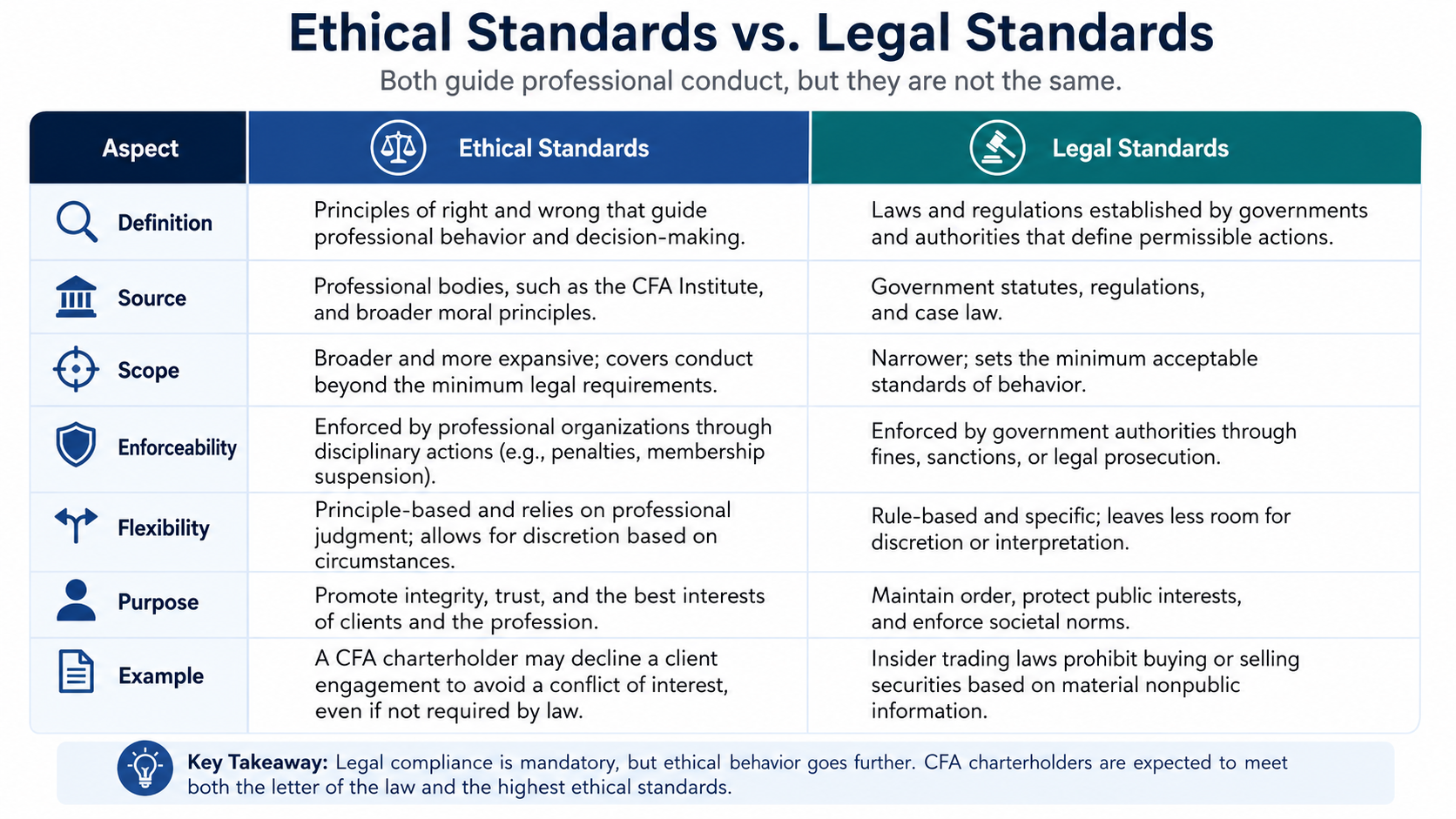
Legal Standards vs Ethical Standards Comparison
The table below lines up the two on the points that matter for exam questions.
Area | Legal Standards | Ethical Standards |
|---|---|---|
Source | Laws, regulations, courts, regulators | Moral principles, professional codes, shared duties |
Enforcement | Government or regulatory sanctions | Professional discipline, employer action, reputational and trust consequences |
Minimum or aspiration | Usually minimum enforceable conduct | May require conduct beyond the legal minimum |
Coverage | Limited to the jurisdiction and written rule | Can guide conduct when law is silent or unclear |
Main exam question | What is legally required? | What should a professional do? |
When Can Legal and Ethical Standards Differ?
Most conduct falls into one of three patterns. Learning to place a scenario into the right one makes the answer faster to find.
Legal and ethical. The conduct follows the law and meets professional duty. This is the routine case and rarely the focus of a hard question.
Illegal and unethical. The conduct breaks the law and a duty at the same time. The task is to identify the rule and the required action.
Legal but in conflict with professional ethical standards. The conduct is permitted by law yet fails a professional duty. This is the pattern the exam tests most often, because it is the one people get wrong.
The CFA context expects compliance with applicable law and the Standards, so spend little time on "ethical but illegal" hypotheticals. For the detailed rules on conflicts between law and the Code, use Standard I(A): Knowledge of the Law.
Why Professional Ethical Standards Can Require More Than the Law
Professional ethical standards can demand more than the law because the relationship between a client and an investment professional carries duties the law does not fully capture. Several factors raise the bar.
Client trust sits at the center, because the client is relying on judgment they cannot easily check. Information asymmetry widens that reliance, since the professional knows more about products, risk, and cost. Where fiduciary-like responsibilities apply, the duty to act in the client's interest is stronger still. Market integrity matters too, because conduct that is technically legal can still erode confidence in the system.
This is why a profession adopts its own standards of ethical conduct. They hold members to a level that local law, on its own, may not reach.
What Should an Investment Professional Do When Standards Differ?
When law and ethics point in different directions, follow a clear order rather than a gut call.
Identify the applicable law, regulation, professional standard, and firm policy.
Follow the requirement that imposes the stronger ethical obligation, where it applies.
Seek compliance or legal guidance when the situation is uncertain.
Do not take part in conduct that violates the governing requirement.
This is the high-level rule. For the full decision process, including how to handle direct conflicts between law and the Code, see Standard I(A): Knowledge of the Law. That note covers the detailed procedures, so this page keeps the principle simple.
Example Scenario
A wealth firm charges a placement fee on certain products and discloses it only in a long document the client signs at account opening. Local rules permit this level of disclosure. A reasonable client, asking how the adviser is paid, would not realize the fee applies to the product being recommended today.
The practice is legal. It is not clearly ethical. The client is relying on the adviser to be open about cost, and burying a material fee in fine print works against that reliance, even if it meets the letter of the rule. Legal permission does not settle the ethical question, because the duty to a trusting client can reach further than the minimum disclosure the law accepts.
The stronger course is to tell the client plainly how the fee works before they decide. Whether a specific rule is broken would be checked against the applicable law and Standards, but the conduct can fall short on ethics regardless of what the local rule allows.
How This Difference Appears in CFA Ethics Questions
Certain phrases are signals that a question is testing the gap between law and ethics. When you see them, do not stop at the legal point.
"Local law permits..."
"No regulation requires..."
"Firm policy allows..."
"The client was not harmed..."
"The conduct was technically compliant..."
Each of these invites you to conclude that legal means fine. The exam usually wants you to test the conduct against the ethical duty as well.
Common Exam Traps
Assuming legal means ethical. The most common error on this topic. Always test the duty, not just the rule.
Choosing personal morality over the applicable professional standard. Your own values are not the test. The professional standard is.
Ignoring a stricter professional duty. When ethics asks for more than the law, the higher duty usually governs.
Jumping to Standard I(A) detail too soon. Identify the conceptual issue first, then apply the specific Standard.
Judging by the result rather than the conduct. A harmless outcome does not make questionable conduct ethical.
Practice Question
An adviser recommends a product that pays the firm a higher commission. Local law does not require the commission to be disclosed, and firm policy does not either. The client is not harmed, because the product performs adequately. What is the most appropriate action for the adviser?
Do nothing further, since the conduct is legal and the client was not harmed.
Disclose the commission and the conflict to the client, because professional ethical standards can require more than the law.
Recommend a different product only if a regulator later requires disclosure.
Correct Answer: B
Legality is the floor, not the full duty. The client is relying on the adviser to be honest about how a recommendation is influenced, so disclosing the conflict meets the higher ethical standard even though no rule compels it.
Option A is wrong because the absence of harm and the presence of legal cover do not resolve the ethical duty.
Option C is wrong because it waits for a rule to force action that ethics already calls for, and it leaves the conflict hidden in the meantime.
Continue Your CFA Level I Prep With KeyPoint
Use structured lessons, practice questions, mock exams, and progress tracking to focus on the time you have left