
CFA ethics questions are not asking whether something turned out badly. They ask whether the conduct, at the moment of the decision, followed the CFA Institute Code of Ethics and Standards of Professional Conduct. The quickest way to get them right is to work from the facts to the governing standard in the same order every time, so you judge the decision rather than the result.
This note gives you a repeatable method for ethical and professional standards questions. It does not reteach every rule. For the underlying duties, use the linked Standard notes and treat this page as the framework that ties them together.
Quick Answer
Solve any CFA Level I ethics scenario in six steps. Identify the actor and their role, isolate the material facts and stakeholders, map those facts to the most specific applicable standard, state the required or prohibited conduct, decide whether a violation occurred and explain why, then recommend a procedure that would prevent the same problem.
Key Takeaways: Solving CFA Ethics Questions
Start with the facts and duties, not the answer choices.
Use the most specific CFA standard the facts support, not the broadest one.
Be ready to explain both a violation and a non-violation conclusion.
Keep mandatory conduct separate from recommended procedures.
A disclosure does not automatically cure conduct that is already prohibited.
A good preventive procedure matches the exact risk shown in the scenario.
What You Need to Know for CFA Level I
For the application learning outcome, you should be able to:
Identify which Standards a scenario triggers.
Recognize the qualifiers that change the answer, such as knowledge, materiality, consent, priority, and disclosure.
Tell a bad result apart from unethical conduct.
Evaluate an employer's policies as well as a person's behavior.
Recommend controls such as written consent, restricted lists, supervisory review, record retention, or disclosure procedures when they fit the risk.
How Should You Approach CFA Level I Ethics Questions?
Approach every question as an evaluation of conduct against a rule, in that order. The exam rewards candidates who slow down long enough to name the actor, the facts, and the standard before reaching a conclusion. Candidates lose points when they react to the outcome, pick a standard that sounds close, or assume a disclosure fixes everything.
The framework below keeps you from skipping that work. It also gives you a consistent way to explain your reasoning, which matters because many questions ask why conduct does or does not violate the Code and Standards, not just whether it does.
The Six-Step Code and Standards Application Framework
Run the same six steps on every scenario. Each step is a single question, and the answer to one feeds the next.
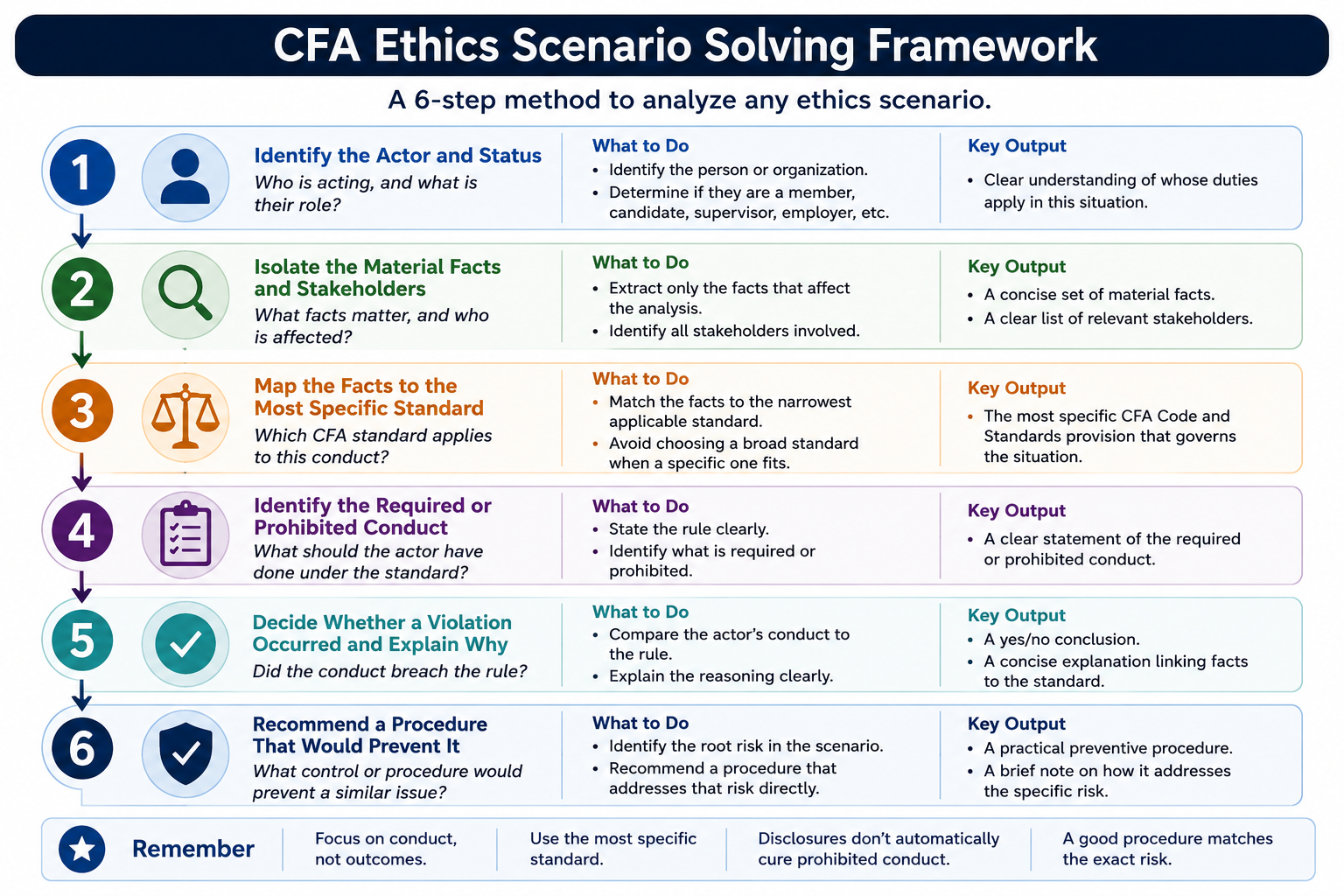
Step 1: Identify the Actor and Status
Ask: who is acting? A member, a candidate, a supervisor, an analyst, a portfolio manager, an employer, or a client. The duties depend on the role. A supervisor carries responsibilities that a junior analyst does not, and the Code and Standards apply to members and candidates rather than to every person in the story.
Step 2: Isolate the Material Facts and Stakeholders
Ask: which facts actually affect the duty? Strip out background detail that does not change the analysis. Note who is affected, such as clients, prospective clients, the employer, and the wider market. A fact is material here if it would change the conclusion about the conduct.
Step 3: Map the Facts to the Most Specific Standard
Ask: which standard governs this exact conduct? Use the narrowest rule that fits. A scenario about acting on a material nonpublic fact points to Standard II(A), not to a broad appeal to professionalism. Picking a general standard when a specific one applies is one of the most common ways to lose an otherwise easy mark.
Step 4: Identify the Required or Prohibited Conduct
Ask: what should the person have done? State the required or prohibited action before you judge the facts. This step forces you to define the rule clearly, which makes the violation question much easier to answer.
Step 5: Decide Whether a Violation Occurred and Explain Why
Ask: did the conduct breach the rule? Connect the specific facts to the duty you named in Step 4. If there is no breach, say why the conduct stayed within the standard. The exam often tests whether you can defend a non-violation answer as confidently as a violation answer.
Step 6: Recommend a Preventive Policy or Procedure
Ask: what would stop this from happening again? Recommend a targeted control, not a generic line about "having a compliance program." If the problem was trading on a sensitive fact, the fix is a restricted list or an information barrier, not a vague promise to act ethically.
Worked Ethics Scenario
Mara Velasco, a CFA charterholder and equity analyst at Northwind Capital, has dinner with a college friend who works in finance at Cortado Foods. Over dinner, the friend mentions that Cortado will report a large, unexpected earnings miss when it releases results next week, and that the news is not yet public. The next morning, Mara tells her portfolio manager that the team should trim its Cortado position right away, without explaining where the information came from. Northwind has no restricted list and no process for flagging securities tied to sensitive information.
Walk the six steps.
Actor and status. Mara is a CFA charterholder and an analyst. Northwind, as her employer, is also relevant because of its missing controls.
Material facts and stakeholders. The earnings miss is nonpublic and clearly material, since it would move the stock. Mara learned it privately, then prompted a trade. Stakeholders include Northwind's clients, the other side of any trade, and the market.
Most specific standard. The conduct centers on acting on material nonpublic information, which is Standard II(A): Material Nonpublic Information. A secondary thread runs through the firm's supervision and controls, closer to Standard IV(C): Responsibilities of Supervisors.
Required or prohibited conduct. A member who has material nonpublic information must not act on it or cause others to act on it. Mara should not have recommended the trade based on the dinner conversation.
Violation and why. Mara violated Standard II(A). She used material nonpublic information to drive an investment action, and the fact that she did not name her source does not change that. The firm's lack of any restricted-list process points to a separate supervisory weakness.
Preventive procedure. Northwind should adopt a restricted list and an information-barrier procedure, so that securities tied to sensitive information are flagged and trading is blocked until the information is public or cleared. A targeted control like this matches the exact risk the scenario shows.
Notice that the bad part is not the earnings miss itself. It is Mara acting on a fact she was not free to use.
Common Exam Traps
Judging the outcome instead of the decision process.
Selecting a broad standard when a more specific one clearly applies.
Skipping over words such as "material," "reasonable," "written," or "prior."
Treating a recommended procedure as if it were the only required action.
Assuming a disclosure cures conduct that should not have happened at all.
Inventing facts that the scenario never states.
Practice Question
Theo Marchetti, an investment adviser, receives an allocation of a heavily oversubscribed initial public offering. He fills his own personal account first, then allocates the next shares to three long-standing clients who often refer business to him. The remaining clients with the same strategy and suitability receive whatever is left. Which policy would best prevent the primary violation in this scenario?
A written allocation policy that distributes IPO shares pro rata across all eligible client accounts before any employee account.
A suitability questionnaire confirming that the IPO matches each client's stated objectives.
A disclosure added to the next client statement explaining that employees may invest alongside clients.
Correct Answer: A
The primary problems are unfair treatment of clients with the same mandate, which relates to Standard III(B): Fair Dealing, and putting a personal account ahead of clients, which relates to Standard VI(B): Priority of Transactions. A pro rata allocation that puts clients ahead of employees targets both risks directly.
Option B is incorrect. Suitability is a real duty, but suitability is not the issue here. Every affected client shares the same strategy and suitability profile, so a questionnaire would not fix the unfair allocation or the personal-account priority.
Option C is incorrect. A disclosure does not cure prohibited priority or unfair treatment. Telling clients after the fact that employees invest alongside them does not justify filling a personal account ahead of theirs.
Continue Your CFA Level I Prep With KeyPoint
Use structured lessons, practice questions, mock exams, and progress tracking to focus on the time you have left
FAQs About Application of the Code and Standards: Level I
How do you solve CFA ethics questions?
Work from the facts to the rule. Identify the actor, isolate the material facts, map them to the most specific standard, state the required or prohibited conduct, decide whether a violation occurred, and recommend a procedure that would prevent it. Judging the conduct in this order keeps you from reacting to the outcome.
What is the best way to identify the applicable CFA Standard?
Match the specific conduct to the narrowest rule that governs it. If a scenario is about trading on a sensitive fact, the answer sits in Standard II(A), not in a broad professionalism argument. When two standards seem to fit, choose the one that speaks most directly to the action in question.
Can one scenario violate more than one CFA Standard?
Yes. A single scenario can breach several standards at once, and exam questions often build in a tempting second issue. Identify the primary violation first, then note any secondary ones, and make sure your recommended procedure addresses the main risk rather than a side detail.