
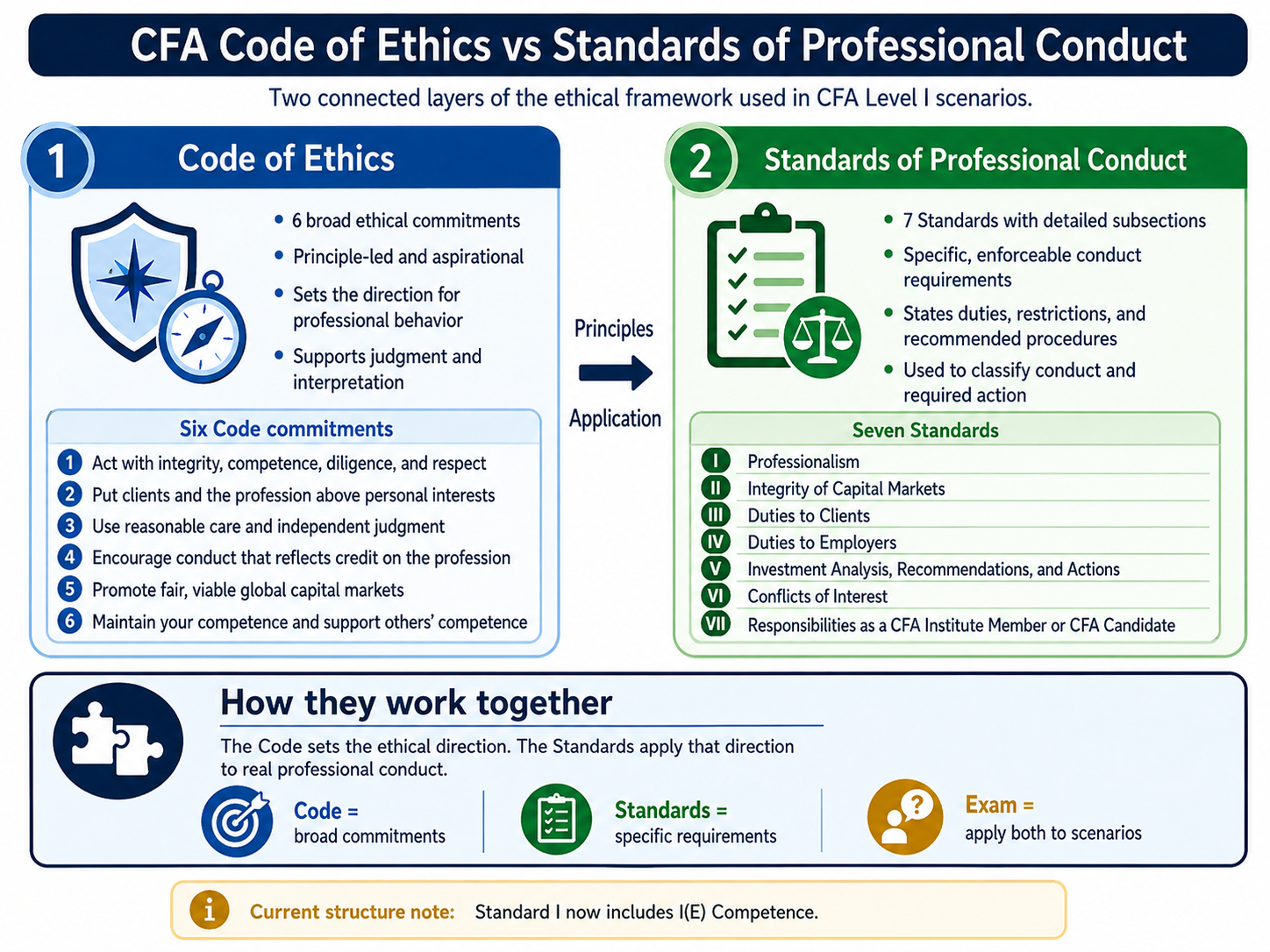
The CFA® Code of Ethics is the high-level statement of how investment professionals should behave. The Standards of Professional Conduct turn that statement into specific requirements you can apply to real situations. Members and candidates have to understand and follow both, and the two work as a pair rather than as separate lists. This note maps the structure of the ethical and professional standards and links to the detailed guidance for each one.
Quick Answer
The CFA Code of Ethics sets out six broad ethical commitments. The Standards of Professional Conduct organize specific requirements into seven categories with detailed subsections. The Code states the direction the profession should move in, while the Standards say what conduct is required, prohibited, or recommended. On the exam, you apply both to scenarios. Memorizing the headings is not enough.
Key Takeaways About the CFA Code of Ethics
The Code is principle-led and aspirational, describing what professionals should strive for.
The Standards of Professional Conduct contain specific, enforceable requirements.
There are six Code components and seven Standards.
Standard I now includes a fifth subsection, I(E) Competence, added in the current version.
A single scenario can raise issues under more than one Standard.
CFA Level I tests recognition of conduct, application to facts, and preventive action.
What You Need to Know for CFA Level I
You should be able to tell the Code apart from the Standards and explain how they relate. You also need the names and order of Standards I through VII, along with the current subsections under each one.
Beyond naming them, the exam asks you to do something with them. You classify conduct as conforming or violating, recommend practices that prevent violations, and work through scenarios where the facts matter more than the label. Scenario-based application is the skill being tested, so most of your study time should go toward applying the rules rather than reciting them.
What Is the CFA Code of Ethics?
The CFA Code of Ethics is a set of six commitments that describe ethical behavior for members and candidates. It is the foundation the rest of the framework builds on. In plain language, the six commitments ask members and candidates to:
Act with integrity, competence, diligence, and respect, and in an ethical manner with everyone they deal with in the markets.
Place the integrity of the profession and the interests of clients above their own personal interests.
Use reasonable care and independent professional judgment.
Practice and encourage others to practice in a way that reflects well on themselves and the profession.
Promote the integrity and viability of the global capital markets for the benefit of society.
Maintain and improve their own professional competence and support the competence of others.
The official Code is the source of record. This summary paraphrases it so you can recall the structure without leaning on exact wording.
What Are the Standards of Professional Conduct?
The Standards of Professional Conduct give the specific requirements that govern professional behavior. Where the Code points a direction, the Standards spell out the conduct.
Each Standard includes duties, supporting guidance, recommended procedures, and application examples. The Standards organize related responsibilities into seven categories. They are meant to be read together, not as a checklist of isolated rules, because a single situation often touches more than one of them.
CFA Code of Ethics vs Standards of Professional Conduct
Area | Code of Ethics | Standards of Professional Conduct |
|---|---|---|
Role | High-level ethical commitments | Specific conduct requirements |
Focus | Professional ideals and priorities | Actions, duties, restrictions, and procedures |
Structure | Six components | Seven Standards with subsections |
Exam use | Supports judgment and interpretation | Used to classify conduct and required action |
Relationship | Sets direction | Applies that direction to professional activity |
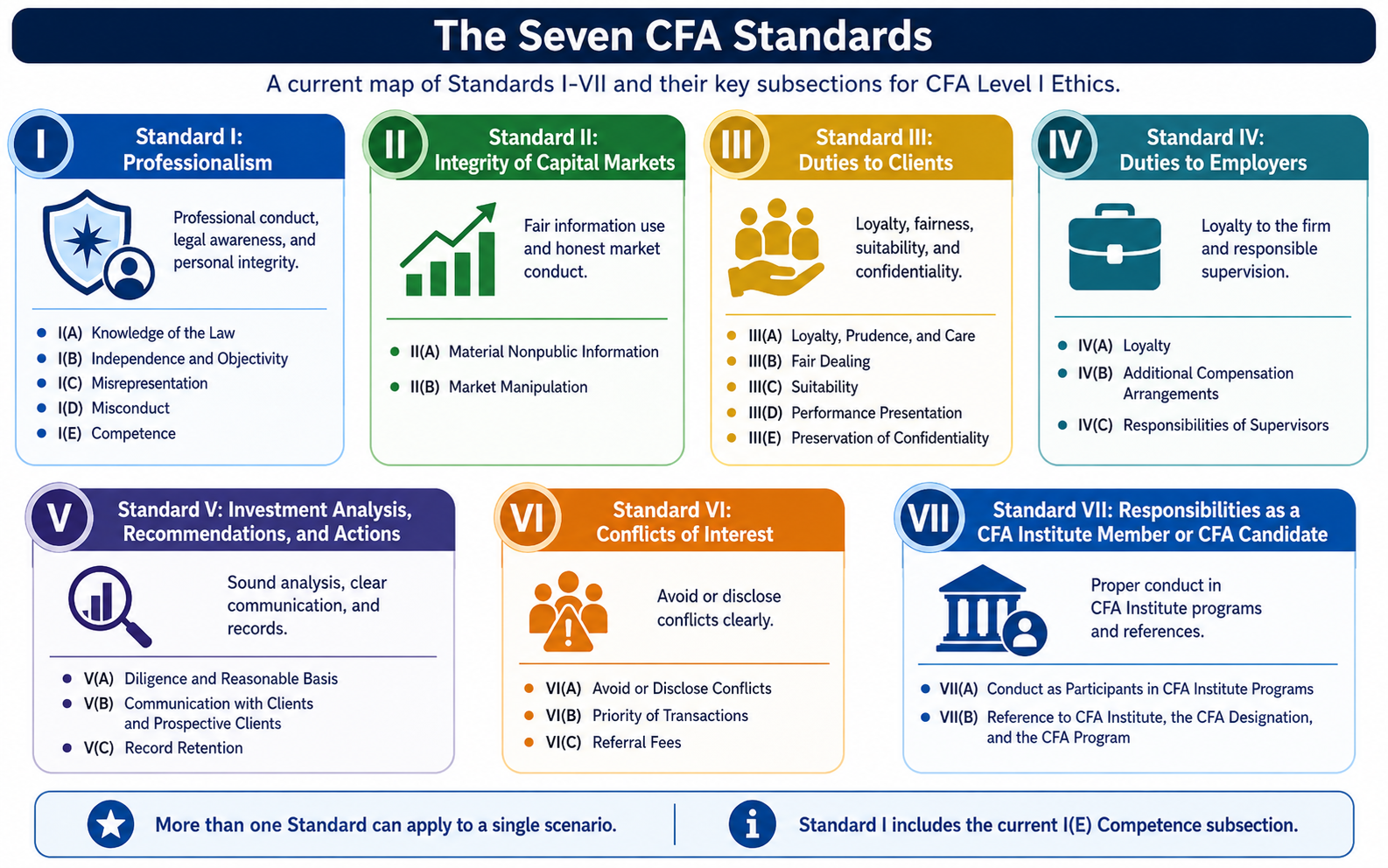
The Seven CFA Standards
Standard I: Professionalism
Standard I covers how members and candidates handle the law, their independence, the accuracy of what they say, their personal conduct, and their competence. It is broad because professionalism touches almost everything an investment professional does. Its subsections are:
I(A) Knowledge of the Law
I(B) Independence and Objectivity
I(C) Misrepresentation
I(D) Misconduct
I(E) Competence
See the detailed Standard I: Professionalism guidance.
Standard II: Integrity of Capital Markets
Standard II protects fair information use and honest price formation. It addresses what professionals may do with information that is not public, and it prohibits conduct designed to mislead the market. Its subsections are:
II(A) Material Nonpublic Information
II(B) Market Manipulation
See the detailed Standard II: Integrity of Capital Markets guidance.
Standard III: Duties to Clients
Standard III sets out what members and candidates owe the people whose money they manage or advise on. It covers loyalty, fairness, suitability, honest performance reporting, and confidentiality. Its subsections are:
III(A) Loyalty, Prudence, and Care
III(B) Fair Dealing
III(C) Suitability
III(D) Performance Presentation
III(E) Preservation of Confidentiality
See the detailed Standard III: Duties to Clients guidance.
Standard IV: Duties to Employers
Standard IV addresses the relationship between members and candidates and the firms they work for. It covers loyalty to the employer, outside compensation, and the duties that come with supervising others. Its subsections are:
IV(A) Loyalty
IV(B) Additional Compensation Arrangements
IV(C) Responsibilities of Supervisors
See the detailed Standard IV: Duties to Employers guidance.
Standard V: Investment Analysis, Recommendations, and Actions
Standard V governs the quality of investment work and how it is communicated and recorded. It asks for a reasonable basis behind recommendations, clear communication with clients, and proper record keeping. Its subsections are:
V(A) Diligence and Reasonable Basis
V(B) Communication with Clients and Prospective Clients
V(C) Record Retention
See the detailed Guidance for Standard V: Investment Analysis, Recommendations, and Actions.
Standard VI: Conflicts of Interest
Standard VI deals with conflicts between a professional's interests and the duties owed to clients and employers. The current version asks members and candidates to avoid conflicts where they reasonably can, and to disclose them clearly when they cannot. Its subsections are:
VI(A) Avoid or Disclose Conflicts
VI(B) Priority of Transactions
VI(C) Referral Fees
See the detailed Guidance for Standard VI: Conflicts of Interest.
Standard VII: Responsibilities as a CFA Institute Member or CFA Candidate
Standard VII covers conduct connected to CFA Institute itself, including behavior in its programs and how the designation is described. Its subsections are:
VII(A) Conduct as Participants in CFA Institute Programs
VII(B) Reference to CFA Institute, the CFA Designation, and the CFA Program
See the detailed Guidance for Standard VII: Responsibilities as a CFA Institute Member or CFA Candidate.
How Do the Code and Standards Apply to Members and Candidates?
Covered members and candidates are required to follow the Code and Standards. That includes charterholders, CFA Institute members, and people enrolled in the CFA Program.
The requirements reach professional activities, conduct in CFA Institute programs, and the way the designation is referenced. Because the Code and Standards are revised from time to time, current guidance should be used when a requirement changes. The process for handling possible violations is separate, and it is covered on the CFA Institute Professional Conduct Program and Enforcement page rather than here.
How Should You Study the CFA Standards?
A practical sequence works better than rereading the list. Use these steps:
Learn the purpose of each Standard in one sentence.
Learn the current subsection names and order.
Restate the duty in plain language you can recall under pressure.
Compare conduct that complies with conduct that violates.
Learn the recommended procedures that prevent each violation.
Practice mixed scenarios where more than one Standard could apply.
Review your mistakes by Standard and by the duty owed, not just by right or wrong.
Studying the CFA standards this way builds the routing instinct the exam rewards.
Example of Overlapping CFA Standards
One action often raises more than one Standard. Consider an analyst who accepts an all-expenses research trip from a company she covers, then publishes a favorable rating without flagging the arrangement or doing independent verification.
The benefit she accepted raises a question under independence and objectivity, because the trip could compromise her judgment. Presenting the rating as independent work, when it leaned on the issuer's hospitality and materials, raises a separate question under misrepresentation. The point of the example is the overlap itself. A single set of facts can implicate two duties at once, and choosing only the first one you notice is a common error. The detailed analysis of each duty lives in the child Standard notes.
Common Exam Traps
Treating the Code and the Standards as the same thing, when one sets principles and the other sets requirements.
Using an outdated Standard I list that leaves out I(E) Competence.
Assuming only one Standard can apply to a scenario.
Reaching for the most severe-sounding Standard instead of the one that fits the duty.
Judging conduct by the outcome rather than by the action and intent.
Reciting official language without knowing what action it requires.
Practice Question
A candidate in the CFA Program argues that the Code of Ethics and the Standards of Professional Conduct are interchangeable, so learning one is enough. Which statement best corrects this view?
The Code and the Standards are identical in function, so the candidate is correct.
The Code sets out broad ethical commitments, while the Standards set specific conduct requirements that apply those commitments.
The Standards are aspirational goals, while the Code lists the enforceable rules.
Correct Answer: B
The Code is principle-led and describes the ethical direction, while the Standards translate that direction into specific requirements used to classify conduct. They are related but not interchangeable.
Option A is incorrect because the two serve different functions and are not identical.
Option C reverses the roles: the Standards, not the Code, contain the specific conduct requirements, while the Code is the high-level statement.
Continue Your CFA Level I Prep With KeyPoint
Use structured lessons, practice questions, mock exams, and progress tracking to focus on the time you have left
FAQs About Code of Ethics and Standards of Professional Conduct
What is the CFA Code of Ethics?
The CFA Code of Ethics is a set of six broad commitments that describe ethical behavior for CFA Institute members and candidates. It states the ethical direction of the profession, and the Standards of Professional Conduct then turn it into specific requirements.
How many CFA Standards of Professional Conduct are there?
There are seven Standards, each divided into subsections. They cover professionalism, integrity of capital markets, duties to clients, duties to employers, investment analysis and actions, conflicts of interest, and responsibilities as a CFA Institute member or candidate.
What is the difference between the Code and the Standards?
The Code of Ethics and Professional Conduct framework has two layers. The Code is principle-led and aspirational, while the Standards are specific and used to judge whether conduct conforms or violates.
Does the CFA Code apply to candidates?
Yes. The Code and Standards apply to CFA Institute members and to candidates enrolled in the CFA Program. Candidacy carries the same obligation to understand and follow them.
Is Competence part of Standard I?
Yes. The current version of Standard I includes I(E) Competence alongside Knowledge of the Law, Independence and Objectivity, Misrepresentation, and Misconduct. Older summaries that list only four subsections are out of date.