
A composite under the Global Investment Performance Standards (GIPS®) is a group of one or more portfolios managed to a similar investment mandate, objective, or strategy. Firms use composites to show how a strategy actually performed across client accounts, rather than presenting a single flattering example. For CFA Level I, you need to understand why composites exist and how a firm decides which portfolios belong in one.
Quick Answer
A GIPS composite is one or more portfolios managed to a similar investment mandate, objective, or strategy. Composites let a firm present representative strategy performance and reduce cherry-picking, because every qualifying portfolio must be included consistently rather than selected based on its return.
Key Takeaways About GIPS Composites
A similar investment strategy is the organizing principle for grouping portfolios.
Qualifying portfolios cannot be picked or dropped based on performance.
Discretion matters, because the manager must be able to implement the strategy.
Composite returns aggregate portfolio results, generally using asset weighting under the applicable methodology.
A composite report is part of a firm's GIPS reporting, but the composite itself does not claim compliance. The firm does.
What You Need to Know for CFA Level I
Explain the purpose of a composite.
Recognize cherry-picking when you see it.
Decide whether a portfolio belongs, based on the composite definition and discretion.
Tell the difference between a composite and a single representative account.
Read the basic meaning of composite dispersion.
What Is a GIPS Composite?
A composite aggregates portfolios that follow the same intended strategy. The grouping is built around the investment approach, not around which accounts happened to do well. If three accounts all follow a large-cap value mandate, they belong in the same composite, whether one gained 4 percent and another gained 9 percent over the period.
Why Do GIPS Composites Exist?
Composites exist to stop selective presentation of performance. Without them, a firm could show only its strongest account and call it representative of the strategy. The composite requirement removes that option. It forces the firm to include every qualifying portfolio, so the reported result reflects the full set of accounts run under that strategy, not a hand-picked winner.
Which Portfolios Belong in a Composite?
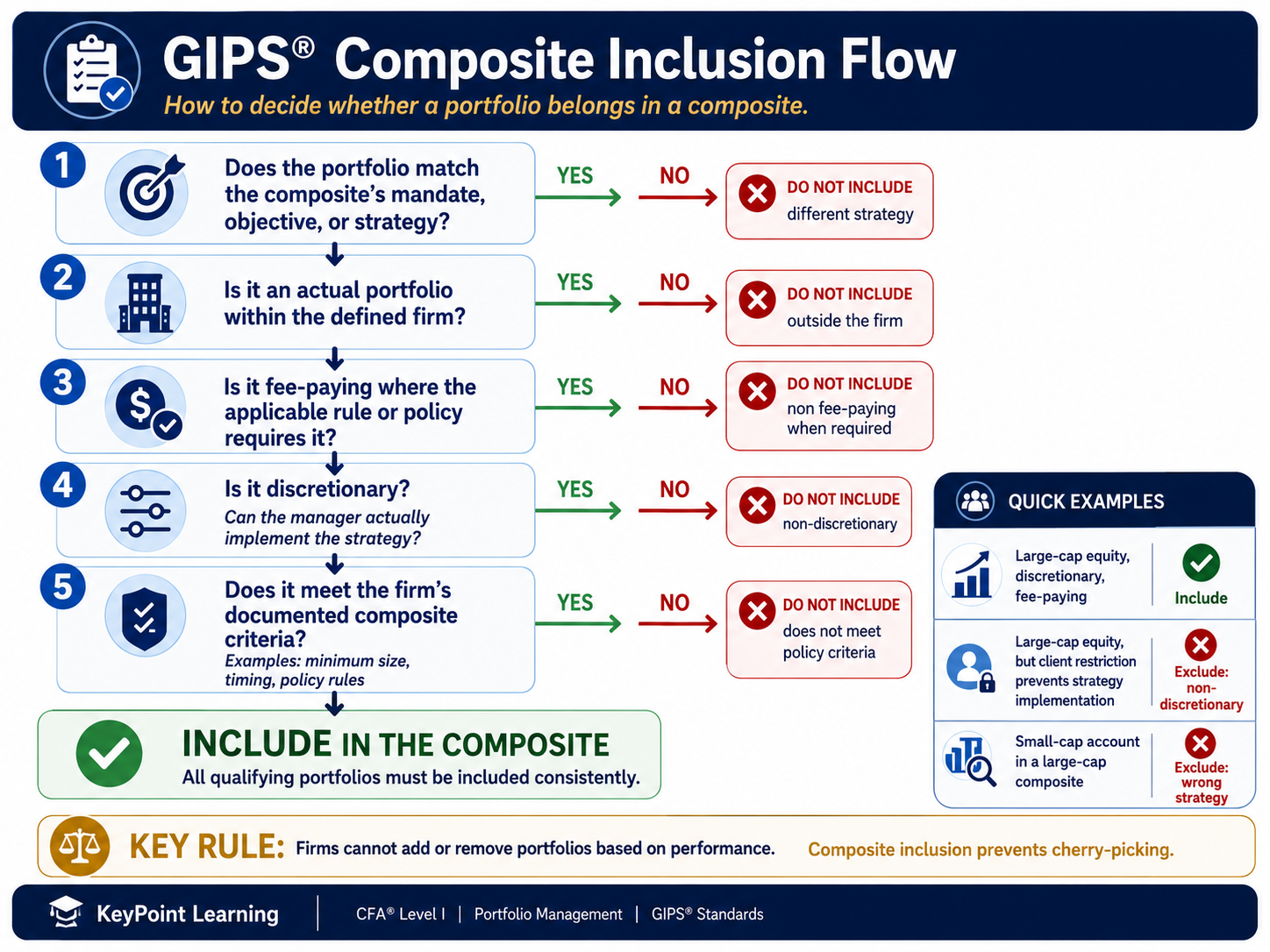
A portfolio belongs in a composite when it fits the composite's defined strategy and the firm can actually run that strategy in the account. Work through these questions in order:
Does the portfolio match the composite's mandate, objective, or strategy?
Is it an actual portfolio within the defined firm?
Is the account fee-paying where the applicable composite rule requires it?
Is the portfolio discretionary, meaning the manager can implement the strategy?
If the relevant conditions are met, include it according to the firm's documented policy.
A firm includes all actual, fee-paying, discretionary portfolios that meet a composite's definition. It cannot leave one out simply because the return was disappointing.
How Is Composite Performance Presented?
Composite performance combines the returns of the included portfolios, generally on an asset-weighted basis. Asset weighting means a larger portfolio carries more weight in the composite return than a smaller one, which reflects how much money was actually managed under the strategy.
Here is a short example. A composite holds three portfolios:
Portfolio A: 20 million dollars, 8.0 percent return
Portfolio B: 30 million dollars, 5.0 percent return
Portfolio C: 50 million dollars, 6.0 percent return
The asset-weighted composite return is (20 × 8.0 + 30 × 5.0 + 50 × 6.0) ÷ 100, which equals 6.1 percent. A simple average of the three returns would be about 6.3 percent. The asset-weighted figure sits lower because it is pulled toward Portfolio C, the largest account.
Composite Definition, Description, and Dispersion
Three related terms come up at Level I:
Composite definition: the detailed criteria that decide which portfolios are members.
Composite description: a general explanation of the strategy, written for the people reading the report.
Composite dispersion: a measure of how spread out the individual portfolio returns are within the composite for a given period.
Dispersion tells a reader how consistent the strategy was across accounts. A wide spread means portfolios in the same composite produced quite different results, even though they followed the same mandate.
Example Scenario
A firm runs a global dividend-equity strategy across three fee-paying, discretionary accounts. All three meet the same composite definition. Over the year, two accounts return around 7 percent, and the third returns 2 percent after a few holdings lagged.
The firm would like to drop the 2 percent account before sending performance to a prospective client. It cannot. The account meets the composite definition and the manager had full discretion, so it stays in the composite. Removing it would turn an honest record into a selective one, which is exactly what the composite requirement prevents.
Common Exam Traps
Believing a composite can hold only the best-performing accounts.
Treating a single representative account as the same thing as a composite.
Adding a heavily restricted, non-discretionary account without checking whether the strategy can be carried out.
Saying the composite, rather than the firm, claims compliance.
Confusing composite dispersion with market volatility or benchmark risk.
Practice Question
A firm defines a composite as: domestic large-cap equity, fully discretionary, fee-paying accounts of at least 2 million dollars. Three accounts are under review.
Account 1: domestic large-cap equity, discretionary, fee-paying, 6 million dollars.
Account 2: domestic large-cap equity, fee-paying, 9 million dollars, but the client requires the manager to hold a 45 percent position in one inherited stock and not sell it.
Account 3: domestic small-cap equity, discretionary, fee-paying, 6 million dollars.
Which account must be included in the composite?
Account 1
Account 2
Account 3
Correct Answer: A
Account 1 fits the strategy, is discretionary and fee-paying, and meets the size minimum, so it must be included.
Option B. Account 2 looks like a fit on paper, but the forced 45 percent holding stops the manager from implementing the large-cap strategy, which makes it non-discretionary for this composite.
Option C. Account 3 follows a small-cap strategy, so it belongs in a different composite, not this one.
Continue Your CFA Level I Prep With KeyPoint
Use structured lessons, practice questions, mock exams, and progress tracking to focus on the time you have left
FAQs About GIPS Composites
Can a firm leave a poorly performing portfolio out of a composite?
No. If the portfolio meets the composite definition and is discretionary, it must be included. Excluding it because of weak returns is cherry-picking, which the GIPS standards are designed to prevent.
Is a single representative account the same as a composite?
No. A composite groups all qualifying portfolios run under a strategy. A single account, even a typical one, can be selected for how it looks, so it does not give the full and fair picture a composite provides.
How many portfolios does it take to form a GIPS composite?
One or more. A composite can hold a single portfolio if only one account follows that strategy, and it can hold many. The count is not what defines a composite. The shared mandate, objective, or strategy is.
Can the same portfolio belong to more than one composite?
Yes. A portfolio can sit in more than one composite if it meets the definition of each. An account might fit both a broad global equity composite and a narrower dividend-focused composite, as long as it genuinely qualifies for each definition.
Are non-fee-paying accounts included in composites?
Composites must include all actual, fee-paying, discretionary portfolios that meet the composite definition. A firm may also include non-fee-paying discretionary portfolios, but it is not required to, and it must disclose their presence if it does.