
Compliance with the Global Investment Performance Standards (GIPS®) applies to a whole firm, as the firm defines itself, and a firm must meet every applicable requirement before it can claim compliance. The firm definition sets the boundary of what compliance covers. Discretion then decides whether a particular portfolio can sit inside a composite. For CFA Level I, the GIPS compliance requirements you need to understand connect three ideas: what compliance demands, how a firm is defined, and what makes a portfolio discretionary.
Quick Answer
GIPS compliance applies to the firm as defined and requires all applicable requirements to be met. The firm may be an investment firm, subsidiary, or division held out as a distinct business entity. A portfolio is discretionary when the manager can implement the intended strategy, and material client restrictions can make it non-discretionary for that strategy.
Key Takeaways About GIPS Compliance Requirements
No partial compliance claim is permitted. Compliance is all or nothing.
The firm definition sets the organizational boundary for compliance.
A division can qualify as a firm without being a separate legal entity, if it is held out as a distinct business entity.
Discretion depends on whether the manager can implement the strategy, not on contract wording alone.
Written policies should define how restrictions are assessed and applied consistently.
What You Need to Know for CFA Level I
Identify an invalid partial compliance claim.
Decide whether a business unit can be included in the firm definition.
Explain why the firm definition must be meaningful and applied consistently.
Assess whether a restriction materially prevents strategy implementation.
Connect discretion to composite inclusion.
What Are the GIPS Fundamentals of Compliance?
Compliance with the GIPS standards is all or nothing. A firm either meets all applicable requirements and follows relevant guidance, or it does not claim compliance at all. Statements like "partially compliant" or "compliant with most requirements" are not allowed.
The standards apply firm-wide, to the firm as defined. A firm also keeps written policies and procedures that document how it meets the requirements, follows applicable law and regulation, and does not present false or misleading performance.
How Is a Firm Defined Under GIPS?
A firm, for GIPS purposes, is an investment firm, subsidiary, or division held out to clients and prospective clients as a distinct business entity. The point is to capture how the business actually presents itself to the market.
A firm should use the broadest, most meaningful definition that reflects how it operates. Defining the firm narrowly to leave out weak results is not acceptable.
Does a Division Need to Be a Separate Legal Entity?
No. A division does not have to be a separate legal entity to be defined as a firm. What matters is whether it is held out to clients as a distinct business entity.
This is a common misunderstanding, and some sources state it incorrectly. Indicators that a division qualifies include separate branding, a distinct way it presents itself to clients, and a clearly identified business operation. Legal structure alone does not settle the question.
What Does Discretion Mean Under GIPS?
Discretion is the firm's ability to put the intended strategy into action in a portfolio. A portfolio is discretionary when the manager can actually implement the strategy it is meant to follow.
Discretion is not just a label in a contract. An account can be called discretionary on paper and still be non-discretionary for a particular strategy if real restrictions block the manager from running it.
How Do Client Restrictions Affect Discretion?
Client restrictions matter when they materially prevent the manager from carrying out the strategy. A minor limit usually does not change discretion. A restriction that blocks a core part of the mandate can.
For example, suppose a mandate requires meaningful exposure to a major asset class, and the client forbids investing in it. The manager cannot implement the strategy as intended, so the portfolio is treated as non-discretionary for that composite, even if the agreement uses the word discretionary.
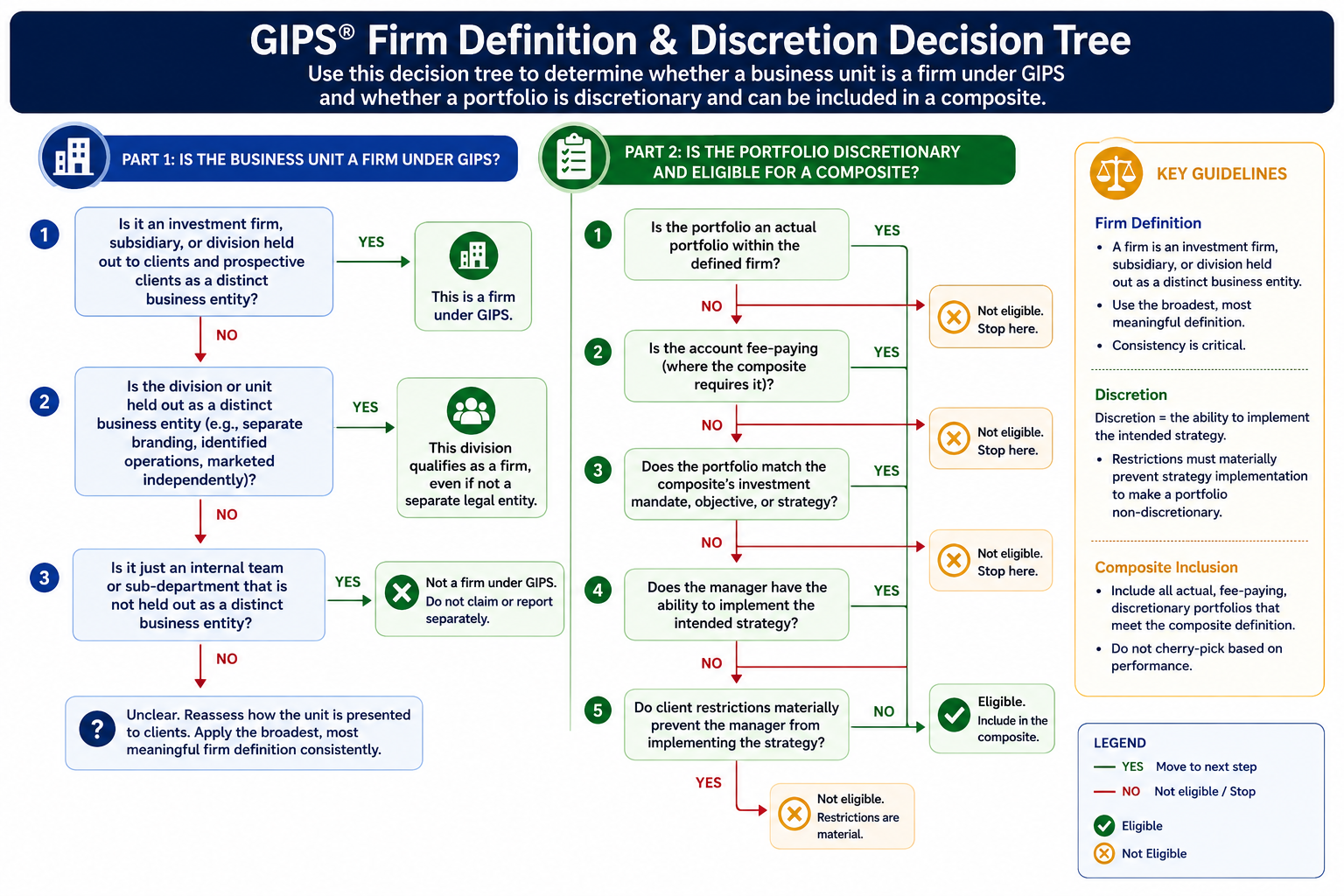
Firm Definition and Discretion Decision Tree
Work through the question in two stages. First define the firm, then test discretion for each portfolio.
Stage 1: Define the firm
Is the unit an investment firm, subsidiary, or division?
Is it held out to clients or prospective clients as a distinct business entity?
Is that boundary applied consistently in policies and reporting?
Stage 2: Assess discretion
What strategy is the portfolio meant to follow?
Are there client restrictions?
Do those restrictions materially prevent the manager from implementing the strategy?
If they do, treat the portfolio as non-discretionary for that strategy under the firm's policy.
Example Scenario
A large financial group runs a unit it markets as a branded wealth division. The division presents itself to clients under its own name and is held out as a distinct business, though it is not a separate legal company. Because it is held out as a distinct business entity, it can be defined as a firm under the GIPS standards. Its legal status inside the group does not block that.
The division manages two accounts under a balanced-growth mandate. The first account has a minor limit, a request to avoid one specific company. The manager can still run the strategy, so the account stays discretionary. The second account comes with a client rule that bars fixed-income holdings entirely, even though the balanced-growth mandate depends on a fixed-income sleeve. That restriction blocks the core strategy, so the second account is non-discretionary for this composite, regardless of the contract wording.
Common Exam Traps
Requiring a division to be a separate legal entity to qualify as a firm.
Treating every client restriction as making a portfolio non-discretionary.
Reading only the contract label instead of asking whether the strategy can be implemented.
Allowing a partial or selected-requirement compliance claim.
Redrawing the firm definition just to improve reported results.
Practice Question
Which statement about GIPS firm definition or discretion is most accurate?
A division must be a separate legal entity before it can be defined as a firm.
A division can be defined as a firm if it is held out to clients as a distinct business entity.
A portfolio is discretionary whenever its contract uses the word discretionary, regardless of any client restrictions.
Correct Answer: B
A division qualifies as a firm when it is presented to clients as a distinct business entity, so B is correct.
Option A is the common trap; separate legal status is not required.
Option C is wrong because discretion depends on whether the manager can implement the strategy, not on a single word in the agreement.
Continue Your CFA Level I Prep With KeyPoint
Use structured lessons, practice questions, mock exams, and progress tracking to focus on the time you have left
FAQs About GIPS Fundamentals
Can a firm claim partial GIPS compliance?
No. Compliance is all or nothing. A firm must meet every applicable requirement to claim compliance, and statements like "partially compliant" or "compliant with selected rules" are not permitted.
What makes a portfolio non-discretionary under GIPS?
Material client restrictions that prevent the manager from implementing the intended strategy. A contract can describe an account as discretionary, but if a restriction blocks a core part of the mandate, the portfolio is treated as non-discretionary for that composite.
Does GIPS compliance apply to a single portfolio or to the whole firm?
To the whole firm, as the firm defines itself. A single portfolio or product cannot claim compliance on its own. Compliance is always claimed at the firm level.
Who is responsible for determining and maintaining GIPS compliance?
The firm. Even when an outside verifier reviews the firm's work, the firm remains responsible for meeting the requirements and keeping its policies and procedures current. Responsibility does not pass to the verifier.
Can a firm change its firm definition to improve reported results?
No. The firm definition should be broad, meaningful, and reflect how the business actually operates. Redrawing it to leave out weak performance is not acceptable.